Why am I getting different incentres for the same triangle?

Maths Pro

New member
Joined
Jan 16, 2026
Messages
28
The question reads : O(0,0), A(6,0) and B(0,8) are the vertices of a triangle. Find the coordinates of the incenter of triangle OAB.
I tried to find equation of AB using two-point form. I get equation as 4x + 3y- 24 = 0. Now since mod of length of perpendicular dropped from incentre(assumed as P(a, b)) to this line is given by mod [(ax+by+c)/root(a^2 +b^2)] = p(perpendicular length), I get mod[(4a+3b-24)/root(4^2 +3^2)] = 2*****
implies mod [(4a+3b-24)/root(16+9))] = 2
implies mod[(4a+3b-24)/root 25] = 2
implies mod[(4a+3b-24)/5] = 2
implies mod [(4a+3b-24] = 10(assuming positive value of R.H.S)
or 4a+3b = 34....(1). Now equation of angle bisector of angle BOC is y = x, (since this line has slope tan 45=1). Line y = x passes through P(a, b)
Hence b=a or a-b =0....(2)
Solving (1) and (2) simultaneously, I get a=34/7 and hence b=34/7*** Or incentre as (34/7, 34/7). Answer is (2,2).
***** I got this length of perpendicular 2 by this method :
Distance from (foot of perpendicular of side OA from P(a, b)) to point A(6,0)= 6-m and distance of point O(0,0) to (foot of perpendicular of side OA from point P(a, b)) = m. Similarly, distance from (foot of perpendicular of side OB from P(a, b)) to point B(0,8)= 8-m and distance of point O(0,0) to (foot of perpendicular of side OB from point P(a, b)) = m.
Length of AB(hypotenuse of OAB)= (8-m)+(6-m) =14-2m=10 => m = 2
So here itself I get radius of incentre as 2 and hence the coordinates of incentre as (2,2)
But then why this anomaly here***
What's happening here?
I am sorry for this long question and thanks for reading it patiently.
 
If by mod[4a+3b-24] you mean [imath]\lvert 4a+3b-24 \rvert[/imath] normally called absolute value, then you need to consider that the result could be [imath]\pm 10[/imath]. Using [imath]-10[/imath] will give you the correct answer. To understand why, look up the formula for distance from point to line. It is a directed formula meaning that the point you want [imath](a,b)[/imath] will either be "above" or "below" the line depending on sign.
 
If by mod[4a+3b-24] you mean ∣4a+3b−24∣\lvert 4a+3b-24 \rvert∣4a+3b−24∣ normally called absolute value, then you need to consider that the result could be ±10\pm 10±10. Using −10-10−10 will give you the correct answer. To understand why, look up the formula for distance from point to line. It is a directed formula meaning that the point you want (a,b)(a,b)(a,b) will either be "above" or "below" the line depending on sign.
But how would I know which sign to apply. There is incentre formula but I don't have it's proof.
 
It would have helped in communicating your work if you had made a picture (and labeled the various points you referred to); that will also help you understand it.

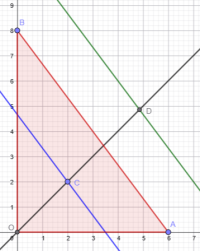
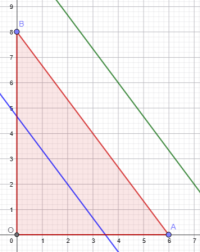
You found that |4a+3b-24| = 10; this means that either 4a+3b-24 = 10 (so that 4a+3b = 34) or 4a+3b-24 = -10 (so that 4a+3b = 14). These are two lines, each 2 units away from AB:

1770571817046.png

You used the green line, and found a point on the wrong side of AB (D instead of C):

1770571929314.png

That's a deficiency in your method; but it's not hard to see how to decide which to use. (Use the line closer to O, which means the smaller number on the RHS.)
There is incentre formula but I don't have it's proof.
What is the formula you know?
 
This isn't exactly a universal formula but with [imath]O(0,0)[/imath], [imath]A(6,0)[/imath], [imath]B(0,8)[/imath] and [imath]I(r,r)[/imath], you can use the formula [imath]A=rs[/imath] where [imath]A=[/imath] area, [imath]r=[/imath] inradius, and [imath]s=[/imath] semi-perimeter. This leads to the equation [imath]24=12r[/imath] and so [imath]r=2[/imath].

It might be worthwhile looking up barycentric coordinates. Ordering the vertices [imath]O,A,B[/imath] the barycentric coordinates are [imath](10:8:6)[/imath]. Normalizing them yields [imath](10/24,8/24,6/24)=(5/12,1/3,1/4)[/imath]. The coordinates can be found by converting these back to cartesian coordinates [imath](5/12) \cdot 0+(1/3) \cdot 6 +(1/4) \cdot 0=2[/imath] and [imath](5/12) \cdot 0+(1/3) \cdot 0 +(1/4) \cdot 8=2[/imath].
 
We are given triangle vertices:
To find the incentre, we use the formula:
where a, b c are the side lengths opposite to vertices A respectively.
 
Oh sorry, here it is :
Incentre (ax1+bx2+cx3)/(a+b+c) , (ay1+by2+cy3)/(a+b+c))
Where a, b,c are sides opposite to vertices A,B and O respectively. O(0,0), A(0,6) and B(0,8). Is it using section formula?
 
Oh sorry, here it is :
Incentre (ax1+bx2+cx3)/(a+b+c) , (ay1+by2+cy3)/(a+b+c))
Where a, b,c are sides opposite to vertices A,B and O respectively. O(0,0), A(0,6) and B(0,8). Is it using section formula?
A close examination will show you that this is essentially the same as my barycentric coordinate solution.
 
Do you have proof for that? Please share
Given [imath]\triangle ABC[/imath] with barycentric coordinates [imath]A(1,0,0)[/imath], [imath]B(0,1,0)[/imath], [imath]C(0,0,1)[/imath] then knowing how an angle bisector divides the side of the triangle that it hits allows you to quickly get [imath]I(a,b,c)[/imath] as the incenter. To normalize, divide all three coordinates by [imath]a+b+c[/imath] so that the sum of the coefficients is [imath]1[/imath]. I'll leave it to you to look up how to convert barycentric coordinates to cartesian coordinates. It is essentially what you did in post #9.
 
The question reads : O(0,0), A(6,0) and B(0,8) are the vertices of a triangle. Find the coordinates of the incenter of triangle OAB.
I tried to find equation of AB using two-point form. I get equation as 4x + 3y- 24 = 0. Now since mod of length of perpendicular dropped from incentre(assumed as P(a, b)) to this line is given by mod [(ax+by+c)/root(a^2 +b^2)] = p(perpendicular length), I get mod[(4a+3b-24)/root(4^2 +3^2)] = 2*****
implies mod [(4a+3b-24)/root(16+9))] = 2
implies mod[(4a+3b-24)/root 25] = 2
implies mod[(4a+3b-24)/5] = 2
implies mod [(4a+3b-24] = 10(assuming positive value of R.H.S)
or 4a+3b = 34....(1). Now equation of angle bisector of angle BOC is y = x, (since this line has slope tan 45=1). Line y = x passes through P(a, b)
Hence b=a or a-b =0....(2)
Solving (1) and (2) simultaneously, I get a=34/7 and hence b=34/7*** Or incentre as (34/7, 34/7). Answer is (2,2).
***** I got this length of perpendicular 2 by this method :
Distance from (foot of perpendicular of side OA from P(a, b)) to point A(6,0)= 6-m and distance of point O(0,0) to (foot of perpendicular of side OA from point P(a, b)) = m. Similarly, distance from (foot of perpendicular of side OB from P(a, b)) to point B(0,8)= 8-m and distance of point O(0,0) to (foot of perpendicular of side OB from point P(a, b)) = m.
Length of AB(hypotenuse of OAB)= (8-m)+(6-m) =14-2m=10 => m = 2
So here itself I get radius of incentre as 2 and hence the coordinates of incentre as (2,2)
But then why this anomaly here***
What's happening here?
I am sorry for this long question and thanks for reading it patiently.
Can you "derive" the co-ordinates of the incenter of a triangle, whose length of the sides are a, b & c?
 
Top