
Compound Inequalities
Sometimes a single inequality doesn't capture what you need to express. Think about temperature: you might need it to be above freezing but below boiling. Or age restrictions: you need to be at least 16 but under 18. These situations require compound inequalities—two inequality conditions combined into one statement.
Compound inequalities come in two flavors: AND inequalities (where both conditions must be true simultaneously) and OR inequalities (where satisfying either condition is enough).
AND Inequalities
An AND inequality requires both conditions to be satisfied simultaneously. You're looking for the overlap—the values that make both inequalities true.
The classic way to write an AND inequality is: \(a < x < b\)
This is shorthand for: \(x > a\) AND \(x < b\)
Example: \(-2 < x < 4\)
This means \(x\) must be greater than -2 AND less than 4. So \(x\) could be 0, 2, 3.9, or -1.5, but not -3 (too small) or 5 (too big).
On a number line, you'd put an open circle at -2 and another at 4, then shade the region between them. This shaded region represents all the numbers that satisfy both conditions.

Example: Solve \(-2 \leq y + 3 \leq 7\).
This is actually two inequalities in one:
- \(y + 3 \geq -2\)
- \(y + 3 \leq 7\)
We solve both at the same time by doing the same operation to all three parts.
Subtract 3 from all parts: $$-2 - 3 \leq y + 3 - 3 \leq 7 - 3$$ $$-5 \leq y \leq 4$$
The solution is all numbers between -5 and 4, including both endpoints. On a number line, put closed circles at -5 and 4, and shade between them.

Example: Solve \(1 < 2x - 3 < 9\).
Add 3 to all parts: $$1 + 3 < 2x - 3 + 3 < 9 + 3$$ $$4 < 2x < 12$$
Divide all parts by 2: $$2 < x < 6$$
Graph: open circles at 2 and 6, shade between.
Writing Separate Inequalities as Compound Inequalities
Sometimes you'll see two separate inequalities that can be combined.
Example: Solve \(x > -1\) AND \(x \leq 4\).
These can be written as a single compound inequality: \(-1 < x \leq 4\)
Notice the inequality symbols point in different directions because one uses \(<\) and the other uses \(\leq\). The solution is all numbers greater than -1 up to and including 4.
Graph: open circle at -1, closed circle at 4, shade between.
Example: Solve \(3x + 2 > 5\) AND \(3x + 2 < 14\).
Solve the first inequality: $$3x + 2 > 5$$ $$3x > 3$$ $$x > 1$$
Solve the second inequality: $$3x + 2 < 14$$ $$3x < 12$$ $$x < 4$$
Combined: \(1 < x < 4\)
OR Inequalities
An OR inequality requires that at least one condition be true. The solution includes values that satisfy either inequality (or both, though with OR inequalities, that's often impossible).
Example: \(x < -1\) OR \(x > 3\)
This means \(x\) can be any number less than -1, or any number greater than 3. Numbers between -1 and 3 don't satisfy either condition, so they're not part of the solution.
On a number line, you'd put an open circle at -1 and shade everything to the left. Then put an open circle at 3 and shade everything to the right. You end up with two separate shaded regions.

Example: Solve \(2y - 3 < 1\) OR \(2y - 3 > 7\).
Solve the first inequality: $$2y - 3 < 1$$ $$2y < 4$$ $$y < 2$$
Solve the second inequality: $$2y - 3 > 7$$ $$2y > 10$$ $$y > 5$$
Solution: \(y < 2\) OR \(y > 5\)
Graph: open circle at 2, shade left. Open circle at 5, shade right.
Example: Solve \(x + 4 \leq 1\) OR \(x - 2 \geq 5\).
First inequality: $$x + 4 \leq 1$$ $$x \leq -3$$
Second inequality: $$x - 2 \geq 5$$ $$x \geq 7$$
Solution: \(x \leq -3\) OR \(x \geq 7\)
Graph: closed circle at -3, shade left. Closed circle at 7, shade right.
How to Tell AND from OR
If you can write the compound inequality in the form \(a < x < b\), it's an AND inequality. The solution is a single interval—a connected region on the number line.
If the solution has two separate regions with a gap in the middle, it's an OR inequality.
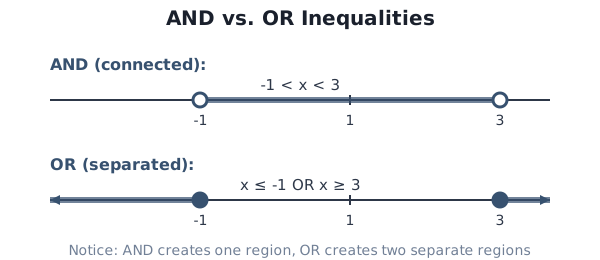
Another clue: AND inequalities use words like "between," "from...to," or "in the range of." OR inequalities use words like "either," "outside the range," or "less than...or greater than."
Special Cases
Example: Solve \(x > 2\) AND \(x > 5\).
If \(x\) is greater than 5, it's automatically greater than 2. So the more restrictive condition is \(x > 5\). That's the solution.
Graph: open circle at 5, shade right.
Example: Solve \(x < 3\) OR \(x < 7\).
Any number less than 3 is also less than 7, but there are numbers less than 7 that aren't less than 3 (like 5). The less restrictive condition is \(x < 7\). That's the solution.
Graph: open circle at 7, shade left (which includes everything less than 3 anyway).
Example: Solve \(x > 4\) AND \(x < 1\).
This is impossible. No number can be both greater than 4 and less than 1 at the same time. The solution is the empty set (no solution).
Example: Solve \(x > 4\) OR \(x < 1\).
This doesn't cover numbers between 1 and 4, but it covers everything else.
Graph: open circle at 1, shade left. Open circle at 4, shade right.
Test Yourself
Solve and describe how you would graph each:
- \(3 < x + 1 < 8\)
- \(x - 5 > 2\) OR \(x + 3 < -1\)
- \(-4 \leq 2y \leq 10\)
- \(3m + 1 < -5\) OR \(3m + 1 > 5\)
- \(-1 < 3 - x < 5\)
Solutions:
-
Subtract 1 from all parts: \(2 < x < 7\). Graph: open circles at 2 and 7, shade between.
-
First: \(x > 7\). Second: \(x < -4\). Solution: \(x < -4\) OR \(x > 7\). Graph: open circle at -4 shade left, open circle at 7 shade right.
-
Divide all parts by 2: \(-2 \leq y \leq 5\). Graph: closed circles at -2 and 5, shade between.
-
First: \(3m < -6\), so \(m < -2\). Second: \(3m > 4\), so \(m > \frac{4}{3}\). Solution: \(m < -2\) OR \(m > \frac{4}{3}\). Graph: two separate regions.
-
Subtract 3 from all parts: \(-4 < -x < 2\). Multiply by -1 (flip both inequalities): \(4 > x > -2\), or \(-2 < x < 4\). Graph: open circles at -2 and 4, shade between.
Tips for Success
When solving a three-part inequality like \(a < b < c\), do the same operation to all three parts. If you subtract 5, subtract it from all three. If you divide by 2, divide all three.
When you multiply or divide by a negative, flip both inequality symbols in a three-part inequality.
For OR inequalities, solve each inequality completely separately, then combine the solutions at the end.
Draw the number line graphs—they help you visualize whether you have an AND (connected region) or OR (separated regions) situation.
Always check your solution by testing a number from your solution region. Does it make the original inequality true?