
Direct Variation
What Is Direct Variation?
When two variables stay in a constant ratio to each other, they're said to vary directly. When one doubles, the other doubles. When one triples, the other triples. They move together in lockstep.
Think about buying apples at a grocery store. If one apple costs $0.50, then two apples cost $1.00, three apples cost $1.50, and so on. The total cost varies directly with the number of apples. The ratio of cost to apples is always the same: $0.50 per apple.
Here's another way to think about it: if A is always twice as much as B, then A and B vary directly. If your shadow is always three times as long as your height, shadow length and height vary directly.
The key characteristic is that the ratio between the two quantities never changes. This constant ratio is what makes direct variation so predictable and useful.
The Formula: y = kx
Every direct variation relationship can be written as:
$$y = kx$$
where \(k\) is called the constant of variation (or constant of proportionality). This constant tells you exactly how the two variables relate to each other.
A concrete example makes this clearer. If \(y = 3x\), then \(k = 3\), and \(y\) is always three times as large as \(x\). Double \(x\), and \(y\) doubles too. The constant \(k\) is the multiplier that connects them.
Notice that this is actually a special type of linear equation. The general form of a line is \(y = mx + b\), but in direct variation, \(b = 0\). There's no y-intercept except at the origin. The line always passes through the point \((0, 0)\).
You might also see direct variation written as:
$$\frac{y}{x} = k$$
This is the same formula, just rearranged. It emphasizes that the ratio of \(y\) to \(x\) is constant.
Finding the Constant
The most common type of problem gives you one pair of values and asks you to find \(k\) or to predict other values.
Example 1: If \(y\) varies directly with \(x\), and \(y = 12\) when \(x = 4\), find the constant of variation.
Use the formula \(y = kx\) and substitute: $$12 = k \cdot 4$$
Before reading on — what operation isolates \(k\) here? Show answerDivide both sides by 4: \(k = 3\)
The constant of variation is 3. This means \(y\) is always three times \(x\), so the equation is \(y = 3x\).
Example 2: If \(y\) varies directly with \(x\), and \(y = 20\) when \(x = 5\), what is \(y\) when \(x = 8\)?
First, find \(k\): $$20 = k \cdot 5$$ $$k = 4$$
Now use \(y = 4x\) with \(x = 8\): $$y = 4 \cdot 8 = 32$$
When \(x = 8\), \(y = 32\).
Example 3: The distance a car travels varies directly with the time it's been driving. If the car travels 120 miles in 2 hours, how far will it travel in 5 hours?
Let \(d\) = distance and \(t\) = time, so \(d = kt\).
Find \(k\): $$120 = k \cdot 2$$ $$k = 60$$
This makes sense: the car is traveling 60 miles per hour. Now find the distance at \(t = 5\): $$d = 60 \cdot 5 = 300$$
The car will travel 300 miles in 5 hours.
Graphing Direct Variation
One of the defining features of direct variation is what its graph looks like. Since the equation is \(y = kx\), you're graphing a line that passes through the origin with slope \(k\).
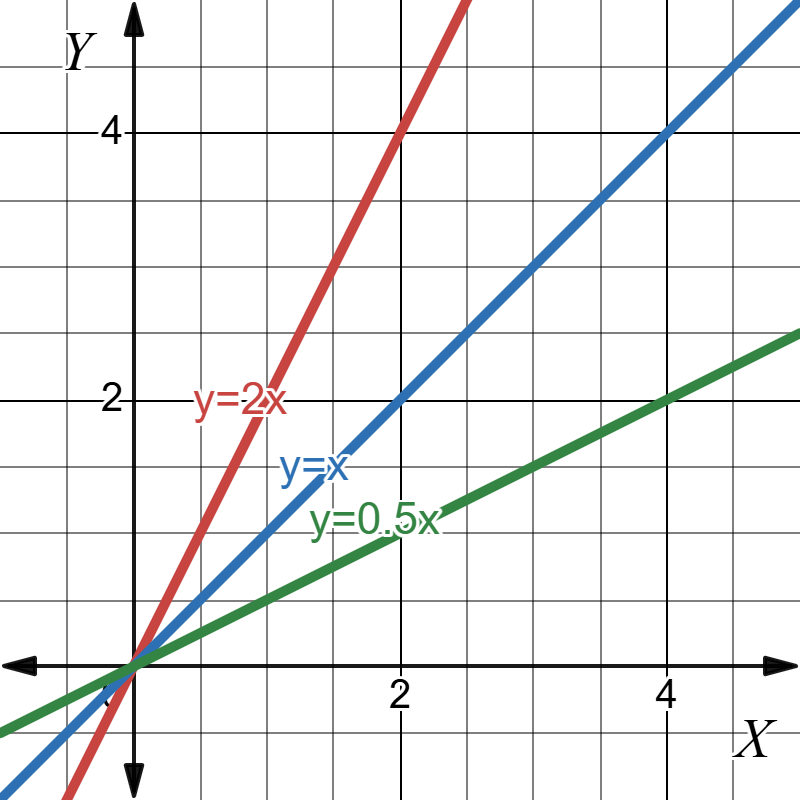
The graph always goes through \((0, 0)\) because when \(x = 0\), \(y\) must also equal 0. Think about it: if you buy zero apples, you pay zero dollars. If you drive for zero hours, you travel zero miles.
The steepness of the line depends on \(k\). A larger value of \(k\) means a steeper line because \(y\) increases faster as \(x\) increases. If \(k = 5\), the line rises faster than if \(k = 2\).
If \(k\) is negative, the line slopes downward from left to right. This represents situations where as one variable increases, the other decreases at a constant rate.
Example 4: Graph \(y = 2x\).
When \(x = 0\), \(y = 0\).
When \(x = 1\), \(y = 2\).
When \(x = 2\), \(y = 4\).
When \(x = 3\), \(y = 6\).
Plot these points and draw a straight line through them. The line passes through the origin with a slope of 2.
Real-World Examples
Direct variation shows up in countless real-world situations where two quantities change together at a constant rate.
Hourly Wages
If you earn $15 per hour, your total pay varies directly with the hours worked. The equation is \(P = 15h\), where \(P\) is pay and \(h\) is hours. Work 3 hours, earn $45. Work 8 hours, earn $120. The constant \(k = 15\) is your hourly rate.
Example 5: Sarah earns $18 per hour. Write the direct variation equation and find how much she earns working 6.5 hours.
The equation is \(P = 18h\).
For 6.5 hours: $$P = 18 \cdot 6.5 = 117$$
Sarah earns $117.
Buying in Bulk
When you buy items at a constant price per unit, the total cost varies directly with the quantity.
Example 6: Oranges cost $0.75 each. Write the equation and find the cost of 12 oranges.
Let \(C\) = total cost and \(n\) = number of oranges. $$C = 0.75n$$
For 12 oranges: $$C = 0.75 \cdot 12 = 9$$
Twelve oranges cost $9.00.
Perimeter of Regular Shapes
The perimeter of a square varies directly with the length of one side. Since a square has four equal sides, \(P = 4s\), where \(P\) is perimeter and \(s\) is the side length. The constant is 4.
Example 7: A square has a perimeter of 48 inches. What is the length of one side?
Use \(P = 4s\): $$48 = 4s$$ $$s = 12$$
Each side is 12 inches long.
Currency Conversion
Exchange rates create direct variation. If 1 US dollar equals 0.85 euros, then the number of euros you get varies directly with the dollars you exchange.
Example 8: If $1 USD = 0.85 EUR, how many euros do you get for $250?
Let \(E\) = euros and \(D\) = dollars. $$E = 0.85D$$
For $250: $$E = 0.85 \cdot 250 = 212.50$$
You get 212.50 euros.
Connection to Proportions
Direct variation is really just another way of talking about proportions. Saying \(y\) varies directly with \(x\) is the same as saying the ratio \(\frac{y}{x}\) is constant.
This means if you know \(y_1\) and \(x_1\) go together, and you want to find \(y_2\) for a different \(x_2\), you can set up a proportion:
$$\frac{y_1}{x_1} = \frac{y_2}{x_2}$$
Think about this for a moment: how is setting up that proportion different from finding \(k\) first? Show answerThey're actually the same thing — the ratio \(\frac{y}{x} = k\) in both cases. Setting up a proportion just skips the step of naming \(k\) explicitly.
Example 9: If 6 pounds of flour cost $12, how much do 10 pounds cost?
Method 1 (Direct Variation):
Find \(k\): \(12 = k \cdot 6\), so \(k = 2\).
Use \(C = 2p\) where \(p\) = pounds: \(C = 2 \cdot 10 = 20\).
Method 2 (Proportion):
$$\frac{12}{6} = \frac{x}{10}$$
Cross-multiply: \(12 \cdot 10 = 6x\), so \(120 = 6x\), thus \(x = 20\).
Both methods give $20. Direct variation and proportions are two sides of the same coin.
Practice Problems
Try these on your own, then check your answers.
-
If \(y\) varies directly with \(x\), and \(y = 15\) when \(x = 3\), find \(k\). Show answer\(k = 5\) — Use \(15 = k \cdot 3\), so \(k = 5\)
-
Using the relationship from problem 1, find \(y\) when \(x = 7\). Show answer\(y = 35\) — Use \(y = 5x\) with \(x = 7\): \(y = 5 \cdot 7 = 35\)
-
The cost of gasoline varies directly with the number of gallons purchased. If 8 gallons cost $28, how much do 12 gallons cost? Show answer$42 — Find \(k\): \(28 = k \cdot 8\), so \(k = 3.50\) (price per gallon). Cost for 12: \(C = 3.50 \cdot 12 = 42\)
-
A recipe calls for ingredients in direct variation. If 2 cups of flour are needed for 12 cookies, how much flour is needed for 30 cookies? Show answer5 cups — Find \(k\): \(2 = k \cdot 12\), so \(k = \frac{1}{6}\). For 30 cookies: \(f = \frac{1}{6} \cdot 30 = 5\)
-
Write the direct variation equation if \(y = 45\) when \(x = 9\). Show answer\(y = 5x\) — Find \(k\): \(45 = k \cdot 9\), so \(k = 5\). Equation: \(y = 5x\)
-
Which of these equations represents direct variation?
a) \(y = 3x + 2\)
b) \(y = 5x\)
c) \(y = x^2\)
d) \(y = \frac{12}{x}\) Show answerb) \(y = 5x\) — Only this one has the form \(y = kx\) with no added constant -
The distance a spring stretches varies directly with the weight attached. If a 5-pound weight stretches it 2 inches, how far will a 15-pound weight stretch it? Show answer6 inches — Find \(k\): \(2 = k \cdot 5\), so \(k = 0.4\). For 15 pounds: \(d = 0.4 \cdot 15 = 6\)
-
If \(y\) varies directly with \(x\) and the constant of variation is -4, what is \(y\) when \(x = 6\)? Show answer\(y = -24\) — Use \(y = -4x\) with \(x = 6\): \(y = -4 \cdot 6 = -24\)
Why This Matters
Direct variation is one of the simplest and most useful relationships in math. It models any situation where two quantities change together at a constant rate: hourly wages, fuel costs, currency conversion, spring stretching, and dozens more.
A few details that come up over and over. The graph of \(y = kx\) always passes through the origin — if it doesn't, the relationship isn't direct variation. The constant \(k\) is the slope of that line; it's also the rate of change between the two variables. And the units of \(k\) carry meaning: dollars per hour, miles per gallon, euros per dollar. The constant isn't just a number, it's a real-world rate.
Watch out for relationships that look proportional but aren't direct variation. An equation like \(y = 2x + 3\) is linear, but the \(+3\) means it doesn't pass through the origin — doubling \(x\) does not double \(y\), so it's not direct variation.
Once direct variation feels routine, the same pattern of reasoning extends to inverse variation, joint variation, and the more complex relationships you'll meet in science, economics, and engineering. The base case is \(y = kx\), and most of what follows builds from there.