sambellamy
Junior Member
- Joined
- Oct 21, 2014
- Messages
- 53
This is the problem I am struggling with:
"Derive Equation 3 for Gaussian optics from Equation 1
by approximating cos ɸ in Equation 2 by its first-degree
Taylor polynomial."
I have attached the relevant information.
In part a, how do I set up a Taylor polynomial for cos ɸ ? Cos ɸ = h, correct? and sin ɸ is A? But i am not sure which variable to use- there is no obvious x i can pick out for the h = f(x) form I usually start a Taylor polynomial with. I understand that h will change with ɸ and thus A - should I use f(A)?
To approximate cos ɸ, i just used h, and defined h as:
ƪ0 = ((h2 + (S0 + R - A)2 )1/2
h2 = ƪ02 - (S0 + R - A)2
h = (ƪ02 - (S0 + R - A)2 )1/2
so I would just plug that in for cos ɸ, giving:
ƪ0 = ( R2 + (S0 + R)2 - 2R(S0 + R)(ƪ02 - (S0 + R - A)2 )1/2 ), all to the 1/2?
I tried expanding everything to see if it will cancel, to no avail.
Please advise!
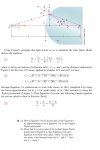
"Derive Equation 3 for Gaussian optics from Equation 1
by approximating cos ɸ in Equation 2 by its first-degree
Taylor polynomial."
I have attached the relevant information.
In part a, how do I set up a Taylor polynomial for cos ɸ ? Cos ɸ = h, correct? and sin ɸ is A? But i am not sure which variable to use- there is no obvious x i can pick out for the h = f(x) form I usually start a Taylor polynomial with. I understand that h will change with ɸ and thus A - should I use f(A)?
To approximate cos ɸ, i just used h, and defined h as:
ƪ0 = ((h2 + (S0 + R - A)2 )1/2
h2 = ƪ02 - (S0 + R - A)2
h = (ƪ02 - (S0 + R - A)2 )1/2
so I would just plug that in for cos ɸ, giving:
ƪ0 = ( R2 + (S0 + R)2 - 2R(S0 + R)(ƪ02 - (S0 + R - A)2 )1/2 ), all to the 1/2?
I tried expanding everything to see if it will cancel, to no avail.
Please advise!
Last edited: