optics problem

sambellamy

Junior Member
Joined
Oct 21, 2014
Messages
53
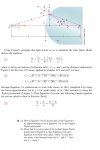
This is the problem I am struggling with:

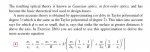
"Derive Equation 3 for Gaussian optics from Equation 1
by approximating cos ɸ in Equation 2 by its first-degree
Taylor polynomial."

I have attached the relevant information.

In part a, how do I set up a Taylor polynomial for cos ɸ ? Cos ɸ = h, correct? and sin ɸ is A? But i am not sure which variable to use- there is no obvious x i can pick out for the h = f(x) form I usually start a Taylor polynomial with. I understand that h will change with ɸ and thus A - should I use f(A)?

To approximate cos ɸ, i just used h, and defined h as:

ƪ0 = ((h2 + (S0 + R - A)2 )1/2

h2 = ƪ02 - (S0 + R - A)2

h = (ƪ02 - (S0 + R - A)2 )1/2

so I would just plug that in for cos ɸ, giving:

ƪ0 = ( R2 + (S0 + R)2 - 2R(S0 + R)(ƪ02 - (S0 + R - A)2 )1/2 ), all to the 1/2?

I tried expanding everything to see if it will cancel, to no avail.

Please advise!


optics.jpg
 
Last edited:
The first part of Eq. 2 is
\(\displaystyle l_0 = \sqrt{R^2 + (S_0+R)^2 - 2 R (S_0 + R) cos(\phi)}\)

The linear Taylor series expansion for \(\displaystyle cos(\phi)\) is given by
\(\displaystyle cos(\phi) = cos(\phi_0) - sin(\phi_0) (\phi - \phi_0)\)
where \(\displaystyle \phi_0\) is the angle we expand about. If we take \(\displaystyle \phi_0 = 0\), then \(\displaystyle cos(\phi_0) = 1\) and
\(\displaystyle cos(\phi) = 1\)

Our equation above then becomes
\(\displaystyle l_0 = \sqrt{R^2 + (S_0+R)^2 - 2 R (S_0 + R)}\)
= \(\displaystyle \sqrt{[ R - (S_0+R)]^2 }\)
=\(\displaystyle \sqrt{S_0^2 }\)
or
\(\displaystyle l_0 = S_0\)

A similar equation holds for \(\displaystyle l_i\)
 
This is certainly helpful, but I am not familiar with "linear Taylor series expansion" for cosine. I can't recognise how the standard cosine Taylor series

Ʃn=0 (-1)n x2n/(2n)!

morphs into [FONT=MathJax_Math]c[/FONT][FONT=MathJax_Math]o[/FONT][FONT=MathJax_Math]s[/FONT][FONT=MathJax_Main]([/FONT][FONT=MathJax_Math]ϕ[/FONT][FONT=MathJax_Main]0[/FONT][FONT=MathJax_Main])[/FONT][FONT=MathJax_Main]−[/FONT][FONT=MathJax_Math]s[/FONT][FONT=MathJax_Math]i[/FONT][FONT=MathJax_Math]n[/FONT][FONT=MathJax_Main]([/FONT][FONT=MathJax_Math]ϕ[/FONT][FONT=MathJax_Main]0[/FONT][FONT=MathJax_Main])[/FONT][FONT=MathJax_Main]([/FONT][FONT=MathJax_Math]ϕ[/FONT][FONT=MathJax_Main]−[/FONT][FONT=MathJax_Math]ϕ[/FONT][FONT=MathJax_Main]0[/FONT][FONT=MathJax_Main])[/FONT]
 
This is certainly helpful, but I am not familiar with "linear Taylor series expansion" for cosine. I can't recognise how the standard cosine Taylor series

Ʃn=0 (-1)n x2n/(2n)!

morphs into [FONT=MathJax_Math]c[/FONT][FONT=MathJax_Math]o[/FONT][FONT=MathJax_Math]s[/FONT][FONT=MathJax_Main]([/FONT][FONT=MathJax_Math]ϕ[/FONT][FONT=MathJax_Main]0[/FONT][FONT=MathJax_Main])[/FONT][FONT=MathJax_Main]−[/FONT][FONT=MathJax_Math]s[/FONT][FONT=MathJax_Math]i[/FONT][FONT=MathJax_Math]n[/FONT][FONT=MathJax_Main]([/FONT][FONT=MathJax_Math]ϕ[/FONT][FONT=MathJax_Main]0[/FONT][FONT=MathJax_Main])[/FONT][FONT=MathJax_Main]([/FONT][FONT=MathJax_Math]ϕ[/FONT][FONT=MathJax_Main]−[/FONT][FONT=MathJax_Math]ϕ[/FONT][FONT=MathJax_Main]0[/FONT][FONT=MathJax_Main])[/FONT]
First of all, we were expanding \(\displaystyle cos(\phi)\), not cos(x), so that \(\displaystyle \phi\) replaces x in the above equation.

Next, when you say the standard cosine Taylor series is as above, what you are really saying is the Taylor series for the expansion of cos(x) about x=0 is as you have given it. If the expansion point was different, the odd terms might not drop out. Note that the linear term is zero in the above expansion as was mine when I set \(\displaystyle \phi_0\) = 0. Since I was only doing linear terms, I did not do n=1 or greater in the series above.
 
OK so I got the first part sorted out by just using the n=0 term to approximate cos Φ - thanks again. For part b, when I calculate the third-degree Taylor polynomial, I get:

1 + -sin(Φ)Φ + -cos(Φ)Φ2.

When I substitute sin(Φ) for Φ, I get:

1 + -sin(sin(Φ))sin(Φ) + -cos(sin(Φ))sin(Φ)2. Which seems wrong - should I not worry about substituting this until later? are they not even asking me to substitute?

Also, using the binomial series is something i do not have much practice with. the question asks to use the binomial series for 1/ᶩ0 and 1/ᶩi - should I use both of these in the binomial series (one as k and one as n)? How should I set that up?

[FONT=MathJax_Math]l[/FONT]Shown below is equation 4 (the goal).


eq4.jpg
 
For part b, since the cubic term is zero for the cosine expansion about zero, you are asked to use up to the \(\displaystyle \phi^2\).That is the same as using \(\displaystyle sin(\phi)\) ~ \(\displaystyle \phi\)

That is, using up to the n=1 term, we have
\(\displaystyle cos(\phi)\) ~ \(\displaystyle 1 - \frac{1}{2} \phi^2\)
so that, dropping terms of higher order than 2,
\(\displaystyle cos^2(\phi) - 1 = -sin^2(\phi)\) ~ -\(\displaystyle \phi^2\)

So we have
\(\displaystyle l_0^2 = R^2 + (S_0+R)^2 - 2 R (S_0 + R) cos(\phi)\)
~ \(\displaystyle R^2 + (S_0+R)^2 - 2 R (S_0 + R) (1 - \frac{1}{2}\phi^2)\)
=\(\displaystyle S_0^2 + R (S_0 + R) \phi^2)\)
=\(\displaystyle S_0^2 (1 + a \phi^2)\)
where
a = =\(\displaystyle \frac{R (S_0 + R)}{S_0^2} \phi^2\)

thus
\(\displaystyle l_0\) ~ \(\displaystyle |S_0| (1 + a \phi^2)^{\frac{1}{2}}\)

Now, using the Binomial Theorem
\(\displaystyle (1+x)^{\frac{1}{2}}\) ~ 1 + \(\displaystyle \frac{1}{2} x\)

Letting x = a \(\displaystyle \phi^2\) and something similar for l1 get a more tractable equation and simplify it.
 
Top