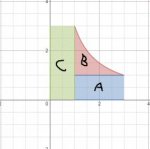
Okay, so I'm struggling with my Calculus II course. We're learning how to use integrals to calculate the volume of a 3-dimensional solid. I think I understand the basic concept, but I'm not getting it when it gets more complex... There are two homework problems, #31 and #33, which are basically identical, but 33 is giving me grief. I can solve 31 fairly easily. The problems consist solely of graphs, with this accompanying text:
I think I understand the process of rotating around the x-axis, but rotating about the y-axis is proving much more difficult for me to understand. I'll work through my process for these problems, and maybe someone can help me understand it better.
When finding the volume of a solid using disks, the integral is \(\displaystyle \pi \int _a^b\:\left(r\left(x\right)\right)^2dx\). I need to find the formula for radius of the solid at any given point, which I believe is the height of the function.
So for #31, I said that f(x)=3/x, so the definite integral I need to use is: \(\displaystyle \displaystyle \pi \int _1^3\:\left(\frac{3}{x}\right)^2dx\). That's an easy integral to resolve and the volume of the solid comes out to 6pi, as it should according to the answer key.
And then for #33, I need to around the y-axis. That means I need the function in terms of y, right? f(x)=3/x, so f(y)=f-1(x). And that means that f(y)=3/y. Then the process should be the same as before, plugging my radius function into the integral. I get \(\displaystyle \displaystyle \pi \int _1^3\:\left(\frac{3}{y}\right)^2dy\). And because effectivly all I did was change the variable from x to y, the integral is also 6pi. But that's not the answer in the back of the book. Somehow, they come up with 12pi. I'm so confused right now.
Consider the region between the graph of f(x)=3/x and the x-axis on [1,3]. For each line of rotation given in Exercises 31-34, use definite integrals to find the volume of the resulting solid.
#31: Around the x-axis
#33: Around the y-axis
I think I understand the process of rotating around the x-axis, but rotating about the y-axis is proving much more difficult for me to understand. I'll work through my process for these problems, and maybe someone can help me understand it better.
When finding the volume of a solid using disks, the integral is \(\displaystyle \pi \int _a^b\:\left(r\left(x\right)\right)^2dx\). I need to find the formula for radius of the solid at any given point, which I believe is the height of the function.
So for #31, I said that f(x)=3/x, so the definite integral I need to use is: \(\displaystyle \displaystyle \pi \int _1^3\:\left(\frac{3}{x}\right)^2dx\). That's an easy integral to resolve and the volume of the solid comes out to 6pi, as it should according to the answer key.
And then for #33, I need to around the y-axis. That means I need the function in terms of y, right? f(x)=3/x, so f(y)=f-1(x). And that means that f(y)=3/y. Then the process should be the same as before, plugging my radius function into the integral. I get \(\displaystyle \displaystyle \pi \int _1^3\:\left(\frac{3}{y}\right)^2dy\). And because effectivly all I did was change the variable from x to y, the integral is also 6pi. But that's not the answer in the back of the book. Somehow, they come up with 12pi. I'm so confused right now.