Volumes by Slicing

ksdhart

Full Member
Joined
Aug 1, 2014
Messages
384
Okay, so I'm struggling with my Calculus II course. We're learning how to use integrals to calculate the volume of a 3-dimensional solid. I think I understand the basic concept, but I'm not getting it when it gets more complex... There are two homework problems, #31 and #33, which are basically identical, but 33 is giving me grief. I can solve 31 fairly easily. The problems consist solely of graphs, with this accompanying text:

Consider the region between the graph of f(x)=3/x and the x-axis on [1,3]. For each line of rotation given in Exercises 31-34, use definite integrals to find the volume of the resulting solid.

#31: Around the x-axis
#33: Around the y-axis

I think I understand the process of rotating around the x-axis, but rotating about the y-axis is proving much more difficult for me to understand. I'll work through my process for these problems, and maybe someone can help me understand it better.

When finding the volume of a solid using disks, the integral is \(\displaystyle \pi \int _a^b\:\left(r\left(x\right)\right)^2dx\). I need to find the formula for radius of the solid at any given point, which I believe is the height of the function.

So for #31, I said that f(x)=3/x, so the definite integral I need to use is: \(\displaystyle \displaystyle \pi \int _1^3\:\left(\frac{3}{x}\right)^2dx\). That's an easy integral to resolve and the volume of the solid comes out to 6pi, as it should according to the answer key.

And then for #33, I need to around the y-axis. That means I need the function in terms of y, right? f(x)=3/x, so f(y)=f-1(x). And that means that f(y)=3/y. Then the process should be the same as before, plugging my radius function into the integral. I get \(\displaystyle \displaystyle \pi \int _1^3\:\left(\frac{3}{y}\right)^2dy\). And because effectivly all I did was change the variable from x to y, the integral is also 6pi. But that's not the answer in the back of the book. Somehow, they come up with 12pi. I'm so confused right now.
 
Okay, so I'm struggling with my Calculus II course. We're learning how to use integrals to calculate the volume of a 3-dimensional solid. I think I understand the basic concept, but I'm not getting it when it gets more complex... There are two homework problems, #31 and #33, which are basically identical, but 33 is giving me grief. I can solve 31 fairly easily. The problems consist solely of graphs, with this accompanying text:


I think I understand the process of rotating around the x-axis, but rotating about the y-axis is proving much more difficult for me to understand. I'll work through my process for these problems, and maybe someone can help me understand it better.

When finding the volume of a solid using disks, the integral is \(\displaystyle \pi \int _a^b\:\left(r\left(x\right)\right)^2dx\). I need to find the formula for radius of the solid at any given point, which I believe is the height of the function.

So for #31, I said that f(x)=3/x, so the definite integral I need to use is: \(\displaystyle \displaystyle \pi \int _1^3\:\left(\frac{3}{x}\right)^2dx\). That's an easy integral to resolve and the volume of the solid comes out to 6pi, as it should according to the answer key.

And then for #33, I need to around the y-axis. That means I need the function in terms of y, right? f(x)=3/x, so f(y)=f-1(x). And that means that f(y)=3/y. Then the process should be the same as before, plugging my radius function into the integral. I get \(\displaystyle \displaystyle \pi \int _1^3\:\left(\frac{3}{y}\right)^2dy\). And because effectivly all I did was change the variable from x to y, the integral is also 6pi. But that's not the answer in the back of the book. Somehow, they come up with 12pi. I'm so confused right now.
The limits you are using are x limits. You need to find the y limits! Just ask yourself "when x goes from 1 to 3 what does y go between" Just make sure the y values are non incr or non decr. All else looks fine.
 
The limits you are using are x limits. You need to find the y limits! Just ask yourself "when x goes from 1 to 3 what does y go between" Just make sure the y values are non incr or non decr. All else looks fine.

In this case though the limits remain the same (numerically)

x = 1 → y = 3

x = 3 → y = 1
 
Well, okay, I understand now why I need to change the integral's bounds from x equals ... to y equals ... However, that doesn't really help me. Even with the bounds going from y = 3 to y = 1 instead of x = 1 to x = 3, I get -6pi as my answer. And that's not right. It's supposed to be 12pi. So I'm still missing something here. :confused:
 
Okay, so I'm struggling with my Calculus II course. We're learning how to use integrals to calculate the volume of a 3-dimensional solid. I think I understand the basic concept, but I'm not getting it when it gets more complex... There are two homework problems, #31 and #33, which are basically identical, but 33 is giving me grief. I can solve 31 fairly easily. The problems consist solely of graphs, with this accompanying text:


I think I understand the process of rotating around the x-axis, but rotating about the y-axis is proving much more difficult for me to understand. I'll work through my process for these problems, and maybe someone can help me understand it better.

When finding the volume of a solid using disks, the integral is \(\displaystyle \pi \int _a^b\:\left(r\left(x\right)\right)^2dx\). I need to find the formula for radius of the solid at any given point, which I believe is the height of the function.

So for #31, I said that f(x)=3/x, so the definite integral I need to use is: \(\displaystyle \displaystyle \pi \int _1^3\:\left(\frac{3}{x}\right)^2dx\). That's an easy integral to resolve and the volume of the solid comes out to 6pi, as it should according to the answer key.

And then for #33, I need to around the y-axis. That means I need the function in terms of y, right? f(x)=3/x, so f(y)=f-1(x). And that means that f(y)=3/y. Then the process should be the same as before, plugging my radius function into the integral. I get \(\displaystyle \displaystyle \pi \int _1^3\:\left(\frac{3}{y}\right)^2dy\). And because effectivly all I did was change the variable from x to y, the integral is also 6pi. But that's not the answer in the back of the book. Somehow, they come up with 12pi. I'm so confused right now.

Draw the graph. What are you rotating? The complete block? What about that part x=3 for y between 0 and 1/3? What about that part x=1 and y between 0 and 3?
 
Well, okay, I understand now why I need to change the integral's bounds from x equals ... to y equals ... However, that doesn't really help me. Even with the bounds going from y = 3 to y = 1 instead of x = 1 to x = 3, I get -6pi as my answer. And that's not right. It's supposed to be 12pi. So I'm still missing something here. :confused:
Draw the slabs which you are rotating around the y-axis. Do you need to use the shell method or is the disc method ok? Do you get a donut when you rotate? Now with respect to these (horizontal) slabs, what is the lowest y value, what is the highest y value? The answer to this last question is y goes from 0 to 3. If you want to use y goes from 3 to 0 then the change in y is -dy, NOT dy!
 
Last edited:
Draw the graph. What are you rotating? The complete block? What about that part x=3 for y between 0 and 1/3? What about that part x=1 and y between 0 and 3?

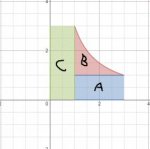
Okay. I believe I got it now. I'm sorry if I seem incredibly dense. I was just having a lot of trouble visualizing the resulting 3D solid. I drew the graph and came up with three separate areas of importance. The shape I'm rotating about the curve includes the part labeled C, but it's not part of the 3D solid, so I need to subtract that portion.

problem33.jpg

The final formula I used was \(\displaystyle \displaystyle V=\pi \cdot \int _0^3\:\left(r^2\left(x\right)-1^2\right)dy=\pi \cdot \int _0^1\:3^2dy+\pi \int _1^3\:\left(\frac{3}{y}\right)^2-\pi \cdot \int _0^3\:dy\)

When I evaluated those integrals, I got 12pi, as expected. Thanks for all the help, guys.
 
Okay. I believe I got it now. I'm sorry if I seem incredibly dense. I was just having a lot of trouble visualizing the resulting 3D solid. I drew the graph and came up with three separate areas of importance. The shape I'm rotating about the curve includes the part labeled C, but it's not part of the 3D solid, so I need to subtract that portion.

View attachment 5324

The final formula I used was \(\displaystyle \displaystyle V=\pi \cdot \int _0^3\:\left(r^2\left(x\right)-1^2\right)dy=\pi \cdot \int _0^1\:3^2dy+\pi \int _1^3\:\left(\frac{3}{y}\right)^2-\pi \cdot \int _0^3\:dy\)

When I evaluated those integrals, I got 12pi, as expected. Thanks for all the help, guys.
1st off what you have after the 1st equal sign does not equal what you have to the left of the equal sign nor does it equal to what you have to the right of it. Actually I do not know what it equals since you never defined what r(x) equals. What you have to the right of this is all correct (good for you!)
I would not have used the disc method for this problem. If I did use the disc method I would have gotten V= pi[ int (1,3) {(3/y)^2-1^2}dy + int(0,1){3^2- 1^2}dy = 12pi.
I would have chosen to use the shell method: V=2pi*int r*xdx= 2pi*int(1,3) x*(3/x)dx.
This integral reduces (after pulling out the constant) to intdx =x. Nice and simple.
Good luck.
 
Last edited:
I definitely agree with your analysis that using the "shell" method is much easier for this problem. However, I only just learned about that technique today, and these homework problems are from section 6.1 about the "slicing" method. So, for better or worse, I'm forced to solve the remaining problems using washers/disks. Thanks though.
 
I definitely agree with your analysis that using the "shell" method is much easier for this problem. However, I only just learned about that technique today, and these homework problems are from section 6.1 about the "slicing" method. So, for better or worse, I'm forced to solve the remaining problems using washers/disks. Thanks though.
OK cool. I edit my last response so please re-read it.
 
Um... actually I'm not 100% sure what r(x) is either. I tried, and failed, so many times at this problem. I think I likely cobbled together several failed attempts, during one of which I'm sure I defined r(x). I need to go back and clean it up a bit. I was so relieved to finally have the right answer that I kind of stopped caring. I really got burnt out and a bit brain dead from working this one problem for too long. At the very least, I know I understand the concept now because I've worked a few further problems and had no difficulties.
 
Top