Perimeter of Regular Polygon

nasi112

Full Member
Joined
Aug 23, 2020
Messages
695
Find the perimeter of a regular polygon of 180 sides inscribed in a circle of diameter 1.00000 m. Compare this number with the circumference of the circle.

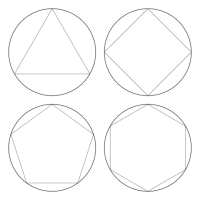
I try to solve this question geometrically. I can't draw 180 sides, so I drew a few.

I found this.

circledpolygons.png
I need software name that can draw these shapes. What patterns I need to see here?

I'm not in hurry to solve it and I will read all comments. Thanks in advance.
 
Beer drenched reaction follows.
Find the perimeter of a regular polygon of 180 sides inscribed in a circle of diameter 1.00000 m. Compare this number with the circumference of the circle.

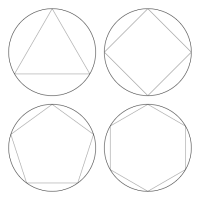
I try to solve this question geometrically. I can't draw 180 sides, so I drew a few.

I found this.

View attachment 39882
I need software name that can draw these shapes. What patterns I need to see here?

I'm not in hurry to solve it and I will read all comments. Thanks in advance.

The nasi112 I remember from 4 or 5 years ago would have made short work of that little puzzle.
Are there two or more users of the nasi112 username?

Screenshot_20251211-002124_Drive.jpg
 
Find the perimeter of a regular polygon of 180 sides inscribed in a circle of diameter 1.00000 m. Compare this number with the circumference of the circle.
1765394832351.png
I try to solve this question geometrically. I can't draw 180 sides, so I drew a few.

I found this.

I need software name that can draw these shapes. What patterns I need to see here?

I'm not in hurry to solve it and I will read all comments. Thanks in advance.
The Geogebra App can draw these shapes for you. But, as @jonah2.0 has already demonstrated above, there is no need to do so; the answers required can be arrived at algebraically.

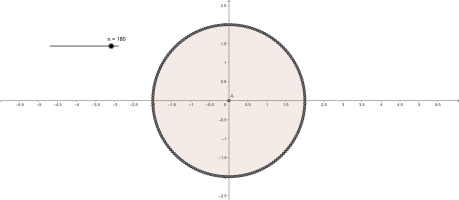
If you insist on a need to draw the figures I have created a Geogebra construction that will allow you to do so.

Clicking on this link will open Geogebra with a triangle inscribed in a circle and a slider set to: n=3 (qv).

As you move the slider to increase n (the number of sides in the polygon) you will get a pentagon (for n=5), a hexagon (n=6) and so on.

You can export any of the images created to file (or your clipboard) by clicking on the hamburger (top right) and choosing 'Export' from the drop-down menu.

I have allowed the slider to go up to 200 but once you create an icosagon (20 sides) or above, the polygon becomes virtually indistinguishable from the circle! 🤷‍♂️
1765396636205.png


Here's what happens when n=180......


Hope that helps. 😊
 
Thanks guys.

Beer drenched reaction follows.


The nasi112 I remember from 4 or 5 years ago would have made short work of that little puzzle.
Are there two or more users of the nasi112 username?
That's me:)

I left study more than 3 years in a row. Recently got back and covered infinite series. Went through probability as well.

If you insist on a need to draw the figures I have created a Geogebra construction that will allow you to do so.
Thanks. I will check it out.
 
Beer soaked ramblings follow.
Find the perimeter of a regular polygon of 180 sides inscribed in a circle of diameter 1.00000 m. Compare this number with the circumference of the circle.

I try to solve this question geometrically. I can't draw 180 sides, so I drew a few.

I found this.

View attachment 39882
I need software name that can draw these shapes. What patterns I need to see here?

I'm not in hurry to solve it and I will read all comments. Thanks in advance.

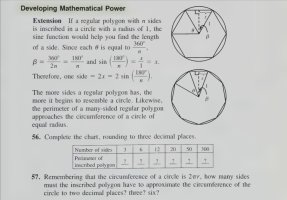
One of the them amazing definitions: The area of a circle is defined as the limit of the areas of
inscribed regular polygons as the number of sides increases without bound.

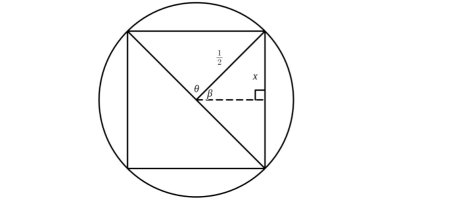
For a regular polygon with 4 sides

Screenshot_20251211-140512_Chrome.jpg,
 
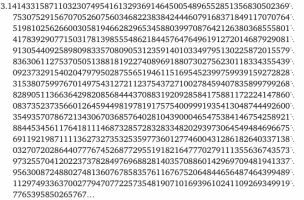
There are quite a few fascinating formulas to approximate [imath] \pi. [/imath] The problem is old, very old: 1800 BC (Babylon).
I like Archimedes's result [imath] 3+\dfrac{10}{70}> \pi > 3+\dfrac{10}{71} [/imath] (250 BC) who used polygons. The most famous formula is probably the Wallis product [math] \pi=2\cdot \dfrac{2}{1}\cdot\dfrac{2}{3}\cdot\dfrac{4}{3}\cdot\dfrac{4}{5}\cdot\dfrac{6}{5}\cdot\dfrac{6}{7}\ldots [/math]However, Ramanujan wouldn't have been Ramanujan if he hadn't found a computationally really efficient approximation
[math] \dfrac{1}{\pi}= \dfrac{\sqrt{8}}{9801}\cdot\displaystyle{\sum_{k=0}^\infty \dfrac{(4k)!(1103+26390k)}{(k!)^4\cdot 396^{4k}}}.[/math]
 
Find the perimeter of a regular polygon of 180 sides inscribed in a circle of diameter 1.00000 m. Compare this number with the circumference of the circle.

I try to solve this question geometrically. I can't draw 180 sides, so I drew a few.

I found this.

View attachment 39882
I need software name that can draw these shapes. What patterns I need to see here?

I'm not in hurry to solve it and I will read all comments. Thanks in advance.

o solve this properly, you don’t actually need to draw 180 sides. There is a direct formula for the perimeter of a regular polygon inscribed in a circle.


1️⃣ Given​


  • Diameter = 1.00000 m
  • Radius R=0.5R = 0.5R=0.5 m
  • Number of sides n=180n = 180n=180

For a regular nnn-gon inscribed in a circle, each side has length:

s=2Rsin⁡(πn)s = 2R \sin\left(\frac{\pi}{n}\right)s=2Rsin(nπ)
So the perimeter is:

Pn=n⋅2Rsin⁡(πn)P_n = n \cdot 2R \sin\left(\frac{\pi}{n}\right)Pn=n⋅2Rsin(nπ)


2️⃣ Substitute values​

P180=180⋅2(0.5)sin⁡(π180)P_{180} = 180 \cdot 2(0.5)\sin\left(\frac{\pi}{180}\right)P180=180⋅2(0.5)sin(180π)
Since 2R=12R = 12R=1, this simplifies to:

P180=180sin⁡(π180)P_{180} = 180 \sin\left(\frac{\pi}{180}\right)P180=180sin(180π)
Now,

π180≈0.0174533\frac{\pi}{180} \approx 0.0174533180π≈0.0174533sin⁡(0.0174533)≈0.0174524\sin(0.0174533) \approx 0.0174524sin(0.0174533)≈0.0174524
So,

P180≈180×0.0174524P_{180} \approx 180 \times 0.0174524P180≈180×0.0174524P180≈3.14143 mP_{180} \approx 3.14143 \text{ m}P180≈3.14143 m


3️⃣ Compare with circle circumference​


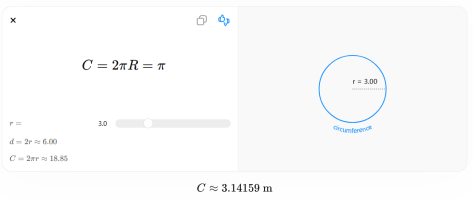
Circumference of the circle:

cirum.png

4️⃣ Comparison​

C−P180≈3.14159−3.14143C - P_{180} \approx 3.14159 - 3.14143C−P180≈3.14159−3.14143≈0.00016 m\approx 0.00016 \text{ m}≈0.00016 m
So the 180-sided polygon underestimates the circumference by only about 0.16 mm.


5️⃣ Pattern to Notice​


As n→∞n \to \inftyn→∞:

nsin⁡(πn)→πn \sin\left(\frac{\pi}{n}\right) \to \pinsin(nπ)→π
This is a classic limit result:

lim⁡n→∞nsin⁡(πn)=π\lim_{n \to \infty} n \sin\left(\frac{\pi}{n}\right) = \pin→∞limnsin(nπ)=π
So increasing the number of sides makes the polygon perimeter converge to the circle’s circumference.


6️⃣ Software for Drawing​


If you want to visualize:


  • GeoGebra (free, excellent for this)
  • Desmos Geometry
  • Wolfram Alpha
  • Python (matplotlib)
  • Any CAD software (AutoCAD, SketchUp, etc.)

But mathematically, drawing 180 sides is unnecessary once you know the formula.


This problem is essentially about understanding how regular polygons approximate a circle — the same idea used historically to approximate π.


Hope this helps 🙂
 
It looks a lot like an AI answer. I had a student who pasted AI work into her document, and it came out like that, lacking delimiters for Latex code. She didn't even notice it wasn't human-readable.
 
Top