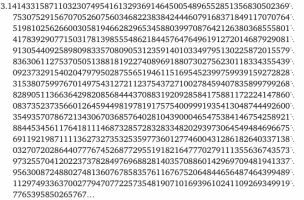
Find the perimeter of a regular polygon of 180 sides inscribed in a circle of diameter 1.00000 m. Compare this number with the circumference of the circle.
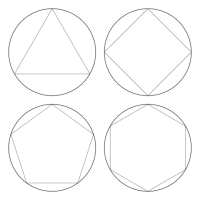
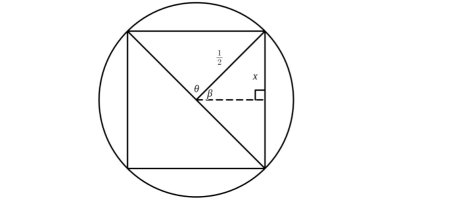
I try to solve this question geometrically. I can't draw 180 sides, so I drew a few.
I found this.
View attachment 39882
I need software name that can draw these shapes. What patterns I need to see here?
I'm not in hurry to solve it and I will read all comments. Thanks in advance.
o solve this properly, you don’t actually need to draw 180 sides. There is a direct formula for the perimeter of a regular polygon inscribed in a circle.
 Given
Given
- Diameter = 1.00000 m
- Radius R=0.5R = 0.5R=0.5 m
- Number of sides n=180n = 180n=180
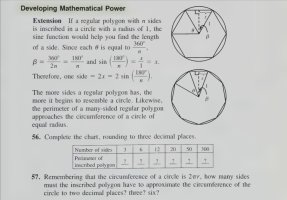
For a regular nnn-gon inscribed in a circle, each side has length:
s=2Rsin(πn)s = 2R \sin\left(\frac{\pi}{n}\right)s=2Rsin(nπ)
So the perimeter is:
Pn=n⋅2Rsin(πn)P_n = n \cdot 2R \sin\left(\frac{\pi}{n}\right)Pn=n⋅2Rsin(nπ)
 Substitute values
P180=180⋅2(0.5)sin(π180)P_{180} = 180 \cdot 2(0.5)\sin\left(\frac{\pi}{180}\right)P180=180⋅2(0.5)sin(180π)
Since 2R=12R = 12R=1, this simplifies to:
P180=180sin(π180)P_{180} = 180 \sin\left(\frac{\pi}{180}\right)P180=180sin(180π)
Now,
π180≈0.0174533\frac{\pi}{180} \approx 0.0174533180π≈0.0174533sin(0.0174533)≈0.0174524\sin(0.0174533) \approx 0.0174524sin(0.0174533)≈0.0174524
So,
P180≈180×0.0174524P_{180} \approx 180 \times 0.0174524P180≈180×0.0174524P180≈3.14143 mP_{180} \approx 3.14143 \text{ m}P180≈3.14143 m
 Compare with circle circumference
Circumference of the circle:
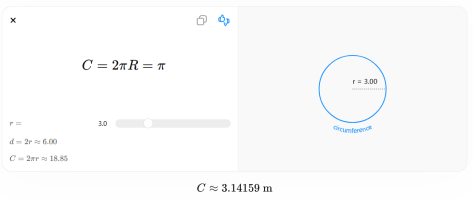
 Comparison
C−P180≈3.14159−3.14143C - P_{180} \approx 3.14159 - 3.14143C−P180≈3.14159−3.14143≈0.00016 m\approx 0.00016 \text{ m}≈0.00016 m
So the 180-sided polygon underestimates the circumference by only about
0.16 mm.
 Pattern to Notice
As n→∞n \to \inftyn→∞:
nsin(πn)→πn \sin\left(\frac{\pi}{n}\right) \to \pinsin(nπ)→π
This is a classic limit result:
limn→∞nsin(πn)=π\lim_{n \to \infty} n \sin\left(\frac{\pi}{n}\right) = \pin→∞limnsin(nπ)=π
So increasing the number of sides makes the polygon perimeter converge to the circle’s circumference.
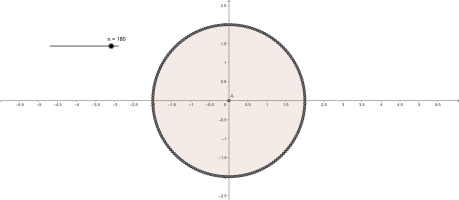
 Software for Drawing
If you want to visualize:
- GeoGebra (free, excellent for this)
- Desmos Geometry
- Wolfram Alpha
- Python (matplotlib)
- Any CAD software (AutoCAD, SketchUp, etc.)
But mathematically, drawing 180 sides is unnecessary once you know the formula.
This problem is essentially about understanding how regular polygons approximate a circle — the same idea used historically to approximate π.
Hope this helps