
King Friday
New member
- Joined
- May 25, 2026
- Messages
- 27
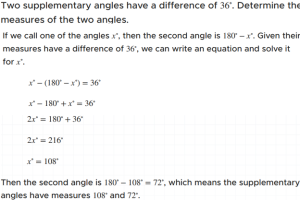
I should have said, "The minus sign before the parenthesis"View attachment 40051
My question is when we distribute the x°, the negative sign before the parenthesis is a minus, not a negative sign.
How then does the x° inside the parenthesis change signs? It's a positive times a negative which leaves its sign as is, a negative.
In the expressionI see. We distribute the minus sign?
Also, you said: "It's a positive times a negative which leaves its sign as is, a negative." (implying multiplication).My question is when we distribute the x°, the negative sign before the parenthesis is a minus, not a negative sign.
How then does the x° inside the parenthesis change signs? It's a positive times a negative which leaves its sign as is, a negative.
Sadly, I was never taught that concept of "distributing" that minus sign.Also, you said: "It's a positive times a negative which leaves its sign as is, a negative." (implying multiplication).
I suspect that may well be where you have confused yourself!
It is actually subtraction (the minus sign outside the parenthesis) of the "minus x°" inside the parenthesis and, as I'm sure you are aware, subtracting the negative is equivalent to adding the positive.
Hope that helps.![]()
When I'm confronted with something like that (and I want to remove the parenthesis) I think of it as a subtraction of everything inside the parenthesis but, to do so, I tend to "get rid" of any minus signs (operators) first, so that I'm then subtracting a sequence of individual(ly) signed terms.Sadly, I was never taught that concept of "distributing" that minus sign.
Distribution was only for multiplication. :-(
Google provides a useful short summary here (qv).Sadly, I was never taught that concept of "distributing" that minus sign.
Distribution was only for multiplication. :-(
Thank you, Highlander.Google provides a useful short summary here (qv).
(Be sure to click on "Show more" when the page opens.)