Supplementary Angle Problem Question

King Friday

New member
Joined
May 25, 2026
Messages
27
Screenshot 2026-06-24 122040.png

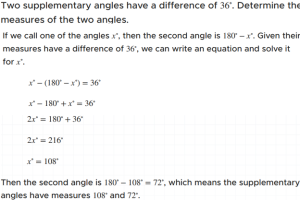
My question is when we distribute the x°, the negative sign before the parenthesis is a minus, not a negative sign.
How then does the x° inside the parenthesis change signs? It's a positive times a negative which leaves its sign as is, a negative.
 
Last edited:
You can think of [imath]a-(b-c)[/imath] as [imath]a+-(b-c)=a+(-b+c)=a+-b+c=a-b+c[/imath]. Ultimately, minus and negative amount to the same thing, and we just distribute the subtraction as if it were negation.
 
I see. We distribute the minus sign?
In the expression
[math]a-(b-c)[/math]
The subtraction can be rewritten as adding the negative of the expression in parentheses:

[math]a-(b-c)=a+(-(b-c))[/math]
Taking the negative of an expression is the same as multiplying by [imath]-1[/imath]:

[math]a+(-(b-c))=a+(-1)(b-c)[/math]
Now distribute [imath]-1[/imath] to each term inside the parentheses:

[math]a+((-1)b+(-1)(-c))[/math]
Simplifying the products gives:

[math]a+(-b+c)[/math]
and removing the parentheses:

[math]a-b+c[/math]
Therefore

[math]a-(b-c)=a-b+c.[/math]
 
My question is when we distribute the x°, the negative sign before the parenthesis is a minus, not a negative sign.
How then does the x° inside the parenthesis change signs? It's a positive times a negative which leaves its sign as is, a negative.
Also, you said: "It's a positive times a negative which leaves its sign as is, a negative." (implying multiplication).

I suspect that may well be where you have confused yourself! 🤷‍♂️

It is actually subtraction (the minus sign outside the parenthesis) of the "minus x°" inside the parenthesis and, as I'm sure you are aware, subtracting the negative is equivalent to adding the positive.


Hope that helps. 😊
 
Also, you said: "It's a positive times a negative which leaves its sign as is, a negative." (implying multiplication).

I suspect that may well be where you have confused yourself! 🤷‍♂️

It is actually subtraction (the minus sign outside the parenthesis) of the "minus x°" inside the parenthesis and, as I'm sure you are aware, subtracting the negative is equivalent to adding the positive.


Hope that helps. 😊
Sadly, I was never taught that concept of "distributing" that minus sign.
Distribution was only for multiplication. :-(
 
Sadly, I was never taught that concept of "distributing" that minus sign.
Distribution was only for multiplication. :-(
When I'm confronted with something like that (and I want to remove the parenthesis) I think of it as a subtraction of everything inside the parenthesis but, to do so, I tend to "get rid" of any minus signs (operators) first, so that I'm then subtracting a sequence of individual(ly) signed terms.

So I would then think of (b - x°) as being (b + x°) which means I am then subtracting a positive b and a negative x° to remove the brackets. (Which leads me to subtracting the negative x° being "replaced" with adding a positive x°)

(Just my way of doing it. 😉😊)
 
Top