A basic, but seemingly impossible, math problem I can't successfully solve. Can you please assist me?

  • Thread starter Deleted member 120137
  • Start date
Status
Not open for further replies.
D

Deleted member 120137

Guest
Column A:
2
4
5
10
10
10
---
41

Column B
1
2
3
4
5
6
---
21
Column A consists of 6 individual numbers plus the total of those 6 numbers when added together. These 6 numbers, plus the total, must not be altered ever.
Column B consists of 6 individual numbers that can be altered. If you add these 6 numbers above it comes to 21. Obviously that total will need to be altered when any or all of the 6 numbers are changed.
Here's the challenge: For a successful solution I need to have any or all of the 6 numbers in Column B changed and then added together so they add up to a number that's 40 or less. Then I have to multiply those 6 individual numbers from Column B (changed or not) by the completely unchanged opposite number in Column A. All 6 of these now multiplied numbers must now "individually" be 42 or more after multiplication in order to successfully solve the problem (how much more doesn't matter").
 
Last edited by a moderator:
Column A:
2
4
5
10
10
10
---
41

Column B
1
2
3
4
5
6
---
21
Column A consists of 6 individual numbers plus the total of those 6 numbers when added together. These 6 numbers, plus the total, must not be altered ever.
Column B consists of 6 individual numbers that can be altered. If you add these 6 numbers above it comes to 21. Obviously that total will need to be altered when any or all of the 6 numbers are changed.
Here's the challenge: For a successful solution I need to have any or all of the 6 numbers in Column B changed and then added together so they add up to a number that's 40 or less. Then I have to multiply those 6 individual numbers from Column B (changed or not) by the completely unchanged opposite number in Column A. All 6 of these now multiplied numbers must now "individually" be 42 or more after multiplication in order to successfully solve the problem (how much more doesn't matter").
The product constraints impose a minimum possible sum of Column B equal to 52.5, which exceeds the required maximum sum of 40. Therefore, no solution exists.
 
Here's a clearer explanation:

This is unchangeable Column A in the above example (1+2+3+4+5+6).
Now when we multiply these six individual numbers with the opposite six individual numbers from Column B the answer is (2x1 =2, 4x2=8, 5x3=15, 10x4=40, 10x5=50, 10x6=60. We then add the 6 individual results together 2+8+15+40 +50 +60 and the total result for Column B is 175.

Now, to successfully solve the problem we need not a result of "175". but a result of 40 or less.

I think there are creative, unusual, rarely used mathematical techniques that can possibly achieve this result.

Don't forget ---- the actual numbers, and their order, in Column A must always remain precisely the same Column A
2
4
5
10
10
10
And any or all of the 6 numbers in Column B can be changed to different numbers. For example Column B
3
4
9
20
1
1

Now the result of all these new figures when we multiply Column A numbers against the new opposite Column B numbers is 2x3=6, 4x4=16, 5x9=45, 10x20=200, 10x1=10, 10x1=10. Then we add 6 + 16+ 45+200+10+10 = "287"
Now to "successfully" solve the problem that "287" result needs to be 40 or less.

I hope everything is clearer now.
 
Last edited by a moderator:
You didn't clarify the problem; you changed it:
For a successful solution I need to have any or all of the 6 numbers in Column B changed and then added together so they add up to a number that's 40 or less. Then I have to multiply those 6 individual numbers from Column B (changed or not) by the completely unchanged opposite number in Column A. All 6 of these now multiplied numbers must now "individually" be 42 or more after multiplication in order to successfully solve the problem (how much more doesn't matter").
Now the result of all these new figures when we multiply Column A numbers against the new opposite Column B numbers is 2x3=6, 4x4=16, 5x9=45, 10x20=200, 10x1=10, 10x1=10. Then we add 6 + 16+ 45+200+10+10 = "287"
Now to "successfully" solve the problem that "287" result needs to be 40 or less.
You changed it from the sum of B being 40 or less, to the sum of the products. Also, you didn't mention the "42 or more"; has that changed?

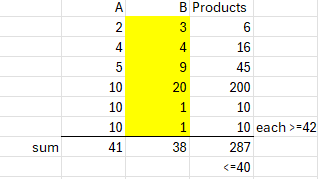
Here is your second example:

1779108970734.png

The products are not individually at least 42. And, of course, if they were, then their sum could not be 40 or less.

Shall we drop the 42 requirement??

And can you tell us where this problem came from? Possibly that would show what the requirements really are.
 
Not really.

What do you think about post #2 ?
I have no idea how his 52.5 figure was calculated and how in his mind it's applied. Nor do I know precisely what he means by "product constraints" and in what manner those constraints are precisely applied in his logic.
 
You didn't clarify the problem; you changed it:


You changed it from the sum of B being 40 or less, to the sum of the products. Also, you didn't mention the "42 or more"; has that changed?

Here is your second example:


The products are not individually at least 42. And, of course, if they were, then their sum could not be 40 or less.

Shall we drop the 42 requirement??

And can you tell us where this problem came from? Possibly that would show what the requirements really are.
It's not the fist line of 6 Column A numbers that must be 40 or less, it's the second line in Column B which is each of the 6 numbers in both lines multiplied by it's horizontally positioned number then the 6 results of that, after being added together, must be 40 or less. If you can acheive that then you've solved the problem. It was changed by me to show what "not" to do. All the numbers in B, need to be multiplied by their opposite horizontal number from A, then those 6 results are added together and the result is 287. Therefore, it fails to successfully solve the problem because the number 287 is higher than "41". To solve the problem a mathematician needs to find a way to change any final result in Column B that's 41 or over to be 40 or less. At first glance this seems impossible. I suspect there's a clever and creative mathematical way to successfully succeed.

You also mention the number 42. Yes they are not individually at least 42 in my example, and when added together are not 40 or less. That's why my example is an example of what not to do. That second line of Column B must equal 40 or less for the problem to be successfully solved. As I said, it seems impossible. I bet it's not.
 
It's not the fist line of 6 Column A numbers that must be 40 or less, it's the second line in Column B which is each of the 6 numbers in both lines multiplied by it's horizontally positioned number then the 6 results of that, after being added together, must be 40 or less. If you can acheive that then you've solved the problem.
I said nothing about column A being 40 or less. Here you agree with your second version, that it is the products that must sum to 40 or less; but in the original version, you said that the numbers in column B themselves must add to 40 or less:

For a successful solution I need to have any or all of the 6 numbers in Column B changed and then added together so they add up to a number that's 40 or less.
You are not communicating clearly, to say the least. But I'm going by the second version.
To solve the problem a mathematician needs to find a way to change any final result in Column B that's 41 or over to be 40 or less. At first glance this seems impossible. I suspect there's a clever and creative mathematical way to successfully succeed.
I suppose what you mean by "any final result" is the sum, not the individual products? That's not clear here, but agrees with the version I'm trying to answer.

What we're trying to show you is that this is provably impossible. You can't just imagine that some method you don't know will solve it.

You also mention the number 42. Yes they are not individually at least 42 in my example, and when added together are not 40 or less. That's why my example is an example of what not to do.
Yes, I understand that your example is not meant to be the solution. But in the restatement, you didn't mention 42, and I'm trying to extract from you some information about what it is that has to be at least 42, or whether you have dropped that requirement.

Are you, or are you not, saying that each number in my product column, must be at least 42?

If that is a requirement, then it should be obvious to you that it is impossible: the sum of six numbers, each of which is at least 42, can't be less than 40. The least the sum can be is [imath]6\times42=252[/imath], which is more than 40.

So you can't possibly mean this, unless you are not thinking at all.
I have no idea how his 52.5 figure was calculated and how in his mind it's applied. Nor do I know precisely what he means by "product constraints" and in what manner those constraints are precisely applied in his logic.
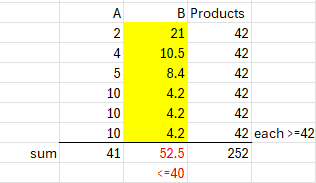
That's based on your original version: If the products are as small as possible, that is, if all are 42, then it looks like this, choosing B appropriately:
1779114402255.png
The sum of column B, 52.5, is more than 40, which in the original version was not allowed. Evidently that is not what you meant, so this answer is not appropriate any longer.

But once we know what you are really trying to say, we can answer you more fully. I'm trying to model for you how to explain your meaning clearly, so that you can get a suitable answer.
 
I said nothing about column A being 40 or less. Here you agree with your second version, that it is the products that must sum to 40 or less; but in the original version, you said that the numbers in column B themselves must add to 40 or less:


You are not communicating clearly, to say the least. But I'm going by the second version.

I suppose what you mean by "any final result" is the sum, not the individual products? That's not clear here, but agrees with the version I'm trying to answer.

What we're trying to show you is that this is provably impossible. You can't just imagine that some method you don't know will solve it.


Yes, I understand that your example is not meant to be the solution. But in the restatement, you didn't mention 42, and I'm trying to extract from you some information about what it is that has to be at least 42, or whether you have dropped that requirement.

Are you, or are you not, saying that each number in my product column, must be at least 42?

If that is a requirement, then it should be obvious to you that it is impossible: the sum of six numbers, each of which is at least 42, can't be less than 40. The least the sum can be is [imath]6\times42=252[/imath], which is more than 40.

So you can't possibly mean this, unless you are not thinking at all.

That's based on your original version: If the products are as small as possible, that is, if all are 42, then it looks like this, choosing B appropriately:
The sum of column B, 52.5, is more than 40, which in the original version was not allowed. Evidently that is not what you meant, so this answer is not appropriate any longer.

But once we know what you are really trying to say, we can answer you more fully. I'm trying to model for you how to explain your meaning clearly, so that you can get a suitable answer.
Each number in your product column must be at least 42.
 
Ok, I'll do a different, much easier scenario and hopefully then people will comprehend it all.

Lets say we have a horse race with 6 horses in it. For a win ----- Horse 1 pays 2, horse 2 pays4, horse 3 pays]5, horse 4 pays10, horse 5 pays 10, horse 6 pays10. We now divide each individual dividend into the number 80 (this can be any number, the mathematical principle is exactly the same). The 6 results of these 6 divisions are ----- Horse 1 = 40, horse 2 =20, horse 3 =16, horse 4 =8, horse 5 =8, horse 6 =8. These division results add up to 100. The first line of figures are what the winning horse dividend is for each dollar bet. The second line of figures are the amount someone bets via one bet on each of the 6 horses. Therefore he bets 100 when all these bets are added together on the 6 horses.

There's 6 horses in the race and no matter which horse wins the punter gets 80 for the win (therefore loses20).

My challenge is ....... can anyone find a 100% mathematical way to bet this100 on all the horses, thus one of the horses he bet on MUST always win and get a return of a minimum of 101 in precisely 100% of all horse races? Thus making a profit of $1 on every race that's ever run (if he bets on every race ever run ha ha).

There ya go, is that now easier to understand? That's on exactly the same mathematical principles as I used in my earlier Column A/Column B scenario.

On the surface, using mathematics alone, you would think to achieve this is 100% impossible. I reckon it's possible, but not with conventional mathematics. I reckon the mathematics to achieve this would be incredibly creative and incredibly complex and that 99.999999999% of mathematicians would fail at achieving a 100% successful solution.

If a successful solution exists I can think of many different areas in life where this solution could be applied to many different subject matters.

And don't forget ...... the 6 horse dividends listed in the 1st column [imath]2,[/imath]4, [imath]5,[/imath]10. [imath]10,[/imath]10 must stay the same and not be altered for this one race. ,

Have you got the solution?
 
Last edited by a moderator:
column Acolumn B
221
411
59
105
105
105
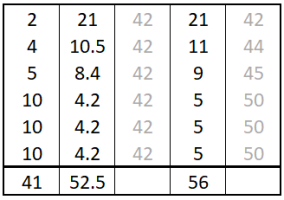
Each number in column B is the smallest possible positive integer that when multiplied by its counterpart in column A gives you 42 or more. That is, assuming positive integers, column B is minimal. The sum (56) is minimal. It's impossible.

There ya go, is that now easier to understand?
 
column Acolumn B
221
411
59
105
105
105
Each number in column B is the smallest possible positive integer that when multiplied by its counterpart in column A gives you 42 or more. That is, assuming positive integers, column B is minimal. The sum (56) is minimal. It's impossible.

There ya go, is that now easier to understand?
Thanks, yes I'm aware of that basic math. However, I suspect that likely only a mere handful of mathematicians have solved this mathematical challenge and haven't shared the solution because the math involved can actually be used for evil purposes, not just good purposes. I've been working on this seemingly basic challenge for years and have gained a few unusual insights, but have never found the 100% final solution that I genuinely think exists.
 
I have no idea how his 52.5 figure was calculated and how in his mind it's applied. Nor do I know precisely what he means by "product constraints" and in what manner those constraints are precisely applied in his logic.
When I first looked at this thread the only response was the one from @Aion and I did the same as what (I believe) s/he did.

Your OP did not specify the column B had to include only integers and so I filled it with numbers that produced exactly 42 as the product of the corresponding numbers in each column as shown below (and in @Dr.Peterson's last post).


Basic Maths Problem.png

That met all the criteria given in your OP and clearly demonstrated that there exists no solution to your problem as stated. The product of the number pairs from each column being set to 42 (ie: the minimum value allowed) results in the total of column B becoming 52.5 (ie: greater than 40) which is not allowed. If the numbers in column B are then replaced with the nearest integer value (that meets your stipulation that the product must be 42 or more) then the sum of column B rises to 56 (as also shown in @mrtwhs' post). That is what @Aion meant by "product constraints": if the products are all set to 42 (the minimum allowed) the the total of column B is 52.5 (or 56 if only integers are allowed).

Does that explain it for you?

However, having come back and seen the further responses, I have to ask: "Is English your first language?". We are always happy to make allowances for people who are not native English speakers; that is why you were asked to supply the source of this problem. (Please do so if you can.)

However, in your second post ("a clearer explanation"???) you state:-

This is unchangeable Column A in the above example (1+2+3+4+5+6).
Now when we multiply these six individual numbers with the opposite six individual numbers from Column B the answer is (2x1 =2, 4x2=8, 5x3=15, 10x4=40, 10x5=50, 10x6=60.
You have now changed column A (to be 1, 2 , 3, 4, 5 & 6) and are multiplying them by the numbers (2,4,5,10,10,10) which were the original column A numbers (as now column B's numbers!).

If English is your first language then what you say is just gibberish!
 
Last edited:
Thanks, yes I'm aware of that basic math. However, I suspect that likely only a mere handful of mathematicians have solved this mathematical challenge and haven't shared the solution because the math involved can actually be used for evil purposes, not just good purposes. I've been working on this seemingly basic challenge for years and have gained a few unusual insights, but have never found the 100% final solution that I genuinely think exists.
I was just finishing my last post when your latest contribution arrived.
I am now fairly convinced that English is your native tongue and everything you say is just
gibberish!!!
 
Here's a clearer explanation:

To successfully solve the problem we need a result of 40 or less.

I think there are creative, unusual, rarely used mathematical techniques that can possibly achieve this result.

Don't forget ---- the actual numbers, and their order, in Column A must always remain precisely the same Column A
2
4
5
10
10
10
And any or all of the 6 numbers in Column B can be changed to different numbers. For example Column B
3
4
9
20
1
1

Now the result of all these new figures when we multiply Column A numbers against the new opposite Column B numbers is 2x3=6, 4x4=16, 5x9=45, 10x20=200, 10x1=10, 10x1=10. Then we add 6 + 16+ 45+200+10+10 = "287"
Now to "successfully" solve the problem that "287" result needs to be 40 or less.

I hope everything is clearer now.
 
Here's a clearer explanation:

This is unchangeable Column A in the above example (1+2+3+4+5+6).
Now when we multiply these six individual numbers with the opposite six individual numbers from Column B the answer is (2x1 =2, 4x2=8, 5x3=15, 10x4=40, 10x5=50, 10x6=60. We then add the 6 individual results together 2+8+15+40 +50 +60 and the total result for Column B is 175.


Now, to successfully solve the problem we need not a result of "175". but a result of 40 or less.
Deleting some of the gibberish (in red) doesn't make what you say any more valid!
It's starting to look like you're some kind of conspiracy theorist!
(Or you're not logistic_guy back again by any chance, I hope!)
 
I suspect that likely only a mere handful of mathematicians have solved this mathematical challenge and haven't shared the solution because the math involved can actually be used for evil purposes, not just good purposes. I've been working on this seemingly basic challenge for years and have gained a few unusual insights, but have never found the 100% final solution that I genuinely think exists.
OK, now I completely understand. The problem as stated is absolutely, positively, provably impossible. However the math cabal which has transported here from the planet Talos IV in the Archillean system has actually solved it and is planning to use it for evil purposes. You've been working on this for years and have some unusual insights? Try an easier (and potentially more profitable) problem. Try to figure out the pin for my ATM card. Here's a hint. It's the last four digits of [imath]\pi[/imath].
 
Ok, I'll do a different, much easier scenario and hopefully then people will comprehend it all.

Lets say we have a horse race with 6 horses in it. For a win ----- Horse 1 pays 2, horse 2 pays4, horse 3 pays]5, horse 4 pays10, horse 5 pays 10, horse 6 pays10. We now divide each individual dividend into the number 80 (this can be any number, the mathematical principle is exactly the same). The 6 results of these 6 divisions are ----- Horse 1 = 40, horse 2 =20, horse 3 =16, horse 4 =8, horse 5 =8, horse 6 =8. These division results add up to 100. The first line of figures are what the winning horse dividend is for each dollar bet. The second line of figures are the amount someone bets via one bet on each of the 6 horses. Therefore he bets 100 when all these bets are added together on the 6 horses.

There's 6 horses in the race and no matter which horse wins the punter gets 80 for the win (therefore loses20).

My challenge is ....... can anyone find a 100% mathematical way to bet this100 on all the horses, thus one of the horses he bet on MUST always win and get a return of a minimum of 101 in precisely 100% of all horse races? Thus making a profit of $1 on every race that's ever run (if he bets on every race ever run ha ha).

There ya go, is that now easier to understand? That's on exactly the same mathematical principles as I used in my earlier Column A/Column B scenario.

On the surface, using mathematics alone, you would think to achieve this is 100% impossible. I reckon it's possible, but not with conventional mathematics. I reckon the mathematics to achieve this would be incredibly creative and incredibly complex and that 99.999999999% of mathematicians would fail at achieving a 100% successful solution.

If a successful solution exists I can think of many different areas in life where this solution could be applied to many different subject matters.

And don't forget ...... the 6 horse dividends listed in the 1st column [imath]2,[/imath]4, [imath]5,[/imath]10. [imath]10,[/imath]10 must stay the same and not be altered for this one race. ,

Have you got the solution?

Suppose there are [imath]n[/imath] possible outcomes. Let [imath]o_i[/imath] be the payout odds and [imath]b_i[/imath] the amount staked on outcome [imath]i[/imath].

Then the total stake is:
[math]S = \sum_{i=1}^n b_i[/math]
If outcome [imath]i[/imath] occurs, the return is:
[math]o_i b_i[/math]
So the profit in outcome [imath]i[/imath] is:
[math]o_i b_i - S[/math]
To guarantee at least a profit [imath]R[/imath] in every outcome, we require:
[math]o_i b_i - S \ge R \quad \forall i[/math]
Rearranging gives:

[math]o_ib_i\ge S+R \implies b_i \ge \frac{S+R}{o_i}[/math]
Now summing over all outcomes:

[math]S = \sum_{i=1}^n b_i \ge (S+R)\sum_{i=1}^n \frac{1}{o_i}[/math]
Dividing by [imath]S>0[/imath]:

[math]1 \ge \left(1 + \frac{R}{S}\right)\sum_{i=1}^n \frac{1}{o_i}[/math]
Now consider the break-even case [imath]R = 0[/imath]. This gives:

[math]1\ge \sum_{i=1}^n \frac{1}{o_i}[/math]
So we obtain the key feasibility condition:
[math]\sum_{i=1}^n \frac{1}{o_i} \begin{cases} < 1 & \text{arbitrage possible} \\ = 1 & \text{perfect break-even} \\ > 1 & \text{impossible to cover all outcomes} \end{cases}[/math]
For the given odds:

[math]\sum\frac{1}{o_i}=\frac{1}{2}+\frac{1}{4}+\frac{1}{5}+\frac{1}{10}+\frac{1}{10}+\frac{1}{10}=1.25[/math]
Now substitute the stated values [imath]S=100[/imath] and [imath]R=1[/imath]:

[math]100\ge101\sum\frac{1}{o_i}=101(1.25)=126.25[/math]
So the condition becomes:
[math]100\ge126.25[/math]
Which is impossible.

Hence no allocation of bets can guarantee even a minimal positive profit. Conceptually, each outcome requires a fixed fraction of the bankroll, and those fractions sum to 125%, exceeding the available 100%, so the system is fundamentally over-constrained.
 
Status
Not open for further replies.
Top