Binomial Distribution Patterns

Manis88

New member
Joined
Nov 9, 2019
Messages
10
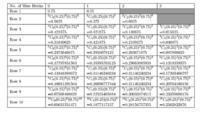
I have to find the probability of exactly 0, 1, 2 and 3 blue bricks being in the different rows. I've already done this and posted the image of the completed table of probabilities. My question is that, what are the different trends observed and provide detailed reasoning for the trend occurring. I've already identified most of the trends such as the probability of selecting exactly 0 blue bricks decreases as the number of trials (rows) increases. This is because as there are more trials, their more combinations that could occur, therefore the probability for exactly 0 blue bricks being their decreases. Now we can also see that for selecting exactly 1, and 2 blue bricks, the probability first increases then it decreases. I don't know why this occurs, I was thinking maybe its approaching expected value but I don't think that's correct. And for the last column, the probability increases as the number of trials (rows) increases. I'm guessing just like the second and the third column that after a certain number of trials that the probability will start to decreases. So again my question is why does this happen? And is my reasoning for the trend in the first column correct? And if you identify any more trends please let me know.
Thank you so much for taking the time out of your day to read this.
 

Attachments

  • 1.PNG
    1.PNG
    71.3 KB · Views: 9
  • Capture.PNG
    Capture.PNG
    115.6 KB · Views: 7
Why is one increase in probability any different from any other increase in probability?

Why is one decrease in probability any different from any other decrease in probability?
 
I think the best answer to both my questions would "it isn't".

Given any p and n, where are the greatest probabilities clustered?
 
Something, but it is not specific to any particular expected value. The structure is the same.

Now, answer the question. where are the greatest probabilities clustered? Near the mean? Away from the mean? Closer to zero? Closer to the maximum value?
 
Something, but it is not specific to any particular expected value. The structure is the same.

Now, answer the question. where are the greatest probabilities clustered? Near the mean? Away from the mean? Closer to zero? Closer to the maximum value?
Close to the mean??
 
Last edited:
Okay, say you're interested in "3 bricks".

As you increase the number of experiments...
n = 1
n = 2
n = 3
n = 4
n = 5

Where does it seem to you that the probability of 3 bricks would increase and where would it decrease?
 
Okay, say you're interested in "3 bricks".

As you increase the number of experiments...
n = 1
n = 2
n = 3
n = 4
n = 5

Where does it seem to you that the probability of 3 bricks would increase and where would it decrease?
Well it's going to start at row number 3 since we need 3 bricks, so it's going to increase until the number of bricks get really big and then it would decrease.
 
Why would p(3) continue to increase for these values, n = 4, 5, 6, 7, 9?
 
is it because of the symmetry in the pascals triangle? Where the values first increase and then they decrease
 
Cluster near the mean.

We're changing 'n'. As the mean gets closer to the number we seek, 3 for example, we should see an increase in probability. As n continues to increase, so does the mean, thus, a fixed value, such as 3, should decrease in probability.
 
Thinking it through... Good work hanging in there!
 
Top