Does anyone have recommendations for videos/books/articles that explain the Fundamental Theorem of Calculus intuitively? Like, why are integrals and antiderivatives related and how? I've watched hours of videos, read sections in 3 textbooks, and asked ChatGPT, but still don't get the intuition.

You are using an out of date browser. It may not display this or other websites correctly.
You should upgrade or use an alternative browser.
You should upgrade or use an alternative browser.
Fundamental Theorem of Calculus
- Thread starter jpanknin
- Start date
I like to think in higher dimensions. If you follow a flow through a potential field, then the gain of energy is determined by your path, and is zero if it is a closed curve. What happens inside is determined by what's happening at the boundary. You can write this as [imath]\int_a^b +\int_b^a=0. [/imath] For a concrete example, you may consider climbing stairs between two floors: the potential is the gravity, the energy gain the difference in potential energy. Your energy gain is [imath] F(3rd)-F(2nd)[/imath] no matter what you did in between, climbing back and forth, pausing, or taking two steps at a time.
I am sure you have seen a lot of examples and maybe a few proofs, too, so it's hard to imagine what else can be done. This is how I see it: it is technically correct, so I accept it. A flow through a vector field is my intuition. If you break this picture down to two dimensions, the graph of a function, you end up with Riemann sums.
I am sure you have seen a lot of examples and maybe a few proofs, too, so it's hard to imagine what else can be done. This is how I see it: it is technically correct, so I accept it. A flow through a vector field is my intuition. If you break this picture down to two dimensions, the graph of a function, you end up with Riemann sums.

Dr.Peterson
Elite Member
- Joined
- Nov 12, 2017
- Messages
- 16,974
It may help if you state your question a little more specifically, because there are many ways to look at this. Which part of the FTC are you primarily thinking of? What is the statement of that theorem as you think of it? What feels wrong to you about it? And what explanation that you've seen came closest to answering your question?
Well, it's difficult to say what I don't understand about it when I don't really understand it (I don't mean that sarcastically). Some part of it just isn't coming together. I don't get how antiderivatives give area under a graph. I don't get how or why that translation happens. The closest I think I've gotten is that as x varies, the slope (derivative) gives an indication of the amount by which the area (integration of the area of a new slice into the whole) will change. But the rate of change doesn't give an idea of the height of that slice, only the change in height. So how do you compute area when you don't know the actual height? And how does F(b) - F(a) give the area regardless of the shape of the graph (and the area under the graph - assuming for now that f(x) >= 0 for all x). I've seen examples that are vastly different shapes of graphs that all have the same F(b) and F(a). How can the area of all these be the same?It may help if you state your question a little more specifically, because there are many ways to look at this. Which part of the FTC are you primarily thinking of? What is the statement of that theorem as you think of it? What feels wrong to you about it? And what explanation that you've seen came closest to answering your question?
So...kind of all of it. I can calculate it based on mechanically following the rules, but I don't "get" it.
All other concepts I've been able to get with a little time, but I don't feel like I'm making any progress with FTC.
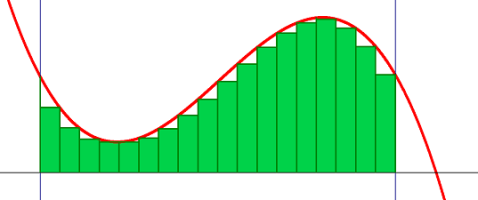
It is not an easy concept. Many aspects reveal their secrets at higher levels, e.g., the historical development, or some closely related theorems. I learned it mechanically, like you at school, and even in university: The area under the curve is filled by using increasingly smaller rectangles and adding their areas.
Differentiation is easier, the slope of secants that approach the slope of a tangent [imath] x_1\longrightarrow x_0. [/imath]
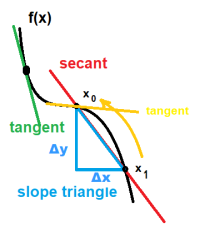
Both concepts involve limits. One with an increasing number of rectangles, and one with an increasing number of secants. However, this does not tell us anything about the functions involved: [imath] Y=\int f(t)\,dt=F(x)\, , \,y=f(x)\, , \, y'=\dfrac{df(x)}{dx}=f'(x).[/imath]
Differentiation means: Given [imath] y, [/imath] find [imath] y'. [/imath]
Integration means: Given [imath] y, [/imath] find [imath] Y. [/imath]
Is your question more about those images and why they describe the tasks, or are you looking for algebraic equations that relate differentiation to integration, in which case I have to think about it a bit longer? The notation is a first hint if we take it a bit sloppily: [imath] Y=y\cdot dx [/imath] and [imath] y'=\dfrac{y}{dx}. [/imath]
Differentiation is easier, the slope of secants that approach the slope of a tangent [imath] x_1\longrightarrow x_0. [/imath]
Both concepts involve limits. One with an increasing number of rectangles, and one with an increasing number of secants. However, this does not tell us anything about the functions involved: [imath] Y=\int f(t)\,dt=F(x)\, , \,y=f(x)\, , \, y'=\dfrac{df(x)}{dx}=f'(x).[/imath]
Differentiation means: Given [imath] y, [/imath] find [imath] y'. [/imath]
Integration means: Given [imath] y, [/imath] find [imath] Y. [/imath]
Is your question more about those images and why they describe the tasks, or are you looking for algebraic equations that relate differentiation to integration, in which case I have to think about it a bit longer? The notation is a first hint if we take it a bit sloppily: [imath] Y=y\cdot dx [/imath] and [imath] y'=\dfrac{y}{dx}. [/imath]
Last edited:
Here is a, to some extent, sloppy algebraic calculation of what is going on. Since we are talking about intuition, I left out all the technical details. Weierstraß's formula for the derivative of [imath] f(x) [/imath] says we can write them as
[math] f'(x)\cdot h= f(x+h)-f(x)+r(h) [/math]where [imath] h [/imath] is a small distance on the [imath] x-[/imath]axis and [imath] r(h) [/imath] a neglibable error term. The (Riemann) integral, on the other hand, can be written as
[math] \int_{x_0}^{x_{n}}f(h)\,dh=\sum_{k=0}^{n-1} f(x_k)\cdot h\, \text{ with } \,h=x_{k+1}-x_k .[/math]Let's combine these two.
[math]\begin{array}{lll} \displaystyle{\int_{x_0}^{x_{n}}f'(h)\,dh}&=\displaystyle{\sum_{k=0}^{n-1}f'(x_k)\cdot h}\\[12pt] &=\displaystyle{\sum_{k=0}^{n-1}\{f(x_k+h)-f(x_k)+r(h)\}}\\[12pt] &=\displaystyle{\sum_{k=0}^{n-1}\{f(x_k+x_{k+1}-x_k)-f(x_{k})+r(x_{k+1}-x_k)\}} \\[12pt] &=\displaystyle{\sum_{k=0}^{n-1}\{f(x_{k+1})-f(x_k)\}+\sum_{k=0}^{n-1}r(x_{k+1}-x_k)}\\[12pt] &=\displaystyle{f(x_n)-f(x_0)+\underbrace{\sum_{k=0}^{n-1}r(x_{k+1}-x_k)}_{\longrightarrow 0}} \end{array}[/math]
This is basically what's going on with FTC. Does this help you with your intuition, or, if not, are your problems in the two definitions, or in the calculation?
[math] f'(x)\cdot h= f(x+h)-f(x)+r(h) [/math]where [imath] h [/imath] is a small distance on the [imath] x-[/imath]axis and [imath] r(h) [/imath] a neglibable error term. The (Riemann) integral, on the other hand, can be written as
[math] \int_{x_0}^{x_{n}}f(h)\,dh=\sum_{k=0}^{n-1} f(x_k)\cdot h\, \text{ with } \,h=x_{k+1}-x_k .[/math]Let's combine these two.
[math]\begin{array}{lll} \displaystyle{\int_{x_0}^{x_{n}}f'(h)\,dh}&=\displaystyle{\sum_{k=0}^{n-1}f'(x_k)\cdot h}\\[12pt] &=\displaystyle{\sum_{k=0}^{n-1}\{f(x_k+h)-f(x_k)+r(h)\}}\\[12pt] &=\displaystyle{\sum_{k=0}^{n-1}\{f(x_k+x_{k+1}-x_k)-f(x_{k})+r(x_{k+1}-x_k)\}} \\[12pt] &=\displaystyle{\sum_{k=0}^{n-1}\{f(x_{k+1})-f(x_k)\}+\sum_{k=0}^{n-1}r(x_{k+1}-x_k)}\\[12pt] &=\displaystyle{f(x_n)-f(x_0)+\underbrace{\sum_{k=0}^{n-1}r(x_{k+1}-x_k)}_{\longrightarrow 0}} \end{array}[/math]
This is basically what's going on with FTC. Does this help you with your intuition, or, if not, are your problems in the two definitions, or in the calculation?
Dr.Peterson
Elite Member
- Joined
- Nov 12, 2017
- Messages
- 16,974
Again, it will be helpful if we can focus on just one of the two parts of the FTC at a time, rather than trying to look at the whole concept at once. That's why I asked several specific questions, which you have not answered.
Here is Stewart's version of the FTC, showing the two parts I referred to:

I'll start with the first part.
First, it's important to recognize that there are two different functions here; g(x) is a function obtained as the definite integral (from 0 to some variable point x) of the function f in the picture @fresh_42 showed:
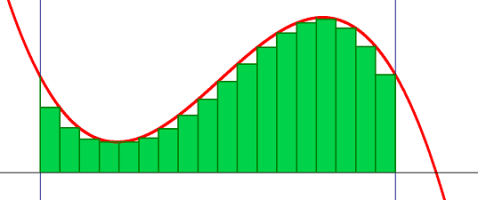 So f(x) is the red curve, and g(x) is the green area. We want to see that f(x) is the derivative of g(x).
(Similarly, the second part involves two different functions, here called f and F, where f is defined as the derivative of F.)
You write as if there were one function whose derivative and integral we were looking at. That may be part of your difficulty:
Anyway, I find the first part very easy to understand intuitively. Look at that picture, and think of it as a graph of f, where we are finding the area under it from 0 to a variable value x. Call this area g(x). In the picture, imagine that we've just increased the right endpoint from x to x + Δx. That added one rectangle to the area (approximately); its width is Δx, and its height (approximately) is f(x); so the change in area, Δg(x) = g(x+Δx) - g(x), is approximately f(x)Δx (height times width).
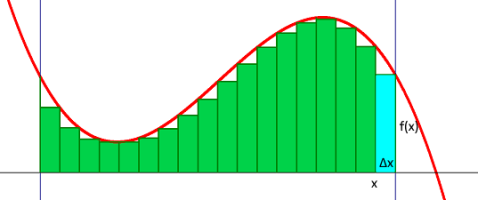
So the rate of change of area as we increase x (the upper limit of integration) is Δg(x)/Δx = f(x). Taking a very small delta, this says that dg(x)/dx = f(x), which is what the first part of the FTC says!
The second part can be easily derived from this fact, but I'll hold off on that.
Here is Stewart's version of the FTC, showing the two parts I referred to:
I'll start with the first part.
First, it's important to recognize that there are two different functions here; g(x) is a function obtained as the definite integral (from 0 to some variable point x) of the function f in the picture @fresh_42 showed:
(Similarly, the second part involves two different functions, here called f and F, where f is defined as the derivative of F.)
You write as if there were one function whose derivative and integral we were looking at. That may be part of your difficulty:
But the rate of change [of g] doesn't give an idea of the height of that slice [of f], only the change in height. So how do you compute area [under f] when you don't know the actual height [of f]?
Anyway, I find the first part very easy to understand intuitively. Look at that picture, and think of it as a graph of f, where we are finding the area under it from 0 to a variable value x. Call this area g(x). In the picture, imagine that we've just increased the right endpoint from x to x + Δx. That added one rectangle to the area (approximately); its width is Δx, and its height (approximately) is f(x); so the change in area, Δg(x) = g(x+Δx) - g(x), is approximately f(x)Δx (height times width).
So the rate of change of area as we increase x (the upper limit of integration) is Δg(x)/Δx = f(x). Taking a very small delta, this says that dg(x)/dx = f(x), which is what the first part of the FTC says!
The second part can be easily derived from this fact, but I'll hold off on that.

The Highlander
Senior Member
- Joined
- Feb 18, 2022
- Messages
- 1,239
This series of (twelve) videos: The Essence of Calculus (qv) should address any and all questions you may have on the subject.Well, it's difficult to say what I don't understand about it when I don't really understand it (I don't mean that sarcastically). Some part of it just isn't coming together. I don't get how antiderivatives give area under a graph. I don't get how or why that translation happens. The closest I think I've gotten is that as x varies, the slope (derivative) gives an indication of the amount by which the area (integration of the area of a new slice into the whole) will change. But the rate of change doesn't give an idea of the height of that slice, only the change in height. So how do you compute area when you don't know the actual height? And how does F(b) - F(a) give the area regardless of the shape of the graph (and the area under the graph - assuming for now that f(x) >= 0 for all x). I've seen examples that are vastly different shapes of graphs that all have the same F(b) and F(a). How can the area of all these be the same?
So...kind of all of it. I can calculate it based on mechanically following the rules, but I don't "get" it.
All other concepts I've been able to get with a little time, but I don't feel like I'm making any progress with FTC.
The eighth lesson deals specifically with FTC but I would recommend working your way through all the preceding videos to understand the author's approach to explaining things and his terminology.