renegade05
Full Member
- Joined
- Sep 10, 2010
- Messages
- 260
I just need to verify i got the right answers.
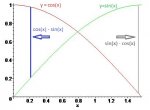
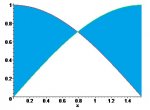
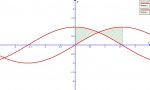
\(\displaystyle Y1=sin(x)\)
\(\displaystyle Y2=cos(x)\)
\(\displaystyle Interval: [0,\pi/2]\)
a.Find the volume of the solid whose cross section is perpendicular to the x-axis is a square.
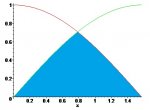
b.a.Find the volume of the solid whose cross section is perpendicular to the y-axis is a semi-circle.
(a) \(\displaystyle \int_0^\frac{\pi}{4} \! (\cos(x)-\sin(x))^2 \, \mathrm{d}x + \int_\frac{\pi}{4}^\frac{\pi}{2} \! (\sin(x)-\cos(x))^2 \, \mathrm{d}x\)
(b) \(\displaystyle \frac{\pi}{2}\left[\int_0^\frac{\pi}{4} \! (\cos(x)-\sin(x))^2 \, \mathrm{d}x + \int_\frac{\pi}{4}^\frac{\pi}{2} \! (\sin(x)-\cos(x))^2 \, \mathrm{d}x\right]\)
\(\displaystyle Y1=sin(x)\)
\(\displaystyle Y2=cos(x)\)
\(\displaystyle Interval: [0,\pi/2]\)
a.Find the volume of the solid whose cross section is perpendicular to the x-axis is a square.
b.a.Find the volume of the solid whose cross section is perpendicular to the y-axis is a semi-circle.
(a) \(\displaystyle \int_0^\frac{\pi}{4} \! (\cos(x)-\sin(x))^2 \, \mathrm{d}x + \int_\frac{\pi}{4}^\frac{\pi}{2} \! (\sin(x)-\cos(x))^2 \, \mathrm{d}x\)
(b) \(\displaystyle \frac{\pi}{2}\left[\int_0^\frac{\pi}{4} \! (\cos(x)-\sin(x))^2 \, \mathrm{d}x + \int_\frac{\pi}{4}^\frac{\pi}{2} \! (\sin(x)-\cos(x))^2 \, \mathrm{d}x\right]\)