volume of a solid

renegade05

Full Member
Joined
Sep 10, 2010
Messages
260
I just need to verify i got the right answers.

\(\displaystyle Y1=sin(x)\)
\(\displaystyle Y2=cos(x)\)
\(\displaystyle Interval: [0,\pi/2]\)

a.Find the volume of the solid whose cross section is perpendicular to the x-axis is a square.
b.a.Find the volume of the solid whose cross section is perpendicular to the y-axis is a semi-circle.

(a) \(\displaystyle \int_0^\frac{\pi}{4} \! (\cos(x)-\sin(x))^2 \, \mathrm{d}x + \int_\frac{\pi}{4}^\frac{\pi}{2} \! (\sin(x)-\cos(x))^2 \, \mathrm{d}x\)

(b) \(\displaystyle \frac{\pi}{2}\left[\int_0^\frac{\pi}{4} \! (\cos(x)-\sin(x))^2 \, \mathrm{d}x + \int_\frac{\pi}{4}^\frac{\pi}{2} \! (\sin(x)-\cos(x))^2 \, \mathrm{d}x\right]\)


renegade05 said:
a. Find the volume of the solid whose cross section is perpendicular to the x-axis is a square.

Is this sentence supposed to read as follows?

Find the volume of the solid whose cross-sections are squares, perpendicular to the x-axis.


b.a.Find the volume of the solid whose cross section is perpendicular to the y-axis is a semi-circle.

Same issue; poor English. What does the improperly-placed phrase "is a semi-circle" supposed to mean?

("b.a." looks like a typographical error)

I'm having difficulties understanding the complete boundaries for these solids.

Did you post all of the given information, for these two exercises? :?

 
Be careful with part b. You just multiplied the first one by Pi/2. You used cross sections perp. to the x axis. The problems asks for cross sections perp to the y axis.

Integrate with respect to y.

Have you covered integration of inverse trig functions yet?.
 
mmm4444bot: thats what my professor wrote down. Might be poor english, but i understand the question. The cross sections are either a square or semi circle.

Galactus: Yes we have done inverse trig functions; however, we do not need to solve the integral, just set it up.

Would:

\(\displaystyle \frac{\pi}{2}\left[\int_0^\frac{\sqrt{2}}{2} \! (\arcsin(y))^2 \, \mathrm{d}y + \int_\frac{\sqrt{2}}{2}^1 \! (\arccos(y))^2 \, \mathrm{d}y\right]\)

be correct? If not.. please help...
 
Note that \(\displaystyle A=\frac{\pi}{2}(r)^{2}\)

So, we have as the radius \(\displaystyle \frac{cos^{-1}(y)-sin^{-1}(y)}{2}\)

\(\displaystyle \frac{\pi}{2}\int_{0}^{\frac{1}{\sqrt{2}}}\left(\frac{cos^{-1}(y)-sin^{-1}(y)}{2}\right)^{2}dy\)
 
renegade05 said:
\(\displaystyle \int_0^\frac{\pi}{4} \! (\cos(x)-\sin(x))^2 \, \mathrm{d}x + \int_\frac{\pi}{4}^\frac{\pi}{2} \! (\sin(x)-\cos(x))^2 \, \mathrm{d}x\)

Thanks for the cross-section confirmation.

I'm still thinking that you have not shared all of the information given to you.

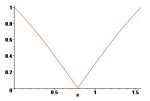
For the object with square cross sections, this graph shows the height of those sections according to your integral above.

Is this the contour that you expect? The resulting shape is actually two objects, since there is nothing at x = Pi/4.

[attachment=0:1r714qhf]piecewised.JPG[/attachment:1r714qhf]


Attachments

  • piecewised.JPG
    piecewised.JPG
    16.3 KB · Views: 121
galactus said:
Note that \(\displaystyle A=\frac{\pi}{2}(r)^{2}\)

So, we have as the radius \(\displaystyle \frac{cos^{-1}(y)-sin^{-1}(y)}{2}\)

\(\displaystyle \frac{\pi}{2}\int_{0}^{\frac{1}{\sqrt{2}}}\left(\frac{cos^{-1}(y)-sin^{-1}(y)}{2}\right)^{2}dy\)

Wait, are you just using the area between cos(x), sin(x) and y=0 ?

The question may be ambiguous but i was under the impression to integrate between x=0 and x=pi/2 which is how i derived my answer:

\(\displaystyle \frac{\pi}{2}\left[\int_0^\frac{\sqrt{2}}{2} \! (\arcsin(y))^2 \, \mathrm{d}y + \int_\frac{\sqrt{2}}{2}^1 \! (\arccos(y))^2 \, \mathrm{d}y\right]\)
 
Re:

mmm4444bot said:
renegade05 said:
\(\displaystyle \int_0^\frac{\pi}{4} \! (\cos(x)-\sin(x))^2 \, \mathrm{d}x + \int_\frac{\pi}{4}^\frac{\pi}{2} \! (\sin(x)-\cos(x))^2 \, \mathrm{d}x\)

Thanks for the cross-section confirmation.

I'm still thinking that you have not shared all of the information given to you.

For the object with square cross sections, this graph shows the height of those sections according to your integral above.

Is this the contour that you expect? The resulting shape is actually two objects, since there is nothing at x = Pi/4.


Yes, that's the contour i expect. Yes, two objects hence two integrals. I suppose you could make it into one using symmetry.

I am not sure what information you think i am not sharing. haha.

I am still curious about the semi-circle one though. My answer is
\(\displaystyle \frac{\pi}{2}\left[\int_0^\frac{\sqrt{2}}{2} \! (\arcsin(y))^2 \, \mathrm{d}y + \int_\frac{\sqrt{2}}{2}^1 \! (\arccos(y))^2 \, \mathrm{d}y\right]\)

But Galactus thinks its
\(\displaystyle \frac{\pi}{2}\int_{0}^{\frac{1}{\sqrt{2}}}\left(\frac{cos^{-1}(y)-sin^{-1}(y)}{2}\right)^{2}dy\)
 
renegade05 said:
could make it into one [object] using symmetry

Actually, I believe that you would need to utilize the arcweld(x) function for that. :lol:


I am not sure what information you think i am not sharing.

You presented the first exercise as:

Y1 = cos(x)
Y2 = sin(x)
x from 0 to Pi/2
Find the solid with square cross sections which are perpendicular to the x-axis


This information does not define a unique solid because there is more than one possible interpretation. To describe a unqiue object, all of the boundaries need to be stated explicitly.

Also, symbols Y1 and Y2 are defined but not used in any description or work.

This all leaves me with a hunch that either something from your professor got left out OR you've incompletely paraphrased the information that you received.


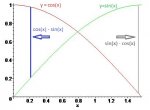
[attachment=2:3o2847xm]squares1.JPG[/attachment:3o2847xm]

Your integral for the object with square cross sections uses the heights above. (I've shown one within [0,Pi/4] in blue and one within [Pi/4,Pi/2] in grey).


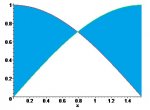
In other words, the region is bounded as shown below. (This is one possibility, and it's two objects.)

[attachment=1:3o2847xm]squares2.jpg[/attachment:3o2847xm]


We could also use the given information to interpret another possibility. In fact, you hinted at it later when you posted, "…are you just using the area between cos(x), sin(x) and y=0?".

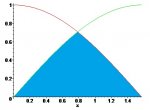
In other words, the region below. (This is another possibility, and it's one object.)

[attachment=0:3o2847xm]squares3.jpg[/attachment:3o2847xm]


You told me that you understand what your professor wants. That's great, but I can't know for sure what the object with square cross sections is, until you provide sufficient details to define something unique. 8-)

I'll leave galactus to respond to your latest question on the second exercise.

Cheers!


Attachments

  • squares1.JPG
    squares1.JPG
    32.2 KB · Views: 110
  • squares2.jpg
    squares2.jpg
    21.9 KB · Views: 110
  • squares3.jpg
    squares3.jpg
    20.7 KB · Views: 110
Nope i am not leaving anything out. This is the exact question my prof posted. Perhaps she posted it as Y1, and Y2 because she wanted us to graph it. So saying Y1/Y2 kinda hints to graph it...

She did not defy any other boundaries. So i guess there are two correct answers as your graphs demonstrate. She will probably accept either one. I mean, she did make it up on the spot so she probably didn't even realize that the question was ambiguous and had more than one possible interpretation.

I will give both answers and maybe impress her!

As for the semi circle i am pretty sure the two answers will be :

\(\displaystyle \frac{\pi}{2}\left[\int_0^\frac{\sqrt{2}}{2} \! (\arcsin(y))^2 \, \mathrm{d}y + \int_\frac{\sqrt{2}}{2}^1 \! (\arccos(y))^2 \, \mathrm{d}y\right]\)

\(\displaystyle \frac{\pi}{2}\int_{0}^{\frac{1}{\sqrt{2}}}\left(\frac{cos^{-1}(y)-sin^{-1}(y)}{2}\right)^{2}dy\)

depending on the interpretation....
 
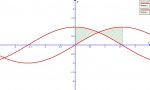
Here is the region I was thinking the problem was talking about, since the problem asks for the area between cos and sin.

But, perhaps it should also say it is bounded by x=0.

Except, I made a mistake on the upper bound. Should be 1.

\(\displaystyle \frac{\pi}{2}\int_{0}^{1}\left(\frac{cos^{-1}(y)-sin^{-1}(y)}{2}\right)^{2}dy\)

The other region, the problem should have said it was bounded by y=0.

Maybe you could get some clarification from your instructor about which region she is referring to?.

As mmm said, it is rather ambiguous as to the interpretation.
 

Attachments

  • sin cos.jpg
    sin cos.jpg
    48 KB · Views: 96
galactus said:
Here is the region I was thinking the problem was talking about, since the problem asks for the area between cos and sin.

But, perhaps it should also say it is bounded by x=0.

Except, I made a mistake on the upper bound. Should be 1.

\(\displaystyle \frac{\pi}{2}\int_{0}^{1}\left(\frac{cos^{-1}(y)-sin^{-1}(y)}{2}\right)^{2}dy\)

The other region, the problem should have said it was bounded by y=0.

Maybe you could get some clarification from your instructor about which region she is referring to?.

As mmm said, it is rather ambiguous as to the interpretation.

No it says, the domain of these two functions is between 0 and pi/2. So, essentially, yes, between x=0, x=pi/2 y=sinx y=cosx.

mmm is mistaken. Nowhere in the problem does it say y=0. So that second graph is incorrect. There is only one interpretation.

But i am not sure how you derived your answer. I keep getting:
\(\displaystyle \frac{\pi}{4}\left[\int_0^\frac{\sqrt{2}}{2} \! (\arcsin(y))^2 \, \mathrm{d}y + \int_\frac{\sqrt{2}}{2}^1 \! (\arccos(y))^2 \, \mathrm{d}y\right]\)

not

\(\displaystyle \frac{\pi}{2}\int_{0}^{1}\left(\frac{cos^{-1}(y)-sin^{-1}(y)}{2}\right)^{2}dy\)

Also, what is the graphing program you use to get all the pretty pictures that you post on here?
 
Also, what is the graphing program you use to get all the pretty pictures that you post on here?

Go to www.padowan.dk and download the FREE graphing utility. It is the best one available that I know of.....for FREE.

It plots in rectangular, polar, and parametric as well as area under a curve, tangent lines, arc length, etc.
 
galactus said:
Also, what is the graphing program you use to get all the pretty pictures that you post on here?

Go to http://www.padowan.dk and download the FREE graphing utility. It is the best one available that I know of.....for FREE.

It plots in rectangular, polar, and parametric as well as area under a curve, tangent lines, arc length, etc.

nice thank you..

renegade05 said:
But i am not sure how you derived your answer. I keep getting:
\(\displaystyle \frac{\pi}{4}\left[\int_0^\frac{\sqrt{2}}{2} \! (\arcsin(y))^2 \, \mathrm{d}y + \int_\frac{\sqrt{2}}{2}^1 \! (\arccos(y))^2 \, \mathrm{d}y\right]\)

not

\(\displaystyle \frac{\pi}{2}\int_{0}^{1}\left(\frac{cos^{-1}(y)-sin^{-1}(y)}{2}\right)^{2}dy\)

can you show me what you did to get your answer... I dont see how you got that...
 
I was using the other region. Go with yours if you're more comfortable with it.

We divide by 2 because of the radius in the area of a semicircle: \(\displaystyle \frac{1}{2}{\pi}(d/2)^{2}\)

\(\displaystyle d=cos^{-1}(y)-sin^{-1}(y)\)
 
Top