
Linear Equations
What Is a Linear Equation?
A linear equation is an equation where the highest power of any variable is 1. That's the simple answer. The name "linear" comes from the fact that when you graph these equations, they form straight lines on a coordinate plane.
More technically, a linear equation is one that depends only on constants and variables raised to the first power (or no power at all). You won't see any squares, cubes, square roots, or more complicated operations on the variables.
For example, \(y = 2x + 3\) is linear. Both \(x\) and \(y\) appear to the first power (even though we don't write the exponent 1, it's understood). The equation \(3x - 7 = 2\) is also linear—it only has \(x\) to the first power.
On the other hand, \(y = x^2 + 1\) is not linear because of that \(x^2\) term. Neither is \(y = \sqrt{x}\) or \(xy = 5\) (when two variables multiply each other, that's actually second degree, not linear).
Why does this matter? Linear equations are the foundation of algebra. They're the first type of equation you really learn to solve and graph. They show up constantly in real-world problems—calculating costs, converting units, predicting trends, analyzing data. Master linear equations, and you've got a tool you'll use for the rest of your life.
Recognizing Linear Equations
How can you tell if an equation is linear? Ask yourself these questions:
1. What's the highest exponent on any variable?
If the answer is 1 (or if there's no exponent written, which means it's 1), you're probably looking at a linear equation. If you see \(x^2\), \(x^3\), or any power higher than 1, it's not linear.
2. Are any variables under a square root or other radical?
If \(x\) appears inside a square root like \(\sqrt{x}\), that's not linear. Linear equations keep variables in simple form.
3. Are variables multiplied together?
Something like \(xy = 10\) isn't linear in the traditional sense because \(x\) and \(y\) are multiplied. (Technically it's called a "nonlinear" equation—specifically, hyperbolic.) For our purposes, if you see two different variables multiplied, be suspicious.
4. Are there any trig functions, exponentials, or logarithms involving the variables?
Equations like \(\sin(x) = 0.5\) or \(2^x = 8\) are definitely not linear. Linear equations stick to basic operations: addition, subtraction, and multiplication by constants.
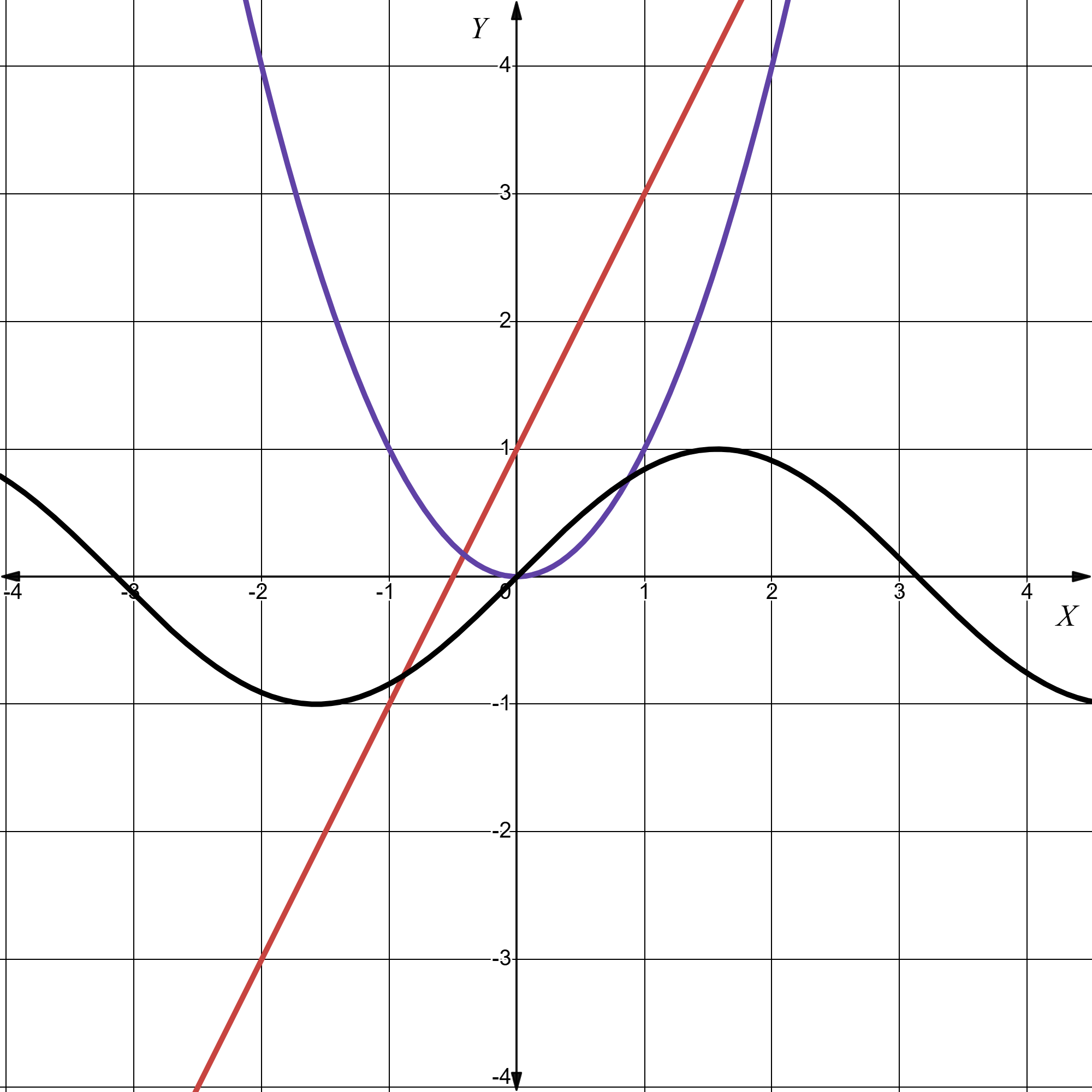
In the graph below, the red line is a linear equation. It is the line made by points that satisfy \(y=2x+1\), a linear equation. The blue and black graphs are definitely non-linear! Blue is \(y=x^2\), while black is \(y=sin(x)\)
Let's practice identifying linear equations:
Examples - Linear or not?
- \(3x + 5 = 11\) → Linear (just \(x\) to the first power)
- \(y = 4x - 7\) → Linear (both variables to the first power)
- \(2a + 3b = 12\) → Linear (both \(a\) and \(b\) to the first power)
- \(x^2 + 3 = 12\) → Not linear (\(x\) is squared)
- \(y = \frac{1}{x}\) → Not linear (this is the same as \(y = x^{-1}\), a negative exponent)
- \(\sqrt{x} = 4\) → Not linear (\(x\) is under a square root)
- \(5 = 2y\) → Linear (just \(y\) to the first power)
- \(xy = 20\) → Not linear (variables multiply each other)
Standard Form
Linear equations can be written in various forms, but there are a few standard ways you'll see them:
One-variable form: \(ax + b = 0\)
This is the simplest form for equations with just one variable. Examples: \(2x - 6 = 0\) or \(5x + 15 = 0\).
Two-variable standard form: \(ax + by = c\)
This is called the "standard form" of a linear equation. Here \(a\), \(b\), and \(c\) are constants (regular numbers), and \(x\) and \(y\) are variables. Examples: \(3x + 2y = 12\) or \(x - 4y = 8\).
By convention, when writing in standard form, we try to make \(a\) positive and all three values (\(a\), \(b\), \(c\)) integers (whole numbers) if possible.
Slope-intercept form: \(y = mx + b\)
This form is incredibly useful for graphing. The \(m\) represents the slope (steepness) of the line, and the \(b\) represents the y-intercept (where the line crosses the y-axis). Examples: \(y = 2x + 3\) or \(y = -\frac{1}{2}x + 7\).
Point-slope form: \(y - y_1 = m(x - x_1)\)
This form uses a known point \((x_1, y_1)\) on the line and the slope \(m\). It's particularly useful when you know a point and the slope but haven't worked out the equation yet.
All of these are just different ways to write the same type of equation. You can convert between them using algebra.
Solving Linear Equations
When a linear equation has just one variable, "solving" it means finding the value of that variable that makes the equation true.
Example 1: Solve \(2x + 5 = 13\).
Our goal is to get \(x\) by itself on one side of the equation. We do this by "undoing" operations using inverse operations.
First, subtract 5 from both sides: $$2x + 5 - 5 = 13 - 5$$ $$2x = 8$$
Now divide both sides by 2: $$\frac{2x}{2} = \frac{8}{2}$$ $$x = 4$$
Check: Does \(2(4) + 5 = 13\)? Yes: \(8 + 5 = 13\) ✓
Example 2: Solve \(7 - 3x = 1\).
Subtract 7 from both sides: $$7 - 3x - 7 = 1 - 7$$ $$-3x = -6$$
Divide both sides by -3: $$\frac{-3x}{-3} = \frac{-6}{-3}$$ $$x = 2$$
Check: Does \(7 - 3(2) = 1\)? Yes: \(7 - 6 = 1\) ✓
Example 3: Solve \(\frac{x}{4} + 3 = 7\).
Subtract 3 from both sides: $$\frac{x}{4} = 4$$
Multiply both sides by 4: $$x = 16$$
Check: Does \(\frac{16}{4} + 3 = 7\)? Yes: \(4 + 3 = 7\) ✓
Example 4: Solve \(5x - 2 = 3x + 6\).
This one has \(x\) on both sides. Let's gather the \(x\) terms on one side. Subtract \(3x\) from both sides: $$5x - 3x - 2 = 3x - 3x + 6$$ $$2x - 2 = 6$$
Now add 2 to both sides: $$2x = 8$$
Divide by 2: $$x = 4$$
Check: Does \(5(4) - 2 = 3(4) + 6\)? Yes: \(20 - 2 = 12 + 6\), and \(18 = 18\) ✓
Example 5: Solve \(2(x + 3) = 14\).
First, distribute the 2: $$2x + 6 = 14$$
Subtract 6: $$2x = 8$$
Divide by 2: $$x = 4$$
Example 6: Solve for \(y\): \(3x + 2y = 12\) when \(x = 2\).
Substitute \(x = 2\): $$3(2) + 2y = 12$$ $$6 + 2y = 12$$
Subtract 6: $$2y = 6$$
Divide by 2: $$y = 3$$
So when \(x = 2\), \(y = 3\). The point \((2, 3)\) is on the line represented by this equation.
The Graphing Connection
Here's what makes linear equations special: when you graph all the possible solutions to a linear equation with two variables, you get a straight line. That's why they're called "linear."
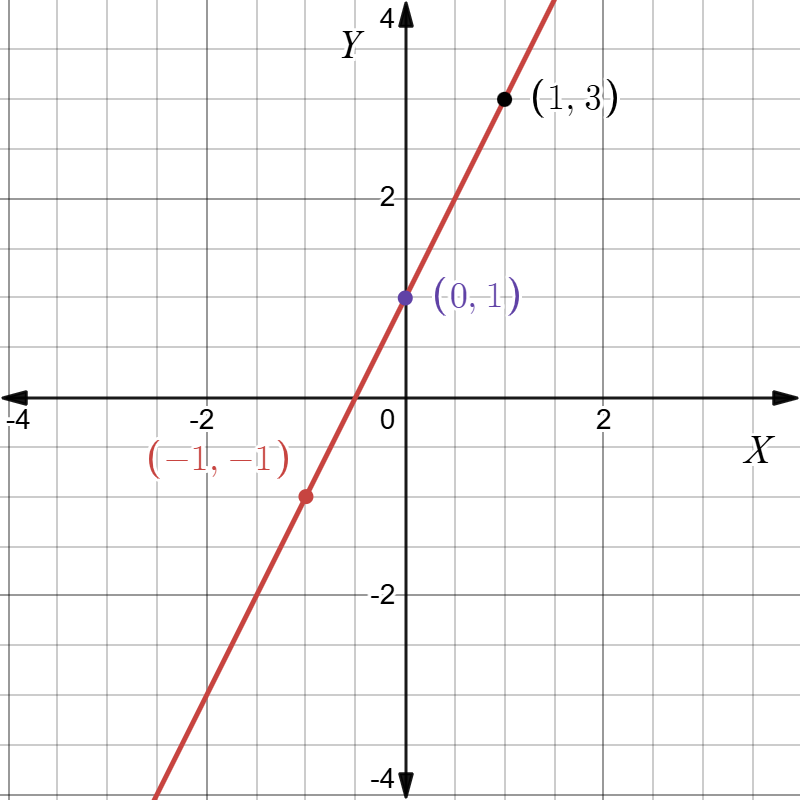
Consider the equation \(y = 2x + 1\). Some solutions are:
- When \(x = 0\), \(y = 1\) → point \((0, 1)\)
- When \(x = 1\), \(y = 3\) → point \((1, 3)\)
- When \(x = 2\), \(y = 5\) → point \((2, 5)\)
- When \(x = -1\), \(y = -1\) → point \((-1, -1)\)
If you plot these points on a coordinate plane and connect them, you get a perfectly straight line. Every point on that line is a solution to the equation \(y = 2x + 1\), and every solution to that equation is a point on that line.
Horizontal and Vertical Lines
Two special cases deserve mention:
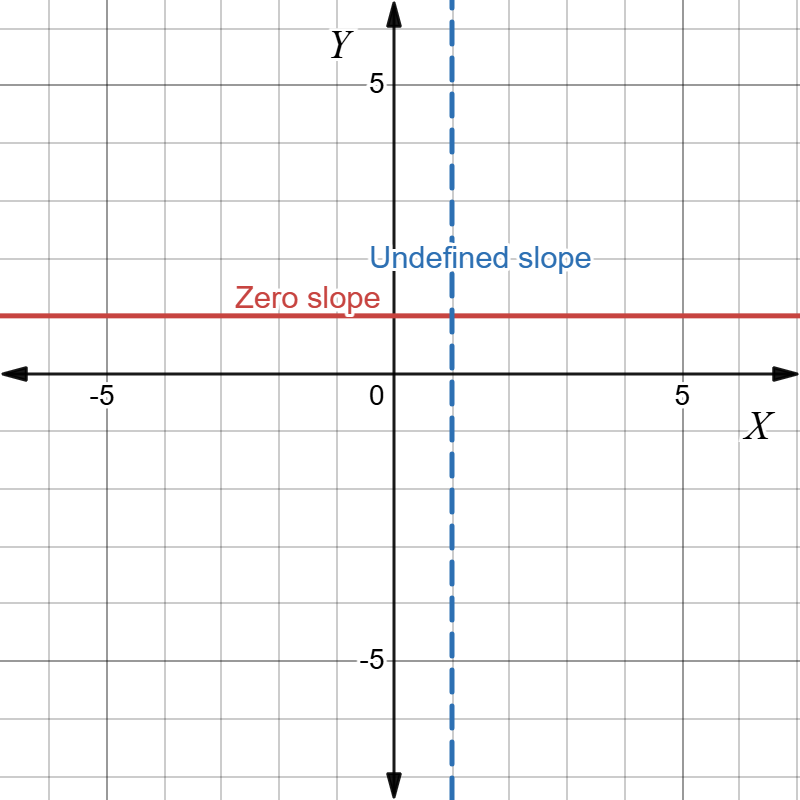
Horizontal lines have equations like \(y = 3\). Every point on this line has a y-coordinate of 3, but the x-coordinate can be anything. The line is perfectly flat, running parallel to the x-axis.
Vertical lines have equations like \(x = -2\). Every point on this line has an x-coordinate of -2, but the y-coordinate can be anything. The line runs parallel to the y-axis.
Technically, vertical lines like \(x = -2\) aren't functions (because one input gives multiple outputs), but they're still linear equations.
Slope and Intercepts
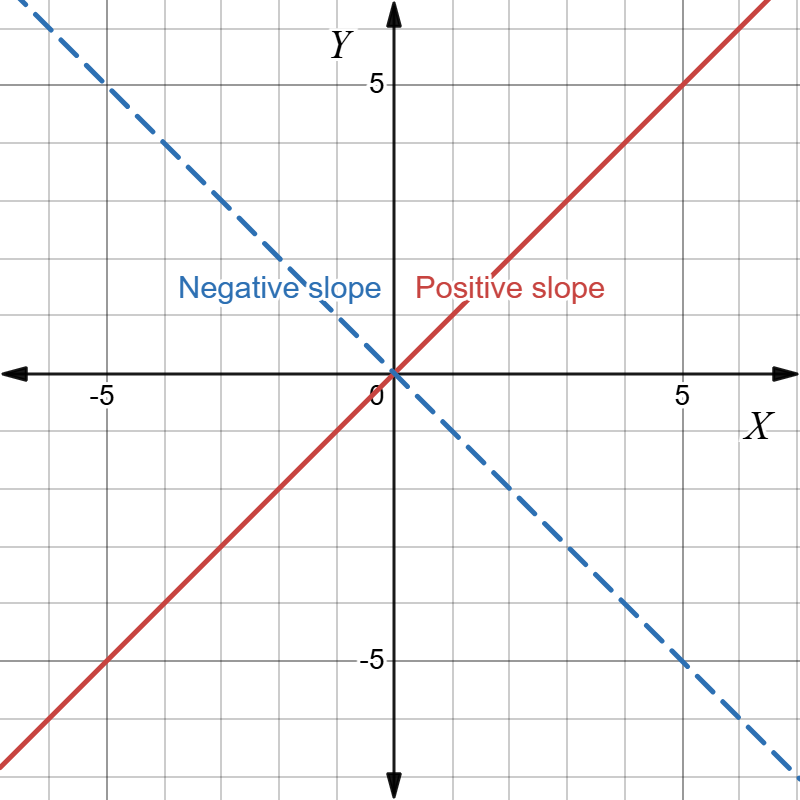
The slope of a line tells you how steep it is and which direction it goes. In the equation \(y = mx + b\), the \(m\) is the slope.
- Positive slope: line goes upward from left to right
- Negative slope: line goes downward from left to right
- Zero slope: horizontal line
- Undefined slope: vertical line
Real-World Applications
Linear equations show up constantly in everyday life. Here are some practical examples:
Example 7: Cost Calculations
A plumber charges $50 for a house call plus $75 per hour of work. The total cost \(C\) can be expressed as: $$C = 75h + 50$$
where \(h\) is the number of hours worked. This is a linear equation.
If the plumber works for 3 hours, the cost is: $$C = 75(3) + 50 = 225 + 50 = 280$$
The bill would be $280.
Example 8: Temperature Conversion
The formula to convert Celsius to Fahrenheit is linear: $$F = \frac{9}{5}C + 32$$
If it's 20°C outside, what's that in Fahrenheit? $$F = \frac{9}{5}(20) + 32 = 36 + 32 = 68$$
It's 68°F.
Example 9: Distance and Speed
If you're driving at a constant speed of 60 mph, the distance \(d\) you travel in \(t\) hours is: $$d = 60t$$
This is linear. After 2.5 hours, you've traveled: $$d = 60(2.5) = 150$$
You've gone 150 miles.
Example 10: Phone Plans
A cell phone plan costs $30 per month plus $0.10 per text message. If \(C\) is the total monthly cost and \(t\) is the number of texts, then: $$C = 0.10t + 30$$
If you send 200 texts in a month: $$C = 0.10(200) + 30 = 20 + 30 = 50$$
Your bill would be $50.
Example 11: Simple Interest
If you invest money at simple interest, the total amount \(A\) after \(t\) years is: $$A = P + Prt$$
where \(P\) is the principal (initial amount) and \(r\) is the interest rate. If we rearrange: $$A = P(1 + rt)$$
For a specific principal and rate, this becomes a linear equation in \(t\).
Try These Problems
Work through these, then check your answers below.
-
Is \(5x + 12 = 3\) a linear equation?
-
Is \(y = x^3 - 4\) a linear equation?
-
Solve: \(3x + 7 = 22\)
-
Solve: \(8 - 2x = 2\)
-
Solve: \(4x + 5 = 2x + 13\)
-
If \(y = 3x - 5\), find \(y\) when \(x = 4\)
-
A gym membership costs $40 per month plus a $100 signup fee. Write a linear equation for the total cost \(C\) after \(m\) months.
-
Using the equation from problem 7, what's the total cost after 6 months?
-
Solve for \(y\): \(2x + 3y = 18\) when \(x = 3\)
-
Is the point \((2, 5)\) a solution to \(y = 2x + 1\)?
Check Your Answers
-
Yes - The highest power of \(x\) is 1
-
No - \(x^3\) means it's cubic, not linear
-
\(x = 5\)
\(3x = 15\), so \(x = 5\) -
\(x = 3\)
\(-2x = -6\), so \(x = 3\) -
\(x = 4\)
\(2x + 5 = 13\), so \(2x = 8\) and \(x = 4\) -
\(y = 7\)
\(y = 3(4) - 5 = 12 - 5 = 7\) -
\(C = 40m + 100\)
-
$340
\(C = 40(6) + 100 = 240 + 100 = 340\) -
\(y = 4\)
\(2(3) + 3y = 18\), so \(6 + 3y = 18\), \(3y = 12\), \(y = 4\) -
Yes
\(5 = 2(2) + 1 = 4 + 1 = 5\) ✓
What to Watch For
Don't confuse linear equations with linear functions. Every linear equation with two variables represents a linear function (except for vertical lines), but when we say "linear equation," we're usually talking about the algebraic form, not necessarily the function concept. For now, focus on recognizing and solving the equations.
Watch your signs when solving. If you have \(-3x = 12\), remember to divide both sides by \(-3\), not \(3\). The answer is \(x = -4\), not \(x = 4\).
Standard form conventions can be flexible. Some books insist that \(a\) must be positive in \(ax + by = c\), while others are more relaxed. Either \(2x - 3y = 6\) or \(-2x + 3y = -6\) represents the same line.
Horizontal vs. vertical lines can be confusing. Remember: \(y = 5\) is horizontal (y is always 5, x can be anything), and \(x = 3\) is vertical (x is always 3, y can be anything).
Not every equation with an equals sign is linear. Always check the exponents on your variables. \(x^2 = 9\) is an equation, but it's not linear.
Moving Forward
Linear equations are your entry point into algebra. Once you're comfortable identifying them, solving them, and understanding what they represent graphically, you're ready to move on to more advanced topics like systems of linear equations (where you solve two or more linear equations together), linear inequalities, and eventually nonlinear equations like quadratics.
The key is practice. The more linear equations you solve, the more automatic the process becomes. And that automation frees up your brain to tackle harder problems down the road.
Graphs created using Desmos Graphing Calculator