
What Is a Parabola?
You've probably graphed lines before. A line goes up or down at a steady rate — consistent, predictable, never changing direction. A parabola is different. It curves. It has a turning point. And once you understand what shapes it, you'll start noticing parabolas everywhere.
What Does It Look Like?
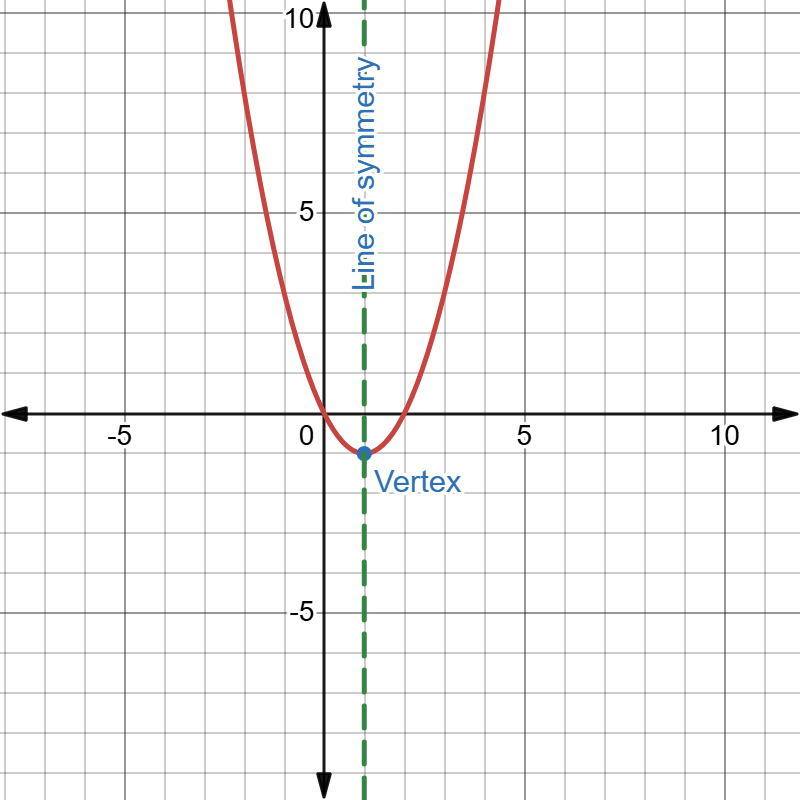
A parabola is a smooth, symmetric curve that looks like a U — or an upside-down U. It opens either upward or downward, and the two sides mirror each other perfectly.
The most important point on a parabola is its vertex — the very tip of the curve. If the parabola opens upward, the vertex is the lowest point. If it opens downward, the vertex is the highest point.
Running straight through the vertex is an invisible line called the axis of symmetry. It divides the parabola into two identical halves. If you were to fold the parabola along this line, both sides would match up exactly.
The Equation
Every parabola you'll work with in algebra comes from a quadratic equation — one where the highest power on \(x\) is 2. The standard form looks like this:
$$y = ax^2 + bx + c$$
The three constants \(a\), \(b\), and \(c\) each play a role:
\(a\) controls the shape and direction. This is the most important one. If \(a\) is positive, the parabola opens upward. If \(a\) is negative, it opens downward. The size of \(a\) controls how wide or narrow the curve is — a large value of \(|a|\) produces a narrow parabola, while a small value produces a wider one.
\(c\) is the y-intercept. When \(x = 0\), the equation becomes \(y = c\). So the parabola always crosses the y-axis at the point \((0, c)\).
\(b\) shifts the axis of symmetry left or right. On its own, \(b\) is harder to visualize, but it works together with \(a\) to position the vertex. The axis of symmetry is always at:
$$x = -\frac{b}{2a}$$
Key Properties
Vertex
The vertex is the turning point of the parabola. To find it, first find the axis of symmetry using \(x = -\frac{b}{2a}\), then plug that \(x\) value back into the equation to get the \(y\) coordinate.
For \(y = x^2 - 4x + 3\):
$$x = -\frac{-4}{2(1)} = \frac{4}{2} = 2$$
$$y = (2)^2 - 4(2) + 3 = 4 - 8 + 3 = -1$$
So the vertex is at \((2, -1)\). Since \(a = 1 > 0\), the parabola opens upward, meaning this is the minimum point.
Roots (x-intercepts)
Where does the parabola cross the x-axis? These points are called the roots or zeros of the equation. A parabola can cross the x-axis at two points, one point (if the vertex just touches it), or not at all.
To find the roots, set \(y = 0\) and solve. You can factor, complete the square, or use the quadratic formula.
Focus and Directrix
These are more advanced properties that come up in precalculus. Every parabola has a focus — a single point inside the curve — and a directrix — a line outside the curve running parallel to its opening. Every point on the parabola is exactly the same distance from the focus as it is from the directrix. This geometric definition is actually where the shape comes from, and it's why parabolic reflectors (like satellite dishes) work so well.
Vertex Form
Standard form \(y = ax^2 + bx + c\) tells you the y-intercept easily, but it makes the vertex harder to find. There's another way to write a parabola's equation called vertex form:
$$y = a(x - h)^2 + k$$
Here \((h, k)\) is the vertex — no calculation required. The \(a\) value works the same as before: positive means opens up, negative means opens down.
For example, \(y = 2(x - 3)^2 + 1\) is a parabola with vertex at \((3, 1)\), opening upward, narrower than \(y = x^2\).
Watch the sign: \(y = (x - 3)^2\) has vertex at \(x = 3\), not \(x = -3\). The subtraction inside the parentheses moves the vertex to the right.
Quick check: what is the vertex of \(y = -3(x + 1)^2 + 4\)? Show answerIt's in vertex form \(y = a(x - h)^2 + k\). Rewrite as \(y = -3(x - (-1))^2 + 4\), so the vertex is \((-1, 4)\). Since \(a = -3 < 0\), the parabola opens downward.
Parabolas in Real Life
Parabolas aren't just textbook shapes. They show up constantly in the physical world.
Projectile motion. When you throw a ball, shoot a basketball, or launch anything into the air (ignoring air resistance), it follows a parabolic path. Gravity pulls the object down at a constant rate, which produces that characteristic arc. The peak of the arc is the vertex.
Satellite dishes and telescopes. A parabolic dish reflects signals toward a single focal point — the focus of the parabola. Every signal coming in parallel to the axis hits the dish surface and bounces straight to the focus, which is where the receiver sits. This is why the shape works so perfectly.
Suspension bridges. The main cables of a suspension bridge hang in a curve that's approximately parabolic when the weight of the roadway is distributed evenly.
Car headlights. The reflector behind a headlight bulb is parabolic. The bulb sits at the focus, so light from it reflects off the dish in parallel beams — a focused, directed beam of light.
Worked Examples
Example 1: Find the vertex and direction of \(y = -2x^2 + 8x - 5\).
Since \(a = -2\), the parabola opens downward. The vertex will be a maximum.
Find the axis of symmetry: $$x = -\frac{b}{2a} = -\frac{8}{2(-2)} = -\frac{8}{-4} = 2$$
Find the y-coordinate of the vertex by substituting \(x = 2\): $$y = -2(2)^2 + 8(2) - 5 = -2(4) + 16 - 5 = -8 + 16 - 5 = 3$$
The vertex is at \((2, 3)\), and since the parabola opens downward, this is the highest point on the curve.
Example 2: Find where \(y = x^2 - x - 6\) crosses the x-axis.
Set \(y = 0\): $$x^2 - x - 6 = 0$$
Factor: $$(x - 3)(x + 2) = 0$$
So \(x = 3\) or \(x = -2\).
The parabola crosses the x-axis at \((3, 0)\) and \((-2, 0)\).
Example 3: A ball is thrown upward from the ground. Its height in feet after \(t\) seconds is given by \(h = -16t^2 + 64t\). When does it reach its peak, and how high does it go?
The equation is a downward-opening parabola (\(a = -16\)), so the vertex gives the maximum height.
$$t = -\frac{64}{2(-16)} = -\frac{64}{-32} = 2$$
The ball reaches its peak at \(t = 2\) seconds. Substitute back: $$h = -16(2)^2 + 64(2) = -16(4) + 128 = -64 + 128 = 64$$
The ball reaches a maximum height of 64 feet after 2 seconds.
Give These a Shot
-
Does \(y = 3x^2 - 6x + 1\) open upward or downward? Find the vertex. Show answerOpens upward (\(a = 3 > 0\)). Axis of symmetry: \(x = -\frac{-6}{2(3)} = 1\). Plug in: \(y = 3(1)^2 - 6(1) + 1 = -2\). Vertex: \((1, -2)\).
-
Find the x-intercepts of \(y = x^2 - 5x + 6\). Show answerSet \(y = 0\): \(x^2 - 5x + 6 = 0\). Factor: \((x-2)(x-3) = 0\). Roots at \(x = 2\) and \(x = 3\).
-
Write the vertex and direction of \(y = -(x + 2)^2 + 5\). Show answerVertex form shows vertex at \((-2, 5)\). Since \(a = -1 < 0\), it opens downward.
-
A parabola has equation \(y = 2x^2 - 4x - 6\). Find its roots. Show answerSet \(y = 0\): \(2x^2 - 4x - 6 = 0\). Divide by 2: \(x^2 - 2x - 3 = 0\). Factor: \((x-3)(x+1) = 0\). Roots at \(x = 3\) and \(x = -1\).
Diagrams created with Desmos Geometry.