
Slope of a Line
Slope measures how steep a line is. It tells you how much a line rises or falls as you move from left to right. If you've ever driven up a mountain road and seen a sign that says "6% grade," that's talking about slope—how much the road rises for every bit of horizontal distance you cover.
In algebra, slope is usually represented by the letter \(m\). A line with a larger absolute value of \(m\) is steeper. A line with \(m\) close to zero is nearly flat.
Rise Over Run
The most intuitive way to think about slope is "rise over run."
$$m = \frac{\text{rise}}{\text{run}}$$
Rise is the vertical change (how much you go up or down).
Run is the horizontal change (how much you go left or right).
To find the slope from a graph, pick two points on the line. Count how many units up or down you move (rise), then count how many units left or right you move (run). The slope is rise divided by run.
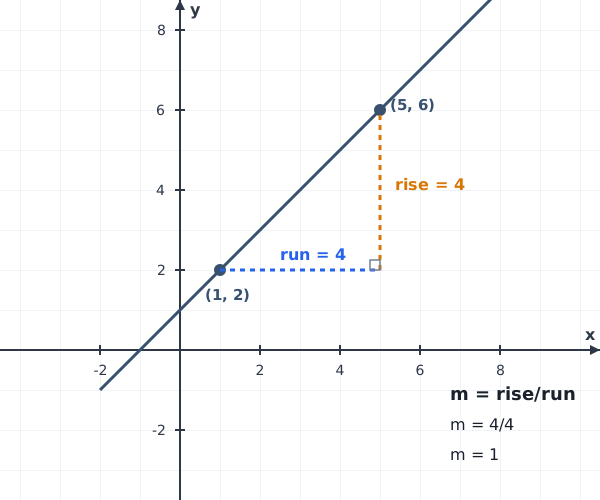
Example: A line passes through \((1, 2)\) and \((5, 6)\).
From \((1, 2)\) to \((5, 6)\), you rise 4 units (from \(y = 2\) to \(y = 6\)) and run 4 units to the right (from \(x = 1\) to \(x = 5\)).
$$m = \frac{4}{4} = 1$$
The slope is 1. This means for every 1 unit you move to the right, the line goes up 1 unit.
The Slope Formula
If you know the coordinates of two points, you can use the slope formula:
$$m = \frac{y_2 - y_1}{x_2 - x_1}$$
This formula is just rise over run written algebraically. The numerator \((y_2 - y_1)\) is the change in \(y\) (the rise), and the denominator \((x_2 - x_1)\) is the change in \(x\) (the run).
Example: Find the slope of the line through \((2, 3)\) and \((5, 11)\).
Let \((x_1, y_1) = (2, 3)\) and \((x_2, y_2) = (5, 11)\).
$$m = \frac{11 - 3}{5 - 2} = \frac{8}{3}$$
The slope is \(\frac{8}{3}\), which is about 2.67. This is a fairly steep upward line.
It doesn't matter which point you call "point 1" and which you call "point 2," as long as you're consistent with the order in both the numerator and denominator.
Example: Find the slope through \((4, 7)\) and \((1, 2)\).
$$m = \frac{2 - 7}{1 - 4} = \frac{-5}{-3} = \frac{5}{3}$$
We could also have done it the other way:
$$m = \frac{7 - 2}{4 - 1} = \frac{5}{3}$$
Same answer either way.
Positive, Negative, Zero, and Undefined Slope
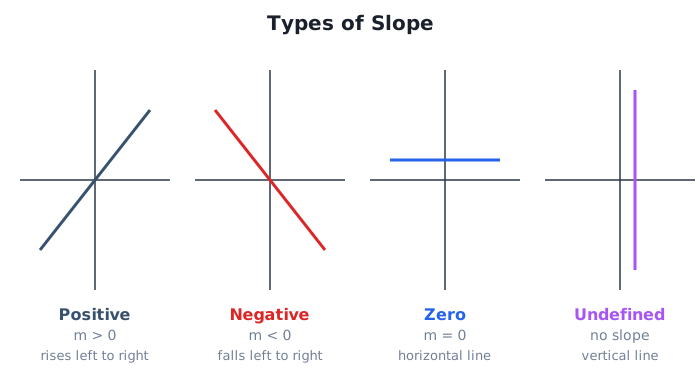
Positive slope: The line goes upward from left to right. As \(x\) increases, \(y\) increases. Example: a line through \((0, 0)\) and \((3, 4)\) has slope \(\frac{4}{3}\).
Negative slope: The line goes downward from left to right. As \(x\) increases, \(y\) decreases. Example: a line through \((0, 5)\) and \((2, 1)\) has slope \(\frac{1 - 5}{2 - 0} = \frac{-4}{2} = -2\).
Zero slope: The line is horizontal. It doesn't rise or fall at all. Example: the line \(y = 3\) has slope \(m = 0\) because it stays at \(y = 3\) no matter what \(x\) is.
Undefined slope: The line is vertical. It has no run—\(x\) doesn't change. Since you can't divide by zero, the slope is undefined. Example: the line \(x = 5\) has undefined slope.
Finding Slope from an Equation
If you have a linear equation in the form \(y = mx + b\), the coefficient of \(x\) is the slope.
Example: What is the slope of \(y = 3x - 7\)?
The slope is \(m = 3\).
Example: What is the slope of \(y = -\frac{1}{2}x + 4\)?
The slope is \(m = -\frac{1}{2}\).
If the equation isn't in this form, you can rearrange it or pick two points and use the slope formula.
Example: Find the slope of \(2x + 3y = 12\).
Method 1: Solve for \(y\). $$3y = -2x + 12$$ $$y = -\frac{2}{3}x + 4$$
The slope is \(-\frac{2}{3}\).
Method 2: Find two points and use the formula.
When \(x = 0\): \(3y = 12\), so \(y = 4\). Point: \((0, 4)\).
When \(x = 3\): \(2(3) + 3y = 12\), so \(6 + 3y = 12\), thus \(y = 2\). Point: \((3, 2)\).
$$m = \frac{2 - 4}{3 - 0} = \frac{-2}{3}$$
Same answer.
Parallel and Perpendicular Lines
Lines that are parallel have the same slope. If one line has slope 2, any line parallel to it also has slope 2.
Lines that are perpendicular have slopes that are negative reciprocals. If one line has slope \(m\), a perpendicular line has slope \(-\frac{1}{m}\).
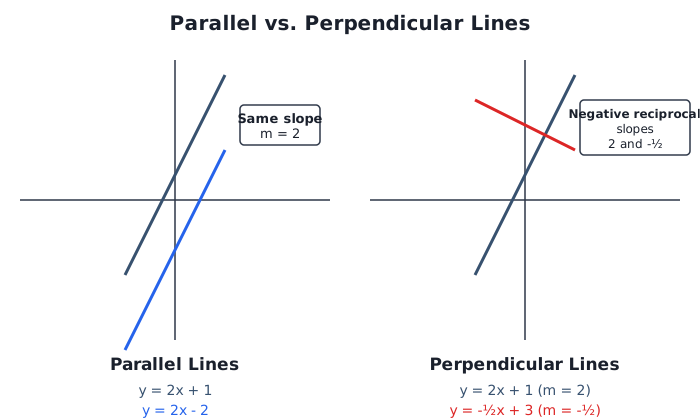
Example: Is the line \(y = 4x + 1\) parallel to \(y = 4x - 3\)?
Both have slope 4, so yes, they're parallel.
Example: What slope would make a line perpendicular to \(y = 2x + 5\)?
The original slope is 2. The negative reciprocal is \(-\frac{1}{2}\). So any line with slope \(-\frac{1}{2}\) is perpendicular to \(y = 2x + 5\).
Example: Are \(y = \frac{3}{4}x + 1\) and \(y = -\frac{4}{3}x - 2\) perpendicular?
The slopes are \(\frac{3}{4}\) and \(-\frac{4}{3}\). Check if they're negative reciprocals:
The negative reciprocal of \(\frac{3}{4}\) is \(-\frac{4}{3}\). Yes, they match! These lines are perpendicular.
Interpreting Slope in Context
Slope has meaning in real-world problems. It represents a rate of change.
Example: A car rental costs $30 plus $0.25 per mile. The equation is \(C = 0.25m + 30\), where \(C\) is cost and \(m\) is miles.
The slope is 0.25, which means the cost increases by $0.25 for each additional mile driven.
Example: Water drains from a tank at a constant rate. After 5 minutes, there are 40 gallons left. After 15 minutes, there are 20 gallons left.
$$m = \frac{20 - 40}{15 - 5} = \frac{-20}{10} = -2$$
The slope is -2, meaning the water level decreases by 2 gallons per minute.
Work Through These
-
Find the slope of the line through \((3, 4)\) and \((7, 10)\).
-
Find the slope of the line through \((-2, 5)\) and \((1, -1)\).
-
What is the slope of \(y = -5x + 3\)?
-
What is the slope of a horizontal line?
-
Find the slope of \(3x - y = 9\).
-
Are the lines \(y = 2x + 1\) and \(y = -\frac{1}{2}x + 4\) perpendicular?
Solutions:
-
\(m = \frac{10 - 4}{7 - 3} = \frac{6}{4} = \frac{3}{2}\)
-
\(m = \frac{-1 - 5}{1 - (-2)} = \frac{-6}{3} = -2\)
-
The slope is -5 (the coefficient of \(x\)).
-
Zero. Horizontal lines don't rise or fall.
-
Solve for \(y\): \(-y = -3x + 9\), so \(y = 3x - 9\). The slope is 3.
-
Yes. The slopes are 2 and \(-\frac{1}{2}\). The negative reciprocal of 2 is \(-\frac{1}{2}\), so they're perpendicular.
Pitfalls to Avoid
Subtracting in the wrong order is a classic mistake. In the slope formula, if you do \(y_2 - y_1\) in the numerator, you must do \(x_2 - x_1\) in the denominator. You can't switch which point is "first" halfway through—stay consistent.
Thinking horizontal lines have undefined slope is backwards. Horizontal lines have zero slope (they don't rise at all). Vertical lines have undefined slope (they don't run at all, so you'd be dividing by zero).
When finding negative reciprocals for perpendicular lines, don't forget that "negative" part. The reciprocal of 3 is \(\frac{1}{3}\), but the negative reciprocal is \(-\frac{1}{3}\). Both the flip AND the sign change matter.
Getting rise and run backwards happens surprisingly often. It's always \(\frac{\text{change in } y}{\text{change in } x}\)—vertical change over horizontal change. Rise first, run second.
Not simplifying your slope fractions looks sloppy. If you get \(\frac{6}{4}\), simplify it to \(\frac{3}{2}\) before you call it done.