
Congruent Triangles Are Identical in Size and Shape
Two triangles are congruent if they have the same size and shape — if you placed one on top of the other, every part would line up perfectly. The symbol for congruence is ≅.
When two triangles are congruent, every pair of corresponding parts is also congruent. That means:
- 3 pairs of corresponding sides are congruent
- 3 pairs of corresponding angles are congruent
In triangles ABC and DEF below, the hash marks on the sides and arcs on the angles show which parts correspond:
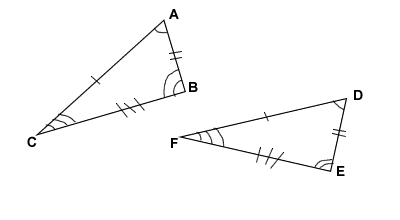
Written out, this means:
- AB ≅ DE
- BC ≅ EF
- AC ≅ DF
- ∠A ≅ ∠D
- ∠B ≅ ∠E
- ∠C ≅ ∠F
Proving Triangles Are Congruent
In a geometry proof, you don't need to show all six congruences — you just need enough information to know the triangles must match. There are five accepted methods:
SSS (Side-Side-Side) — If all three sides of one triangle are congruent to all three sides of another, the triangles are congruent.
SAS (Side-Angle-Side) — If two sides and the included angle (the angle between those two sides) are congruent to the corresponding parts of another triangle, the triangles are congruent.
ASA (Angle-Side-Angle) — If two angles and the included side are congruent to the corresponding parts of another triangle, the triangles are congruent.
AAS (Angle-Angle-Side) — If two angles and a non-included side are congruent to the corresponding parts of another triangle, the triangles are congruent.
HL (Hypotenuse-Leg) — Applies only to right triangles. If the hypotenuse and one leg of one right triangle are congruent to the corresponding parts of another right triangle, the triangles are congruent. (This is really just SSS in disguise, since the third side can be found from the other two using the Pythagorean theorem.)
Two Things That Don't Work
AAA — Three equal angles only proves the triangles have the same shape, not the same size. You can draw two equilateral triangles with different side lengths — they have the same angles but are not congruent.
SSA (or ASS) — Two sides and a non-included angle is not enough. It's possible to construct two non-congruent triangles that both satisfy the same SSA conditions, so this method doesn't guarantee congruence.
Example A
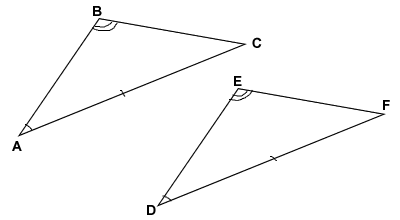
From the diagram, we know:
- ∠A ≅ ∠D
- ∠B ≅ ∠E
- side AC ≅ side DF
Two angles and a non-included side — that's AAS. Conclusion: △ABC ≅ △DEF by AAS.
Example B
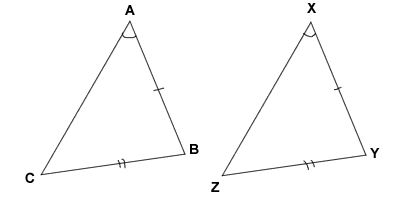
The diagram shows one angle and two sides congruent. That's SSA — and as noted above, SSA is not a valid congruence method. We cannot conclude the triangles are congruent. They might be, but the given information isn't enough to prove it.