
The Coordinate Plane
If you've ever used a map to find a location, you've used something similar to the coordinate plane. Just like a map uses coordinates to pinpoint a spot, the coordinate plane uses two numbers to identify any point in two-dimensional space.
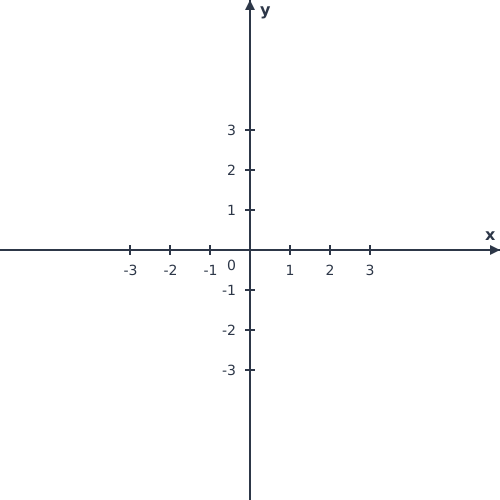
The coordinate plane (also called the Cartesian plane, named after mathematician René Descartes) is formed by two perpendicular number lines. The horizontal line is the \(x\)-axis, and the vertical line is the \(y\)-axis. Where they cross is called the origin, and it's labeled with the coordinates \((0, 0)\).
Ordered Pairs
Every point on the coordinate plane can be described by an ordered pair \((x, y)\). The first number is the \(x\)-coordinate, which tells you how far to move left or right from the origin. The second number is the \(y\)-coordinate, which tells you how far to move up or down.
The word "ordered" is important. The point \((3, 2)\) is not the same as the point \((2, 3)\). The order matters.
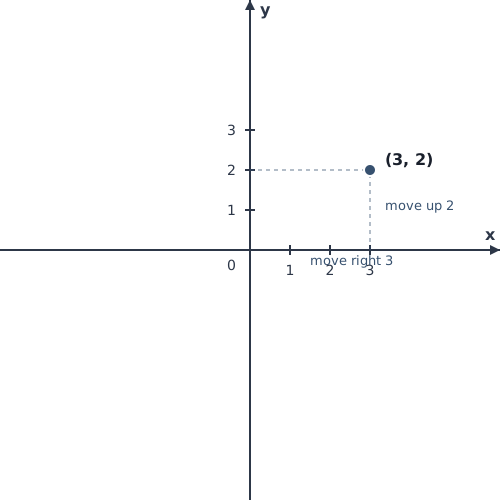
Example: Plot the point \((3, 2)\).
Start at the origin \((0, 0)\). Move 3 units to the right (because the \(x\)-coordinate is positive 3). Then move 2 units up (because the \(y\)-coordinate is positive 2). Put a dot there. That's the point \((3, 2)\).
Example: Plot the point \((-3, 5)\).
Start at the origin. Move 3 units to the left (because the \(x\)-coordinate is -3). Then move 5 units up (because the \(y\)-coordinate is positive 5). That's your point.
Example: Plot the point \((2, -4)\).
From the origin, move 2 units right, then 4 units down (because the \(y\)-coordinate is -4).
The Four Quadrants
The coordinate plane is divided into four sections called quadrants. They're numbered using Roman numerals, starting in the upper-right and going counterclockwise.
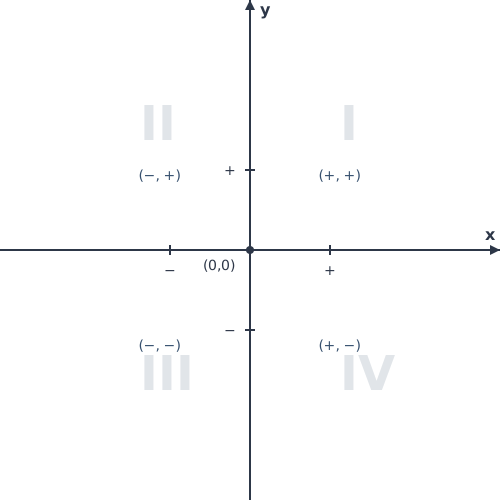
Quadrant I (top right): Both \(x\) and \(y\) are positive. Example: \((3, 5)\)
Quadrant II (top left): \(x\) is negative, \(y\) is positive. Example: \((-4, 2)\)
Quadrant III (bottom left): Both \(x\) and \(y\) are negative. Example: \((-6, -3)\)
Quadrant IV (bottom right): \(x\) is positive, \(y\) is negative. Example: \((5, -7)\)
Points that lie exactly on the \(x\)-axis or \(y\)-axis are not in any quadrant.
Special Points on the Axes
If a point has an \(x\)-coordinate of 0, it lies on the \(y\)-axis. For example, \((0, 5)\) is on the \(y\)-axis, 5 units above the origin.
If a point has a \(y\)-coordinate of 0, it lies on the \(x\)-axis. For example, \((-3, 0)\) is on the \(x\)-axis, 3 units to the left of the origin.
The origin itself, \((0, 0)\), is where the axes intersect.
Reading Coordinates from a Graph
If you're given a graph with a point plotted on it, you can find its coordinates by seeing how far it is from the origin in each direction.
Look at how far the point is from the \(y\)-axis to find the \(x\)-coordinate. If it's to the right of the \(y\)-axis, the \(x\)-coordinate is positive. If it's to the left, it's negative.
Look at how far the point is from the \(x\)-axis to find the \(y\)-coordinate. If it's above the \(x\)-axis, the \(y\)-coordinate is positive. If it's below, it's negative.
Example: A point is 3 units to the left of the origin and 2 units up. What are its coordinates? Show answerLeft means negative \(x\), and up means positive \(y\). The point is \((-3, 2)\).
Why the Coordinate Plane Matters
The coordinate plane is the foundation for graphing equations, which you'll do constantly in algebra and beyond. When you graph a linear equation like \(y = 2x + 1\), you're plotting points on the coordinate plane and connecting them to show the relationship between \(x\) and \(y\).
The coordinate plane also shows up in real life. Maps use coordinate systems (latitude and longitude). Video games use coordinates to track where characters are on the screen. Architects use coordinates to design buildings. GPS uses a three-dimensional version to pinpoint locations on Earth.
Symmetry and Reflections
The coordinate plane has some interesting symmetry properties.
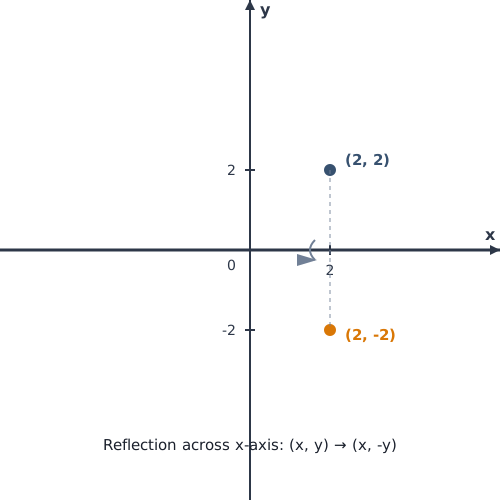
If you take a point \((x, y)\) and reflect it across the \(x\)-axis, you get the point \((x, -y)\). The \(x\)-coordinate stays the same, but the \(y\)-coordinate changes sign.
Example: The point \((2, 2)\) reflected across the \(x\)-axis becomes \((2, -2)\).
If you reflect a point across the \(y\)-axis, you get \((-x, y)\). The \(y\)-coordinate stays the same, but the \(x\)-coordinate changes sign.
Example: The point \((5, -2)\) reflected across the \(y\)-axis becomes \((-5, -2)\).
If you reflect a point through the origin (rotate it 180 degrees around the origin), both coordinates change sign: \((x, y)\) becomes \((-x, -y)\).
Example: The point \((2, 3)\) reflected through the origin becomes \((-2, -3)\).
Practice Problems
-
Plot the following points on a coordinate plane: \((2, 3)\), \((-4, 1)\), \((0, -3)\), \((3, -2)\) Show answer\((2, 3)\) is in Quadrant I. \((-4, 1)\) is in Quadrant II. \((0, -3)\) is on the \(y\)-axis. \((3, -2)\) is in Quadrant IV.
-
In which quadrant is each point located?
- \((-5, 6)\) Show answerQuadrant II (negative \(x\), positive \(y\))
- \((4, -7)\) Show answerQuadrant IV (positive \(x\), negative \(y\))
- \((-2, -3)\) Show answerQuadrant III (both negative)
- \((8, 1)\) Show answerQuadrant I (both positive)
-
What is the reflection of \((6, -4)\) across the \(x\)-axis? Show answer\((6, 4)\) — the \(x\)-coordinate stays the same, the \(y\)-coordinate changes sign.
-
What is the reflection of \((-3, 5)\) across the \(y\)-axis? Show answer\((3, 5)\) — the \(y\)-coordinate stays the same, the \(x\)-coordinate changes sign.
-
A point is 7 units to the right of the origin and 2 units down. What are its coordinates? Show answer\((7, -2)\) — right means positive \(x\), down means negative \(y\).
-
If a point is in Quadrant III, what can you say about its coordinates? Show answerBoth coordinates are negative.
What's Next?
A few patterns to keep in mind as you practice. The order of coordinates matters: \(x\) comes first, \(y\) second (they're in alphabetical order). The \(x\)-coordinate controls horizontal movement; the \(y\)-coordinate controls vertical movement. Negative \(x\) means left, negative \(y\) means down. When reflecting across the \(x\)-axis, only the \(y\)-coordinate flips sign — and vice versa. And points sitting exactly on either axis aren't in any quadrant: if either coordinate is 0, the point lives on an axis.
Next stop: graphing linear equations, where the same coordinate system gets used to draw lines from equations like \(y = 2x + 1\).