Hi there
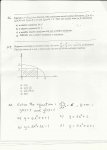
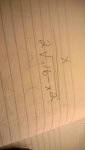
Thanks for your help and being patient. I reviewed the critical values and it simply said to set the derivative function to zero. Which I did and concluded that answer b must be correct. However, to be honest I used a derivative calculator. So at this point obviously my problem is that I am not doing derivations correctly because my result looked absolutely nothing like what was displayed as the correct one. When you get a chance, would you mind getting me started on the first few steps of the d/dx so I can try it and then upload that much and see if it looks right to you?
I am going to go all the way back to the beginning.
Name your variables
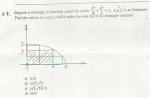
area of rectangle = xy. What is to be maximized is a.
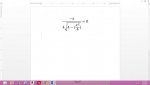
Write down your constraints: \(\displaystyle \dfrac{x^2}{16} + \dfrac{y^2}{4} = 1,\ x \ge 0, y \ge 0.\)
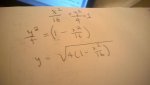
\(\displaystyle But\ y \ge 0 \implies y = 0.5\sqrt{16 - x^2} \implies A = 0.5x\sqrt{16 - x^2}.\) You eventually got here.
So far this is all preliminary algebra.
Now I would use substitution, the multiplication rule, the power rule, and the chain rule. I am aiming for something like a = uw that's simple to work with.
\(\displaystyle u = 0.5x \implies \dfrac{du}{dx} = what?\) First substitution and multiplication rule.
\(\displaystyle v = 16 - x^2 \implies \dfrac{dv}{dx} = what?\) Second substitution and power rule.
\(\displaystyle w = \sqrt{v} = v^{(1/2)} \implies \dfrac{dw}{dv} = what? \implies \dfrac{dw}{dx} = what?\)
Third substitution, power rule, and chain rule
\(\displaystyle And\ a = uw \implies \dfrac{da}{dx} = what?\) Multiplication and chain rules
You can do all this in one fell swoop without any substitutions, but, until you get experience, I suggest breaking it up into pieces like this. It is a bit complex to figure out what the pieces should be, but each one should be easy to work with.
Once you have \(\displaystyle \dfrac{da}{dx}\), set it equal to zero and solve for x, remembering that \(\displaystyle x \ge 0\).
Once you know x, you can compute y.
Give it a try