
Solving and Graphing Inequalities
Not every mathematical statement uses an equals sign. Sometimes we need to express that one quantity is greater than or less than another. That's where inequalities come in. An inequality compares two expressions and tells us about their relative size, not their exact value.
The symbols you'll use are:
- \(<\) means "less than"
- \(>\) means "greater than"
- \(\leq\) means "less than or equal to"
- \(\geq\) means "greater than or equal to"
When you solve an inequality, you're finding all the values that make the inequality true. Unlike an equation, which usually has one solution, an inequality typically has infinitely many solutions.
Reading Inequality Symbols
Think of the inequality symbol as an alligator's mouth that always wants to eat the bigger number.
The statement \(x > 3\) means "\(x\) is greater than 3." The mouth is open toward \(x\), showing that \(x\) is the larger value. So \(x\) could be 4, 5, 100, or any number greater than 3.
The statement \(x \leq 7\) means "\(x\) is less than or equal to 7." Here, \(x\) could be 7, 6, 0, -10, or any number that's either equal to 7 or smaller than 7.
Solving Inequalities: Almost Like Equations
Solving inequalities works almost exactly like solving equations. You can add, subtract, multiply, or divide both sides by the same number to isolate the variable. The goal is to get the variable alone on one side.
Example: Solve \(x + 5 > 12\).
Subtract 5 from both sides: $$x > 7$$
That's the solution. Any number greater than 7 makes this inequality true. We could check: if \(x = 8\), then \(8 + 5 = 13\), and yes, \(13 > 12\).
Example: Solve \(3y \leq 15\).
Divide both sides by 3: $$y \leq 5$$
Any number less than or equal to 5 works. If \(y = 5\), then \(3(5) = 15\), and \(15 \leq 15\) is true (since the symbol includes "equal to").
Example: Solve \(\frac{n}{4} > 2\).
Multiply both sides by 4: $$n > 8$$
The Special Rule: Multiplying or Dividing by Negatives
Here's where inequalities differ from equations in an important way. When you multiply or divide both sides by a negative number, you must flip the inequality symbol.
Why? Think about it with concrete numbers. We know that \(3 < 5\) is true. Now multiply both sides by -1. We get \(-3\) and \(-5\). But \(-3\) is actually greater than \(-5\) (remember, \(-3\) is closer to zero). So the inequality flips: \(-3 > -5\).
Example: Solve \(-2x < 10\).
Divide both sides by -2. Since we're dividing by a negative, flip the inequality: $$x > -5$$
Check this with a number: if \(x = 0\), then \(-2(0) = 0\), and \(0 < 10\) is true. If \(x = -6\) (which doesn't satisfy \(x > -5\)), then \(-2(-6) = 12\), and \(12 < 10\) is false. The solution \(x > -5\) is correct.
Example: Solve \(-\frac{x}{3} \geq 4\).
Multiply both sides by -3 and flip the inequality: $$x \leq -12$$
Multi-Step Inequalities
Just like with equations, you might need to do several steps to solve an inequality.
Example: Solve \(2x - 7 < 5\).
Add 7 to both sides: $$2x < 12$$
Divide by 2: $$x < 6$$
Example: Solve \(-3y + 5 \geq 14\).
Subtract 5 from both sides: $$-3y \geq 9$$
Divide by -3 and flip the inequality: $$y \leq -3$$
Example: Solve \(4(m + 3) > 20\).
Distribute the 4: $$4m + 12 > 20$$
Subtract 12: $$4m > 8$$
Divide by 4: $$m > 2$$
Graphing Inequalities on a Number Line
Once you've solved an inequality, you can represent the solution visually on a number line.
For \(x > 3\), you draw a number line, put an open circle at 3 (because 3 itself is not included), and shade everything to the right.

For \(x \leq -2\), you put a closed circle at -2 (because -2 is included) and shade to the left.

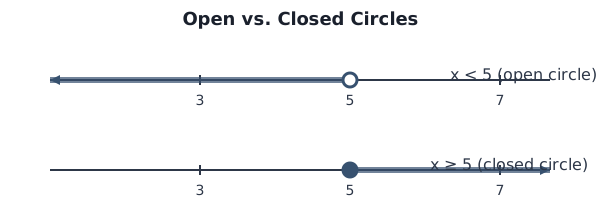
Think of the open circle as saying "everything up to but not including this point" and the closed circle as "everything including this point."
Open vs. Closed Circles
The difference between \(<\) and \(\leq\) (or between \(>\) and \(\geq\)) is whether the endpoint is included:
Example: Graph \(x \geq -1\).
Draw a number line. Put a closed circle (or filled dot) at -1. Shade to the right, showing all numbers greater than or equal to -1.

Example: Graph \(y < 4\).
Draw a number line. Put an open circle at 4. Shade to the left, showing all numbers less than 4.

Inequalities with Variables on Both Sides
Just like equations, you can have the variable appear on both sides of an inequality.
Example: Solve \(5x - 3 > 2x + 9\).
Subtract \(2x\) from both sides: $$3x - 3 > 9$$
Add 3: $$3x > 12$$
Divide by 3: $$x > 4$$
Example: Solve \(7 - 2y \leq 3y + 17\).
Add \(2y\) to both sides: $$7 \leq 5y + 17$$
Subtract 17: $$-10 \leq 5y$$
Divide by 5: $$-2 \leq y$$
This can also be written as \(y \geq -2\) (same thing, just reversed).
Practice Problems
- Solve and graph: \(x + 4 < 9\)
- Solve and graph: \(3y \geq -12\)
- Solve: \(-5m > 20\)
- Solve: \(2a - 8 \leq 6\)
- Solve: \(-4x + 3 > 15\)
- Solve: \(5p - 2 \geq 3p + 8\)
Solutions:
- \(x < 5\) — Graph: open circle at 5, shade left
- \(y \geq -4\) — Graph: closed circle at -4, shade right
- Divide by -5, flip sign: \(m < -4\)
- Add 8: \(2a \leq 14\), divide by 2: \(a \leq 7\)
- Subtract 3: \(-4x > 12\), divide by -4, flip: \(x < -3\)
- Subtract \(3p\): \(2p - 2 \geq 8\), add 2: \(2p \geq 10\), divide by 2: \(p \geq 5\)
Common Mistakes
The biggest mistake is forgetting to flip the inequality when multiplying or dividing by a negative. This is easy to miss, so always pause and check: "Am I dividing or multiplying by a negative? If so, flip the sign."
Graphing with the wrong type of circle happens often. Remember: \(<\) and \(>\) use open circles. \(\leq\) and \(\geq\) use closed circles.
Shading the wrong direction is another common error. After solving, think about what the solution means. If \(x > 5\), you want all numbers bigger than 5, so shade to the right.
Not simplifying before solving can make the problem unnecessarily complicated. If you have \(3x + 2x - 5 > 10\), combine the \(x\) terms first: \(5x - 5 > 10\).