
Special Pairs of Angles
When two angles have a specific relationship with each other, knowing one tells you something about the other. Three of these relationships come up constantly in geometry.
Complementary Angles
Two angles are complementary if their measures add up to 90°. You'll often see complementary angles in right triangles or at a corner where a line meets a perpendicular.
Example: Two complementary angles are in the ratio 1 : 14. Find each angle.
Let the angles be \(x\) and \(14x\). They sum to 90°:
$$x + 14x = 90$$ $$15x = 90$$ $$x = 6$$
The smaller angle is 6°, and the larger is \(14 \times 6 = 84°\). Check: \(6 + 84 = 90°\). ✓
Supplementary Angles
Two angles are supplementary if their measures add up to 180°. You'll see supplementary pairs whenever a line is divided by a ray — the two angles on either side form a straight line and must sum to 180°.
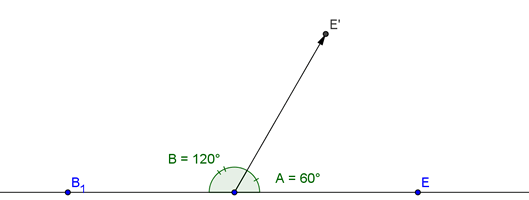
Example: An angle is 30° greater than twice its supplementary angle. Find the angle.
Let \(d\) = the angle. Its supplement is \(180 - d\). The problem says:
$$d = 2(180 - d) + 30$$ $$d = 360 - 2d + 30$$ $$3d = 390$$ $$d = 130°$$
Check: the supplement is \(180 - 130 = 50°\), and \(2(50) + 30 = 130°\). ✓
Vertical Angles
When two lines cross, they form four angles. The angles across from each other — the ones that share only the intersection point, not a side — are called vertical angles, and they are always equal.
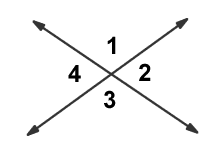
In the diagram, angles 1 and 3 are vertical angles, as are angles 2 and 4. Notice also that angles 1 and 2 are supplementary (they're side by side on a straight line), and so are every other adjacent pair.
Example: If ∠1 = 80°, then ∠3 = 80° (vertical angles). Since ∠1 and ∠2 are supplementary, ∠2 = 100°, and therefore ∠4 = 100° (vertical angles).
The four angles will always come in two pairs: the two vertical pairs add up to the full 360° around the intersection point.
What if the angles have variable expressions? If ∠2 = \(x + 4\), then ∠4 = \(x + 4\) as well — because vertical angles are equal, you can just copy the expression. No solving needed unless the problem asks for the actual degree measure.