
Rectangles, Rhombuses, and Squares
All the properties of parallelograms apply to rectangles, rhombuses, and squares. But each of these figures has additional properties that make them more specialized.
Rectangle
A rectangle is a parallelogram with four right angles. Its special properties:
- All rules of a parallelogram apply
- All four angles are 90°
- The diagonals are congruent (equal in length)
- The diagonals bisect each other
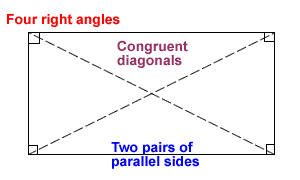
Example: In rectangle ABCD, diagonals AC and BD intersect at point R. AR = \(2x - 6\) and CR = \(x + 10\). Find BD.
Since the diagonals bisect each other, AR = CR:
$$2x - 6 = x + 10$$ $$x = 16$$
So AR = \(2(16) - 6 = 26\). Since R is the midpoint of both diagonals, CR = 26 as well — meaning the full diagonal AC = 52. And since the diagonals of a rectangle are equal in length, BD = 52.
Rhombus
A rhombus is a parallelogram with four congruent sides. Its special properties:
- All rules of a parallelogram apply
- All four sides are equal in length
- The diagonals intersect at right angles (they are perpendicular)
- Each diagonal bisects the vertex angles it passes through
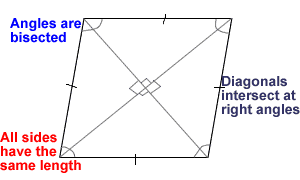
Example: ABCD is a rhombus and ∠D = 60°. Find ∠A and ∠B.
In a rhombus, opposite angles are equal, so ∠B = ∠D = 60°.
Consecutive angles are supplementary:
$$\angle A = 180 - 60 = 120°$$
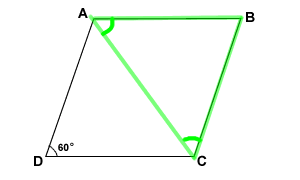
You can also verify with the triangle formed by the diagonal. In triangle AEB (where E is the intersection of the diagonals), the diagonals are perpendicular so ∠AEB = 90°. Since the diagonal bisects ∠B, we have ∠ABE = 30°. Then:
$$\angle A \text{ (half)} = 180 - 90 - 30 = 60°$$
So the full ∠A = 2 × 60 = 120°. ✓
Square
A square is a parallelogram that is both a rectangle and a rhombus — it has four right angles and four equal sides.
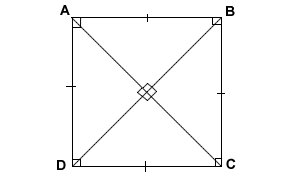
Example: In square ABCD, AB = \(x + 4\). Find the perimeter.
All four sides are equal, so:
$$P = 4s = 4(x + 4) = 4x + 16$$
How They Relate
Every square is a rectangle and a rhombus. Every rectangle and rhombus is a parallelogram. But a rectangle is not necessarily a rhombus (unless it's also a square), and vice versa.