
Properties of Trapezoids
A trapezoid is a quadrilateral with exactly one pair of parallel sides. The two parallel sides are called the bases, and the two non-parallel sides are called the legs.
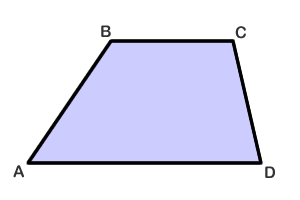
Angle Properties
Like any quadrilateral, the four angles of a trapezoid sum to 360°. What makes trapezoids interesting is how the base angles relate to each other.
Because the bases are parallel, each leg acts like a transversal cutting across them. That makes the angles at each end of a leg co-interior angles (also called same-side interior angles), which means they are supplementary — they add up to 180°.
In trapezoid ABCD with AB ∥ CD:
$$\angle A + \angle B = 180°$$ $$\angle C + \angle D = 180°$$
Isosceles Trapezoids
A trapezoid is isosceles if its legs are equal in length. This one additional condition creates some nice symmetry:
- The two base angles on the bottom are equal to each other
- The two base angles on the top are equal to each other
- The diagonals have the same length
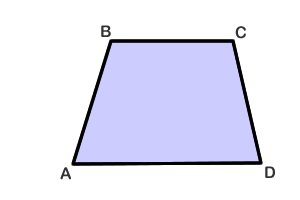
In other words, for isosceles trapezoid ABCD with AB ∥ CD:
$$\angle A = \angle B \quad \text{and} \quad \angle C = \angle D$$
Example
In isosceles trapezoid MATH, side HT ∥ side MA, and MH ≅ AT (the legs are equal). The measure of ∠MHT = 60°. Find the other three angles.
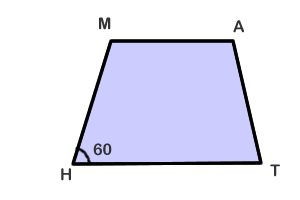
Since the trapezoid is isosceles, the two base angles at H and T are equal:
$$\angle T = 60°$$
Now use the supplementary property. The angle at M is supplementary to angle H (they're on the same leg):
$$\angle M = 180 - 60 = 120°$$
By the same logic, ∠A = 120°. You can verify: \(60 + 60 + 120 + 120 = 360°\). ✓