
Properties of a 30-60-90 Right Triangle
A 30-60-90 triangle is a special right triangle where the three angles measure 30°, 60°, and 90°. What makes it special is that the side lengths always exist in a fixed ratio, so if you know any one side you can find the other two without using trigonometry.
That ratio is \(1 : \sqrt{3} : 2\), where:
- The shortest side (opposite the 30° angle) has length 1
- The longer leg (opposite the 60° angle) is \(\sqrt{3}\) times the shortest side
- The hypotenuse (opposite the 90° angle) is twice the shortest side
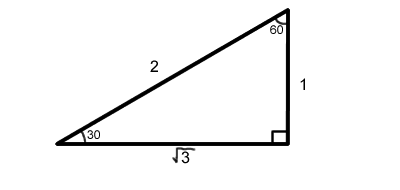
A good way to remember it: the hypotenuse is always double the short side. Once you know those two, the remaining side is just the short side times \(\sqrt{3}\).
Example 1
Find the lengths of the missing sides in the triangle below.
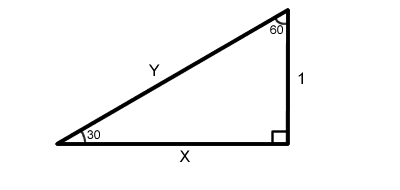
The short side is 1 and it's opposite the 30° angle, so we're working directly with the base ratio. Side X is opposite the 60° angle, so it equals \(1 \times \sqrt{3} \approx 1.73\). Side Y is the hypotenuse, opposite the 90° angle, so it equals \(1 \times 2 = 2\).
Example 2
Now find the unknown sides X and Y in this triangle.
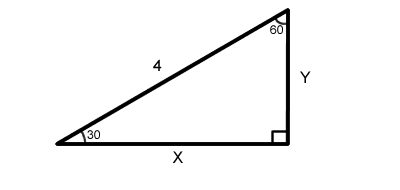
This time the known side is 4, and it's the longest side — the hypotenuse. Since the hypotenuse is always twice the shortest side, Y (the short side) must be \(4 \div 2 = 2\).
Now that we know the short side, the remaining leg X is opposite the 60° angle, so \(X = 2\sqrt{3}\).
Where Does the Ratio Come From?
This isn't an arbitrary formula — it comes directly from trigonometry. The sine of 30° is exactly \(\frac{1}{2}\), which means the ratio of the opposite side to the hypotenuse is always 1 to 2. The cosine of 30° is \(\frac{\sqrt{3}}{2}\), which gives the relationship between the longer leg and the hypotenuse. The 30-60-90 triangle is easy to work with precisely because the sine and cosine of those angles work out to such clean values.
Give These a Try
1. A 30-60-90 triangle has a hypotenuse of 10. Find the lengths of the other two sides.
2. The longer leg of a 30-60-90 triangle is \(3\sqrt{3}\). Find the hypotenuse and the shorter leg.
Answers:
1. The short side is half the hypotenuse: \(10 \div 2 = 5\). The longer leg is \(5\sqrt{3}\).
2. The longer leg equals the short side times \(\sqrt{3}\), so the short side is \(3\sqrt{3} \div \sqrt{3} = 3\). The hypotenuse is \(3 \times 2 = 6\).