
Exterior Angles of a Triangle
At each vertex of a triangle, you can extend one side outward to form an angle on the outside of the triangle. That angle is called an exterior angle.
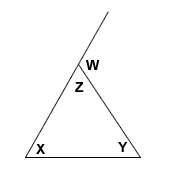
Why the Exterior Angle Equals the Two Remote Interior Angles
Let the three interior angles of a triangle be \(x\), \(y\), and \(z\), and let \(w\) be the exterior angle formed at the vertex of angle \(z\).
We know two things:
$$x + y + z = 180 \quad \text{(angles of a triangle)}$$ $$w + z = 180 \quad \text{(supplementary angles on a straight line)}$$
Both expressions equal 180, so we can set them equal to each other:
$$x + y + z = w + z$$
Subtract \(z\) from both sides:
$$x + y = w$$
This result is the Exterior Angle Theorem: the measure of an exterior angle of a triangle equals the sum of the two remote interior angles — that is, the two interior angles that are not adjacent to it.
Example A
The exterior angle measures \((3x - 10)°\), and the two remote interior angles measure 25° and \((x + 15)°\). Find \(x\), then find all three angle measures.
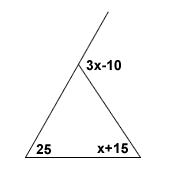
Using the theorem:
$$3x - 10 = 25 + (x + 15)$$ $$3x - 10 = x + 40$$ $$2x = 50$$ $$x = 25$$
Plugging back in: the exterior angle is \(3(25) - 10 = 65°\), and the two remote interior angles are 25° and \(25 + 15 = 40°\). Check: \(25 + 40 = 65\). ✓
Example B
The exterior angle is 110°. One remote interior angle is 50°, and the other is \((2x + 30)°\). Find \(x\).
$$110 = 50 + (2x + 30)$$ $$110 = 2x + 80$$ $$30 = 2x$$ $$x = 15$$
The second interior angle is \(2(15) + 30 = 60°\). Check: \(50 + 60 = 110\). ✓
A Quick Shortcut
Once you know the theorem, these problems become fast: just set the exterior angle equal to the sum of the two angles across from it, and solve. You don't need to involve 180° at all unless the problem is giving you supplementary angle information instead.