Geometry Terms You Need to Know
Geometry has its own vocabulary, and not knowing these terms is one of the most common reasons students get lost early on. Here are the definitions you'll encounter most in a first geometry course.
Angles
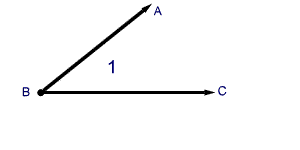
Two rays that share the same endpoint form an angle. The shared endpoint is called the vertex of the angle. The symbol for angle is ∠.
Angles are named in three ways:
- Three capital letters — the middle letter is always the vertex. For example, ∠ABC or ∠DEF. These are read "angle ABC" and "angle DEF."
- Just the vertex — if there's only one angle at that vertex, you can call ∠ABC simply "angle B."
- A number or label — angles are often labeled 1, 2, 3, etc. when you need to refer to several of them in a diagram.
The degree measure of an angle describes the amount of rotation from one ray to the other. A full rotation is 360°; a right angle is a quarter rotation, or 90°.
Lines, Rays, and Segments
A line is infinite in both directions. In practice, you can't draw a true line — anything you draw is a line segment, which is the portion of a line between two endpoints.
A ray starts at one endpoint and extends infinitely in one direction. The sides of an angle are rays.
Postulates and Theorems
As you move further into geometry, you'll encounter two important types of statements:
A postulate is a statement assumed to be true without requiring proof. Postulates are the starting assumptions that geometry is built on.
A theorem is a statement that has been proved to be true using postulates and previously established results.
Perpendicular Lines
Two lines are perpendicular if they meet to form a right angle (90°). The symbol for perpendicular is ⊥. You'd write "line AB ⊥ line CD" to say those two lines are perpendicular.
Adjacent Angles
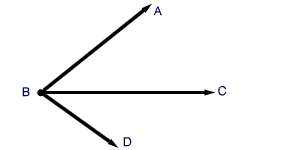
Two angles are adjacent if they share the same vertex, share one side, and don't overlap. Think of a doorway opening — the angle the door sweeps through and the remaining angle in the room are adjacent.
Congruent Segments and Angles
When two segments have the same length, they are congruent. When two angles have the same measure, they are congruent. The symbol for congruence is ≅.
So if line segment AB = 10 and line segment CD = 10, we write AB ≅ CD.
Congruent does not just mean "equal in measure" — it means the two figures are identical in form, so they could be placed on top of each other perfectly.
Midpoint
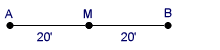
The midpoint of a line segment is the point that divides it into two equal halves. If M is the midpoint of segment AB, then AM = MB.
Any line or segment that passes through the midpoint of a segment bisects it — cuts it into two equal parts.