
Interior Angles of a Polygon
The interior angles of a polygon are the angles formed on the inside at each vertex. A square has four of them, each measuring 90°. A triangle has three, summing to 180°.
There's a formula that works for any polygon. If a polygon has \(n\) sides, the sum \(S\) of its interior angles is:
$$S = (n - 2) \cdot 180$$
Why \(n - 2\)? Because any polygon can be divided into triangles by drawing diagonals from one vertex, and the number of triangles formed is always two fewer than the number of sides. Each triangle contributes 180° to the total.
Finding Angles from a Ratio
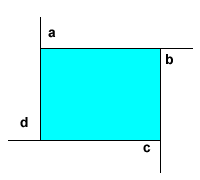
Example 1: Quadrilateral ABCD has four angles in the ratio 2 : 3 : 3 : 4. Find the largest angle.
A quadrilateral has \(n = 4\) sides, so the angle sum is \((4 - 2)(180) = 360°\). Let the angles be \(2x\), \(3x\), \(3x\), and \(4x\):
$$2x + 3x + 3x + 4x = 360$$ $$12x = 360$$ $$x = 30$$
The largest angle is \(4 \times 30 = 120°\). The others are 90°, 90°, and 60°.
Regular Polygons
A regular polygon is both equilateral (all sides equal) and equiangular (all angles equal). A square is a regular polygon. A regular hexagon has six equal sides and six equal angles.
Example 2: Find the sum of interior angles of a hexagon. If it's regular, find each angle.
$$S = (6 - 2)(180) = 4 \times 180 = 720°$$
In a regular hexagon, all six angles share that 720° equally: \(720 \div 6 = 120°\) per angle.
Working Backward: Finding the Number of Sides
Example 3: The sum of the interior angles of a polygon is 3600°. How many sides does it have?
Use the formula and solve for \(n\):
$$3600 = (n - 2)(180)$$ $$3600 = 180n - 360$$ $$3960 = 180n$$ $$n = 22$$
A 22-sided polygon.
Exterior Angles
At each vertex, you can draw an exterior angle by extending one side of the polygon. The interior and exterior angles at any vertex are supplementary — they add up to 180°.
For a regular polygon, all exterior angles are equal. There's a clean formula: each exterior angle = \(\frac{360}{n}\).
Example 4: Find each interior and exterior angle of a regular hexagon.
We already found each interior angle is 120°. The exterior angle is simply \(180 - 120 = 60°\). Or using the formula: \(\frac{360}{6} = 60°\). Both give the same answer.
Example 5: Each interior angle of a regular polygon measures 150°. How many sides does it have?
If the interior angle is 150°, the exterior angle is \(180 - 150 = 30°\). Using the exterior angle formula:
$$30 = \frac{360}{n}$$ $$n = \frac{360}{30} = 12$$
A 12-sided polygon — a dodecagon.