
The Four Kinematic Equations
Most introductory physics problems about motion involve an object moving with constant acceleration — a car braking steadily, a ball rolling down a smooth ramp, a rock falling under gravity. Four equations describe this kind of motion, and most of the work in solving a problem is recognizing which one fits.
This lesson lists the four equations, names every variable, and walks through a strategy for picking the right one based on what the problem gives you and what it asks for.
The Five Variables
Every constant-acceleration problem involves at most five quantities:
| Symbol | Meaning | Typical units |
|---|---|---|
| \(v_0\) | initial velocity (at \(t = 0\)) | m/s |
| \(v\) | final velocity (at time \(t\)) | m/s |
| \(a\) | acceleration (constant) | m/s² |
| \(t\) | elapsed time | s |
| \(\Delta x\) | displacement (how far it moved) | m |
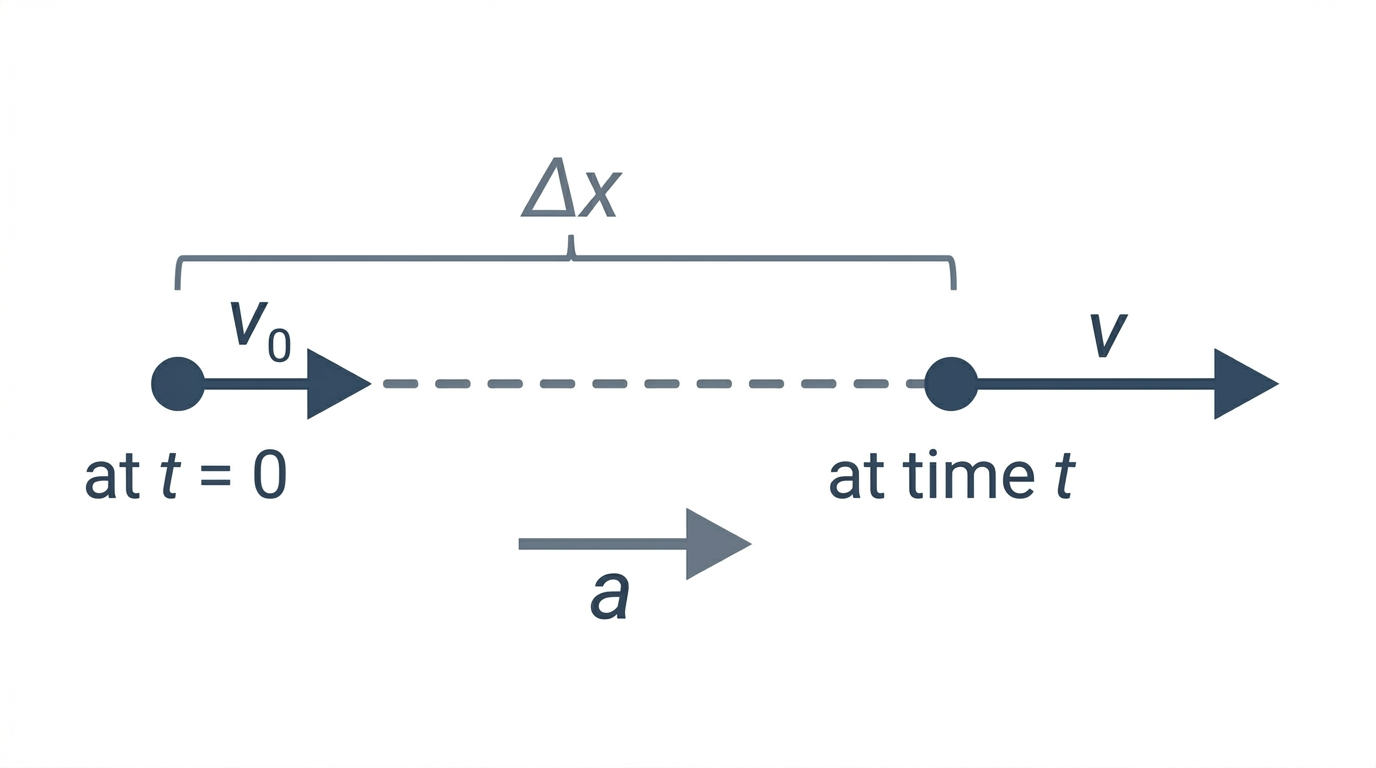
There are five variables and four equations. Each equation involves exactly four of the five, leaving one out. That structure is the key to picking the right equation: identify the variable that's neither known nor asked for, and use the equation that omits it.
The Four Equations
| # | Equation | Omits |
|---|---|---|
| 1 | \(v = v_0 + at\) | \(\Delta x\) |
| 2 | \(\Delta x = v_0 t + \tfrac{1}{2} a t^2\) | \(v\) |
| 3 | \(v^2 = v_0^2 + 2a \Delta x\) | \(t\) |
| 4 | \(\Delta x = \tfrac{1}{2}(v_0 + v)\, t\) | \(a\) |
The "Omits" column tells you when to use each one. If a problem doesn't mention time, use equation 3. If it doesn't mention final velocity, use equation 2. And so on.
The Graphs Behind the Equations
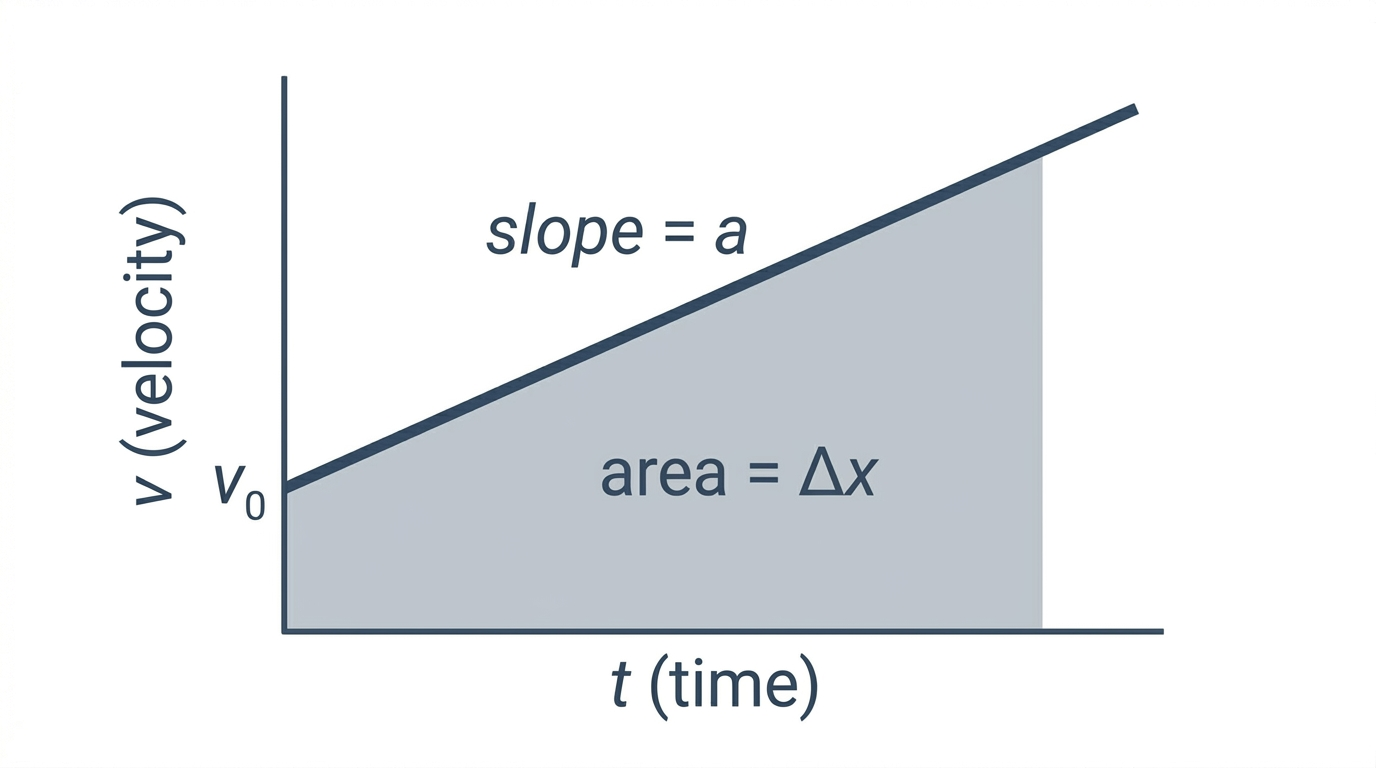
Two graphs make the equations feel less like memorized symbols. On a velocity-vs-time plot, constant acceleration shows up as a straight line: the y-intercept is \(v_0\), the slope is \(a\), and the area under the line is the displacement \(\Delta x\). That single picture contains equations 1 and 4.
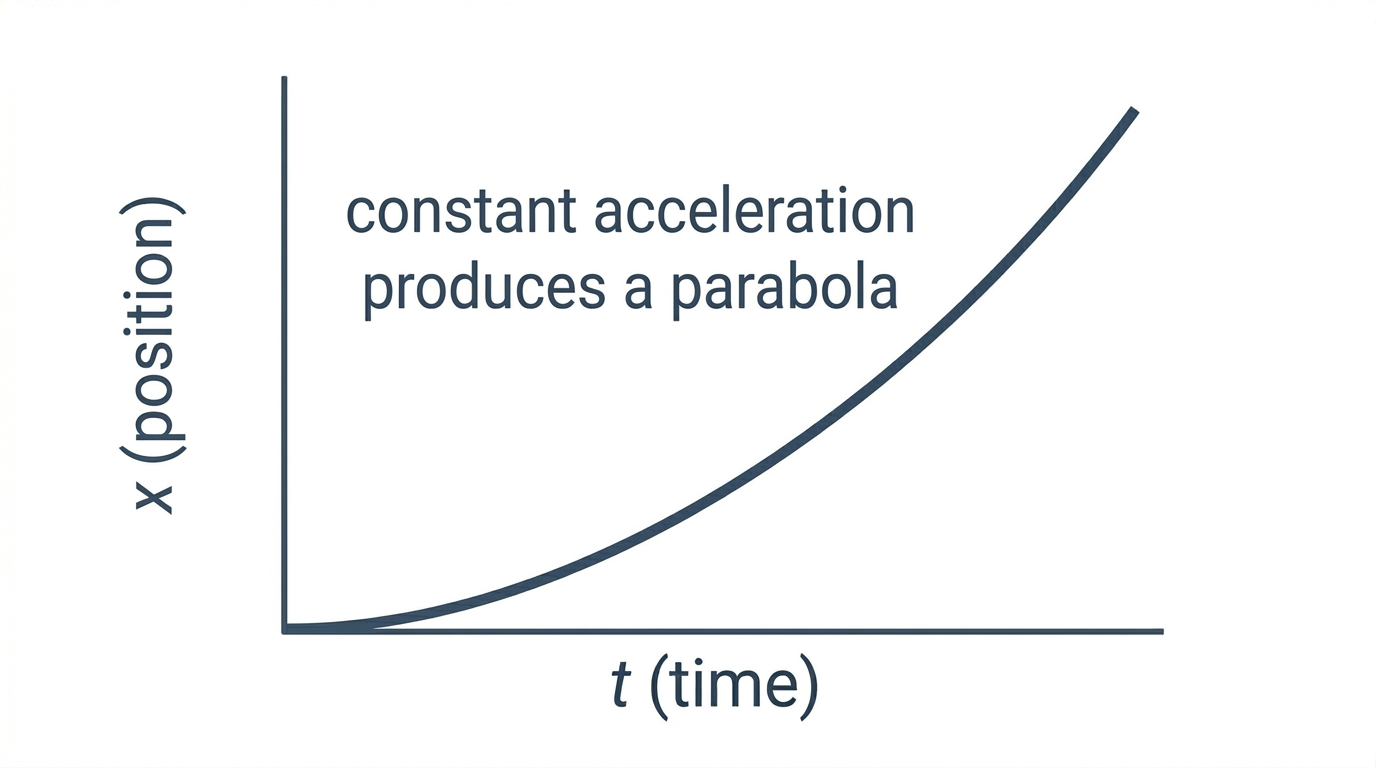
On a position-vs-time plot, the same motion produces a parabola. The curving shape is a direct visual signature of constant acceleration — and matches equation 2, which is quadratic in \(t\).
A Strategy for Solving
- Write down everything you know. Make a quick list with each variable and its value. Don't forget hidden values — "starts from rest" means \(v_0 = 0\); "comes to a stop" means \(v = 0\); a dropped object has \(v_0 = 0\) and \(a = g = 9.8\) m/s².
- Identify the unknown. What is the problem asking for?
- Spot the irrelevant variable. Of the five, which one is neither known nor asked? That's your "missing" variable.
- Pick the equation that omits that variable.
- Rearrange algebraically first, then plug in numbers. Cleaner work, fewer arithmetic mistakes.
Worked Example: a rolling ball
A ball is rolled across a flat floor at \(v_0 = 6\) m/s. Friction slows it at a constant rate of \(a = -0.5\) m/s². How far does it roll before stopping?
Knowns: \(v_0 = 6\) m/s, \(a = -0.5\) m/s², \(v = 0\) m/s (it stops). Unknown: \(\Delta x\) Irrelevant: \(t\) — the problem doesn't give it and doesn't ask for it.
| # | Equation | Omits |
|---|---|---|
| 1 | \(v = v_0 + at\) | \(\Delta x\) |
| 2 | \(\Delta x = v_0 t + \tfrac{1}{2} a t^2\) | \(v\) |
| 3 | \(v^2 = v_0^2 + 2a \Delta x\) | \(t\) |
| 4 | \(\Delta x = \tfrac{1}{2}(v_0 + v)\, t\) | \(a\) |
Use the equation that omits \(t\), which is equation 3:
\[v^2 = v_0^2 + 2a \Delta x\]
Solve for \(\Delta x\):
\[\Delta x = \frac{v^2 - v_0^2}{2a} = \frac{0 - 36}{2(-0.5)} = \frac{-36}{-1} = 36 \text{ m}\]
The ball rolls 36 meters before stopping.
Worked Example: a car accelerating from rest
A car accelerates from rest at \(a = 3\) m/s² for \(t = 5\) s. Find its final velocity, then find how far it has traveled.
Knowns: \(v_0 = 0\), \(a = 3\) m/s², \(t = 5\) s. Unknowns: \(v\) and \(\Delta x\).
| # | Equation | Omits |
|---|---|---|
| 1 | \(v = v_0 + at\) | \(\Delta x\) |
| 2 | \(\Delta x = v_0 t + \tfrac{1}{2} a t^2\) | \(v\) |
| 3 | \(v^2 = v_0^2 + 2a \Delta x\) | \(t\) |
| 4 | \(\Delta x = \tfrac{1}{2}(v_0 + v)\, t\) | \(a\) |
For the final velocity, use equation 1 (it omits \(\Delta x\), which is also unknown but not what we're after right now):
\[v = v_0 + at = 0 + (3)(5) = 15 \text{ m/s}\]
| # | Equation | Omits |
|---|---|---|
| 1 | \(v = v_0 + at\) | \(\Delta x\) |
| 2 | \(\Delta x = v_0 t + \tfrac{1}{2} a t^2\) | \(v\) |
| 3 | \(v^2 = v_0^2 + 2a \Delta x\) | \(t\) |
| 4 | \(\Delta x = \tfrac{1}{2}(v_0 + v)\, t\) | \(a\) |
For the displacement, use equation 2 (it omits \(v\), which we just found):
\[\Delta x = v_0 t + \tfrac{1}{2} a t^2 = 0 + \tfrac{1}{2}(3)(5)^2 = 37.5 \text{ m}\]
The car reaches \(15\) m/s and covers \(37.5\) m.
Worked Example: a dropped rock
A rock is dropped from a tall cliff. Ignoring air resistance, what is its velocity after \(3\) s, and how far has it fallen?
Near Earth's surface, gravity gives a constant acceleration of \(g = 9.8\) m/s² downward. Take downward as positive for this problem.
Knowns: \(v_0 = 0\) (dropped from rest, not thrown), \(a = 9.8\) m/s², \(t = 3\) s.
| # | Equation | Omits |
|---|---|---|
| 1 | \(v = v_0 + at\) | \(\Delta x\) |
| 2 | \(\Delta x = v_0 t + \tfrac{1}{2} a t^2\) | \(v\) |
| 3 | \(v^2 = v_0^2 + 2a \Delta x\) | \(t\) |
| 4 | \(\Delta x = \tfrac{1}{2}(v_0 + v)\, t\) | \(a\) |
Velocity (equation 1):
\[v = v_0 + at = 0 + (9.8)(3) = 29.4 \text{ m/s}\]
| # | Equation | Omits |
|---|---|---|
| 1 | \(v = v_0 + at\) | \(\Delta x\) |
| 2 | \(\Delta x = v_0 t + \tfrac{1}{2} a t^2\) | \(v\) |
| 3 | \(v^2 = v_0^2 + 2a \Delta x\) | \(t\) |
| 4 | \(\Delta x = \tfrac{1}{2}(v_0 + v)\, t\) | \(a\) |
Distance (equation 2):
\[\Delta x = v_0 t + \tfrac{1}{2} a t^2 = 0 + \tfrac{1}{2}(9.8)(3)^2 = 44.1 \text{ m}\]
After \(3\) s the rock is falling at \(29.4\) m/s and has fallen \(44.1\) m.
Worked Example: a cyclist speeding up
A cyclist accelerates from \(4\) m/s to \(10\) m/s over a span of \(8\) s. How far did she travel in that time?
Knowns: \(v_0 = 4\) m/s, \(v = 10\) m/s, \(t = 8\) s. Unknown: \(\Delta x\) Irrelevant: \(a\) — the problem doesn't say what the acceleration is, and doesn't ask.
| # | Equation | Omits |
|---|---|---|
| 1 | \(v = v_0 + at\) | \(\Delta x\) |
| 2 | \(\Delta x = v_0 t + \tfrac{1}{2} a t^2\) | \(v\) |
| 3 | \(v^2 = v_0^2 + 2a \Delta x\) | \(t\) |
| 4 | \(\Delta x = \tfrac{1}{2}(v_0 + v)\, t\) | \(a\) |
Use the equation that omits \(a\), which is equation 4:
\[\Delta x = \tfrac{1}{2}(v_0 + v)\, t = \tfrac{1}{2}(4 + 10)(8) = \tfrac{1}{2}(14)(8) = 56 \text{ m}\]
She covered \(56\) meters. Notice how this problem can't be solved with equations 1, 2, or 3 — each of those requires knowing \(a\), which we don't. Equation 4 is the one designed for "I know the starting and ending speeds and the time, but not the acceleration."
A Note on Signs
The equations don't care which way is "positive" — that's a choice you make at the start of the problem. The convention has to be consistent through the whole problem:
- If you pick up as positive, then gravity is \(a = -9.8\) m/s² and a ball thrown upward has positive \(v_0\).
- If you pick down as positive, then gravity is \(a = +9.8\) m/s² and a ball thrown upward has negative \(v_0\).
Either choice works. Just don't flip mid-problem.
Practice Problems
1. A skateboarder starts from rest and accelerates at \(2\) m/s² down a hill. How fast is she going after \(4\) s? Show answerUse equation 1: \(v = v_0 + at = 0 + (2)(4) = 8\) m/s.
2. A car traveling at \(25\) m/s slows uniformly to a stop over a distance of \(50\) m. What is its acceleration? Show answerUse equation 3: \(v^2 = v_0^2 + 2a\Delta x\), so \(a = \dfrac{v^2 - v_0^2}{2\Delta x} = \dfrac{0 - 625}{100} = -6.25\) m/s² (negative because it's slowing down).
3. A ball is thrown straight up at \(14\) m/s. How long until it reaches its highest point? (At the top, \(v = 0\). Take up as positive, so \(a = -9.8\) m/s².) Show answerUse equation 1: \(t = \dfrac{v - v_0}{a} = \dfrac{0 - 14}{-9.8} \approx 1.43\) s.
4. An object starting from rest accelerates at \(5\) m/s² for \(6\) s. How far has it traveled? Show answerUse equation 2: \(\Delta x = v_0 t + \tfrac{1}{2}at^2 = 0 + \tfrac{1}{2}(5)(36) = 90\) m.
5. A train traveling at \(20\) m/s accelerates to \(30\) m/s over a distance of \(250\) m. How long does it take? Show answerUse equation 4 (it omits \(a\)): \(\Delta x = \tfrac{1}{2}(v_0 + v)t\), so \(t = \dfrac{2 \Delta x}{v_0 + v} = \dfrac{500}{50} = 10\) s.
Related Math
The kinematic equations are pure algebra in physical clothing. If any of the above felt rusty, these lessons go straight to the math underneath:
- Solving multi-step equations — rearranging to isolate a variable
- Solving literal equations — working with formulas that contain several letters
- Quadratic formula — equation 2 is quadratic in \(t\), so problems that ask for time sometimes need the quadratic formula