
Projectile Motion
Once vectors and the kinematic equations are settled, projectile motion is just both at once.
A projectile is any object moving under gravity alone — a thrown ball, a kicked football, a launched rock once it leaves your hand, water from a hose, an artillery shell after the engines cut. In the standard simplification used for introductory physics (no air resistance), the path is a clean parabola you can solve analytically with the tools you already have.
The Key Insight: Horizontal and Vertical Motion Are Independent
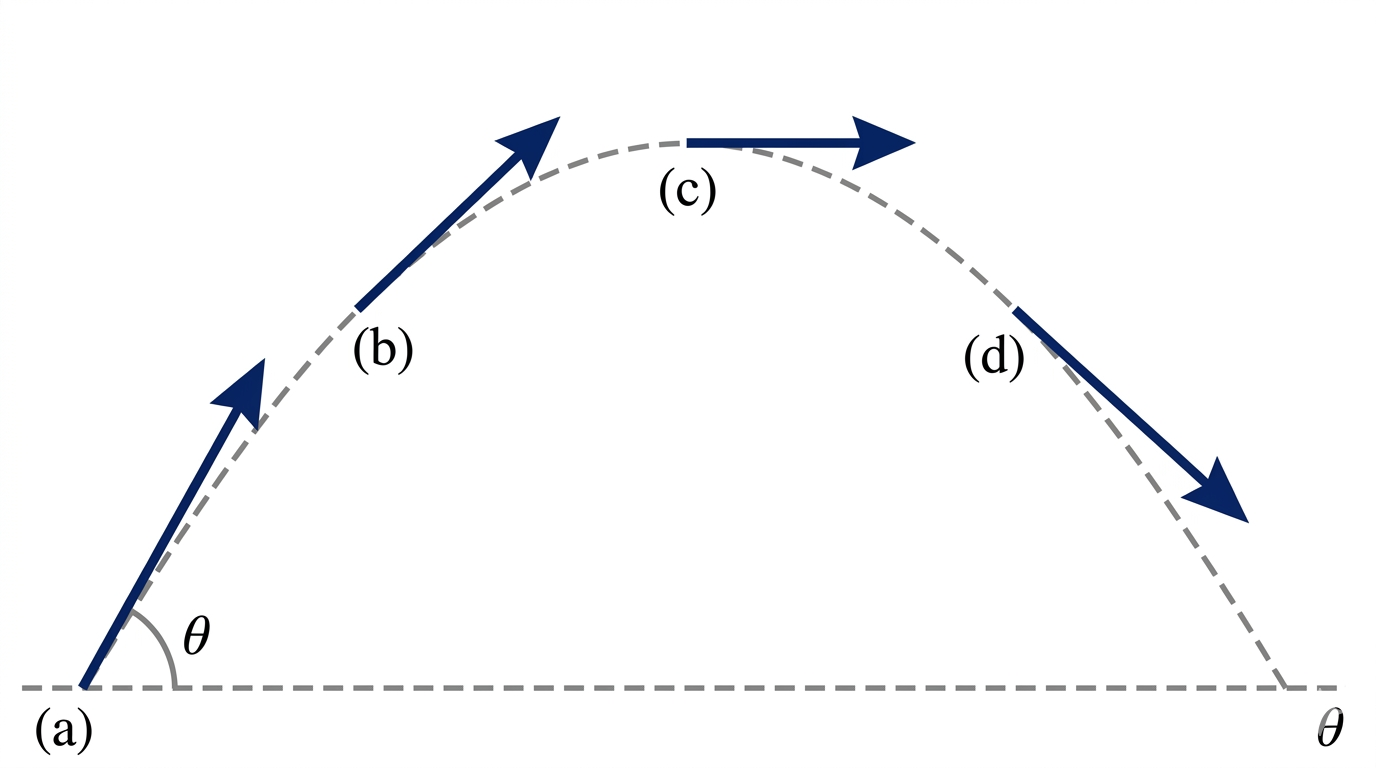
Gravity pulls down. Nothing pulls sideways (since we're ignoring air resistance). So the horizontal and vertical pieces of the motion behave completely separately:
- Horizontally, the projectile moves at constant velocity. No force, no acceleration, no slowing down.
- Vertically, the projectile is in constant-acceleration motion with \(a = -g = -9.8\) m/s² (taking up as positive). That's exactly the constant-acceleration setup handled by the kinematic equations.
The two motions share one variable: time. Whatever time has elapsed for the vertical motion has also elapsed for the horizontal. That's the bridge between them.
Setting Up a Problem
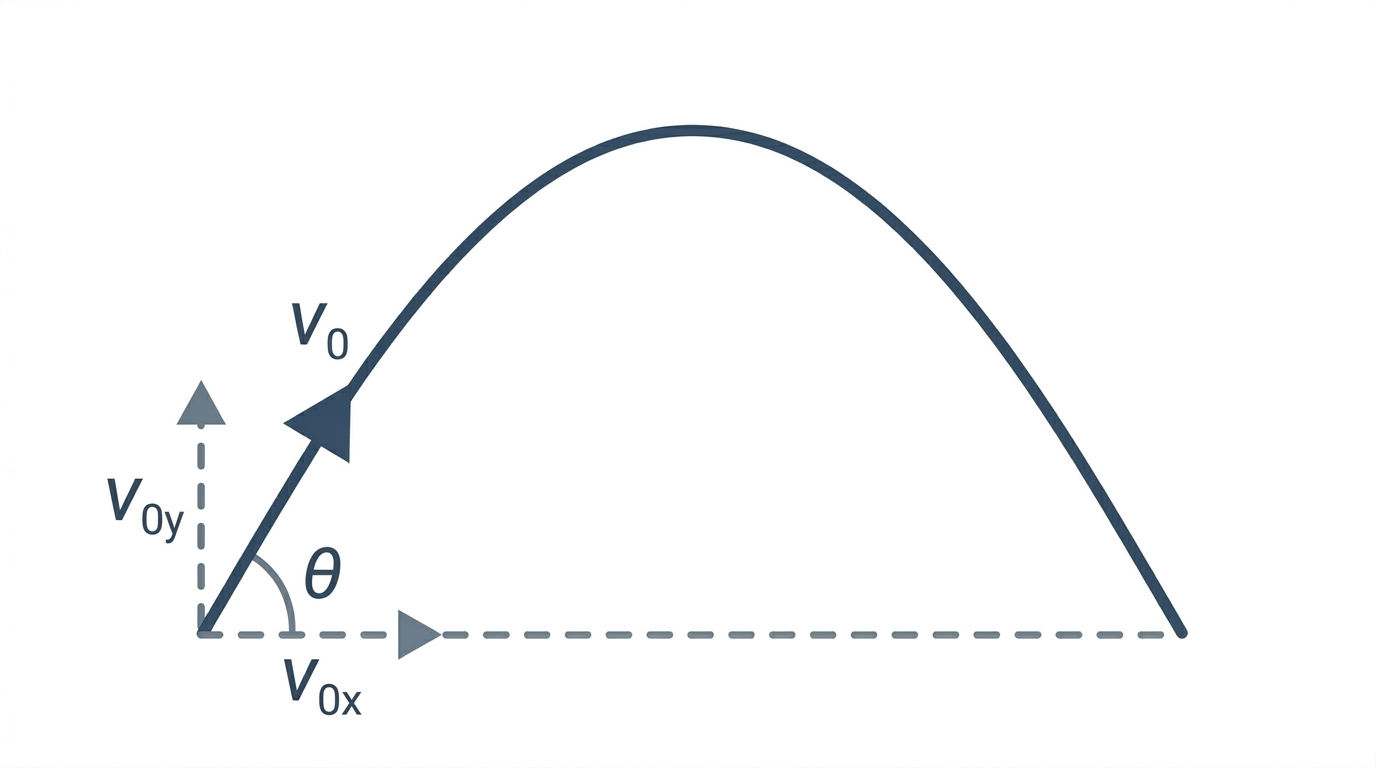
A projectile launched with speed \(v_0\) at angle \(\theta\) above the horizontal has initial velocity components:
\[v_{0x} = v_0 \cos\theta\] \[v_{0y} = v_0 \sin\theta\]
Cosine for horizontal, sine for vertical — the same component decomposition that applies to any vector. After the launch, gravity acts only on the vertical component, so \(v_{0x}\) stays the same forever while \(v_{0y}\) changes with time.
The Equations of Motion
Taking up as positive and \(g = 9.8\) m/s², the position at any time \(t\) is:
\[x(t) = v_{0x} \cdot t\] \[y(t) = y_0 + v_{0y} \cdot t - \tfrac{1}{2} g t^2\]
and the vertical velocity is:
\[v_y(t) = v_{0y} - g t\]
You don't usually need all three at once. Pick the equation that lets you solve for what the problem actually asks.
Three Common Quantities
Time to maximum height
At the top of the arc, the vertical velocity is briefly zero. From \(v_y = v_{0y} - g t = 0\):
\[t_{\text{up}} = \dfrac{v_{0y}}{g}\]
Maximum height
Using the kinematic equation that omits time:
\[y_{\text{max}} = y_0 + \dfrac{v_{0y}^2}{2g}\]
Range (for symmetric launches)
If the projectile lands at the same height it started, the total time aloft is exactly \(2 t_{\text{up}}\) (the arc is symmetric), and the horizontal distance traveled is:
\[R = \dfrac{v_0^2 \sin(2\theta)}{g}\]
This formula has a memorable consequence: range is maximized at \(\theta = 45°\), where \(\sin(2\theta) = \sin 90° = 1\).
Worked Example: a thrown ball
A baseball is thrown with \(v_0 = 30\) m/s at \(\theta = 40°\) above horizontal, from ground level. How far does it travel before landing?
Step 1: components.
\[v_{0x} = 30 \cos 40° \approx 22.98 \text{ m/s}\] \[v_{0y} = 30 \sin 40° \approx 19.28 \text{ m/s}\]
Step 2: time of flight.
\(t_{\text{up}} = v_{0y} / g = 19.28 / 9.8 \approx 1.97\) s. The arc is symmetric, so the total time aloft is \(2 t_{\text{up}} \approx 3.94\) s.
Step 3: horizontal distance.
\[R = v_{0x} \cdot t_{\text{total}} = 22.98 \times 3.94 \approx 90.5 \text{ m}\]
You can also get this directly from the range formula:
\[R = \dfrac{30^2 \sin 80°}{9.8} \approx 90.5 \text{ m} \checkmark\]
Worked Example: launched from a cliff
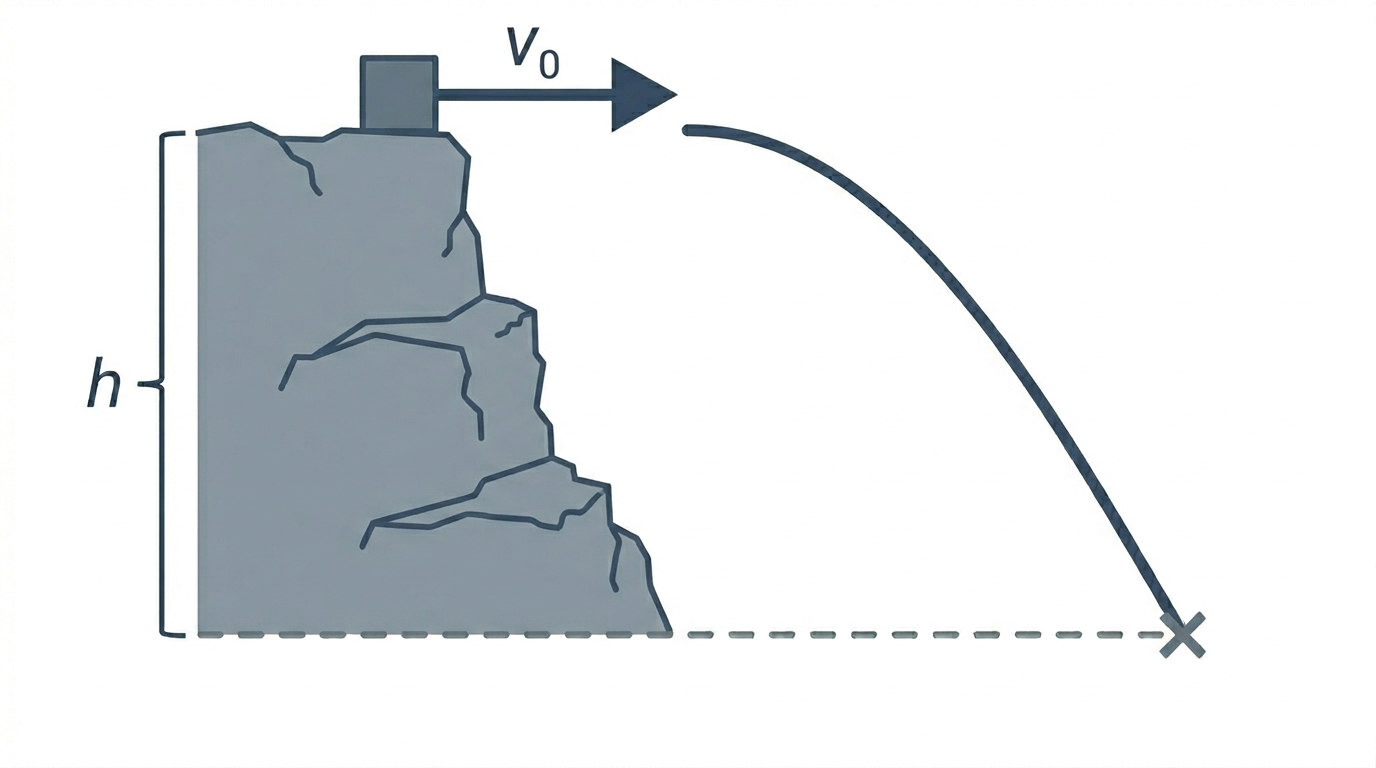
A rock is launched horizontally (\(\theta = 0°\)) from a \(45\) m cliff at \(v_0 = 12\) m/s. How long does it stay in the air, and how far from the base of the cliff does it land?
A horizontal launch means \(v_{0y} = 0\). The vertical motion is just a free fall from \(45\) m.
Time to fall (vertical):
\[y(t) = y_0 - \tfrac{1}{2}g t^2 = 0\] \[45 = \tfrac{1}{2}(9.8) t^2\] \[t = \sqrt{\dfrac{2 \cdot 45}{9.8}} \approx 3.03 \text{ s}\]
Horizontal distance:
\[x = v_{0x} \cdot t = 12 \times 3.03 \approx 36.4 \text{ m}\]
The rock hits the ground about \(36\) m from the base of the cliff, after \(3\) seconds in the air. Notice that the launch angle of zero made the problem easier — the horizontal-vertical independence lets you solve the vertical drop without thinking about the horizontal motion at all.
Worked Example: passing through a height twice
A ball is thrown at \(v_0 = 20\) m/s at \(\theta = 60°\) above horizontal. At what time(s) does it pass through a height of \(10\) m above the launch point?
Components:
\[v_{0y} = 20 \sin 60° \approx 17.32 \text{ m/s}\]
Set the vertical position equal to \(10\):
\[17.32 t - 4.9 t^2 = 10\] \[4.9 t^2 - 17.32 t + 10 = 0\]
This is a quadratic in \(t\). Using the quadratic formula:
\[t = \dfrac{17.32 \pm \sqrt{17.32^2 - 4(4.9)(10)}}{2(4.9)} = \dfrac{17.32 \pm \sqrt{299.98 - 196}}{9.8} = \dfrac{17.32 \pm 10.20}{9.8}\]
\[t \approx 0.73 \text{ s} \quad \text{or} \quad t \approx 2.81 \text{ s}\]
The ball passes through \(10\) m twice: once on the way up, once on the way back down. That's the parabolic arc in action — two answers, both physically meaningful.
A Note on Air Resistance
Every projectile-motion problem in this lesson assumes air resistance is negligible. That's a reasonable approximation for dense objects moving at moderate speeds (a thrown rock, a kicked ball), but it's a poor approximation for a feather, a parachute, or a baseball traveling at major-league pitching speeds. The "real" trajectory of an air-resisted projectile isn't a clean parabola and doesn't usually admit a closed-form solution — those are simulated numerically, not solved with a single equation.
For introductory work, stick with the no-air-resistance idealization and the answers stay clean.
Practice Problems
1. A football is kicked at \(25\) m/s at \(35°\) above horizontal from ground level. What is its maximum height? Show answer\(v_{0y} = 25 \sin 35° \approx 14.34\) m/s. Max height \(= v_{0y}^2 / (2g) = 14.34^2 / 19.6 \approx 10.49\) m.
2. A javelin is thrown at \(18\) m/s at \(45°\) from ground level. How far does it travel? Show answerUse \(R = v_0^2 \sin(2\theta) / g = 18^2 \sin 90° / 9.8 = 324 / 9.8 \approx 33.06\) m.
3. An object is launched horizontally at \(10\) m/s from a \(20\) m cliff. How far from the base of the cliff does it land? Show answerTime to fall: \(t = \sqrt{2(20)/9.8} \approx 2.02\) s. Range: \(10 \times 2.02 \approx 20.2\) m.
4. At what launch angle is the range of a projectile maximized (assuming flat ground and the same launch and landing height)? Show answer\(45°\), because \(\sin(2\theta)\) is maximized when \(2\theta = 90°\), i.e., \(\theta = 45°\).
5. A ball is thrown straight up at \(15\) m/s. How long is it in the air before returning to the thrower's hand? Show answerSymmetric arc starting and ending at the same height. \(t_{\text{up}} = 15 / 9.8 \approx 1.53\) s. Total time \(= 2 t_{\text{up}} \approx 3.06\) s.
Related Math
Projectile motion sits on top of two strands of math:
- Trigonometry — sine and cosine to break the initial velocity into components
- Quadratic formula — whenever you ask "at what time does the projectile reach height \(y\)?" you get a quadratic in \(t\)
- Pythagorean theorem — for the magnitude of the velocity vector at any moment in the flight