
Vectors — Magnitude, Direction, and Components
Some physical quantities are described by just a number. Mass, temperature, and time are like this — five kilograms is five kilograms, regardless of which way you point. Quantities like these are called scalars.
Other quantities — velocity, force, displacement, acceleration — need two pieces of information: how much and in which direction. These are vectors.
The math of vectors is mostly the math you already know from right-triangle geometry — the Pythagorean theorem and basic trigonometry. What's new is the physical interpretation. This lesson covers how to draw a vector, how to break it into components, and how to add two vectors together.
Drawing a Vector
A vector is drawn as an arrow. The length of the arrow shows the magnitude (how big the quantity is), and the direction of the arrow shows which way it acts.
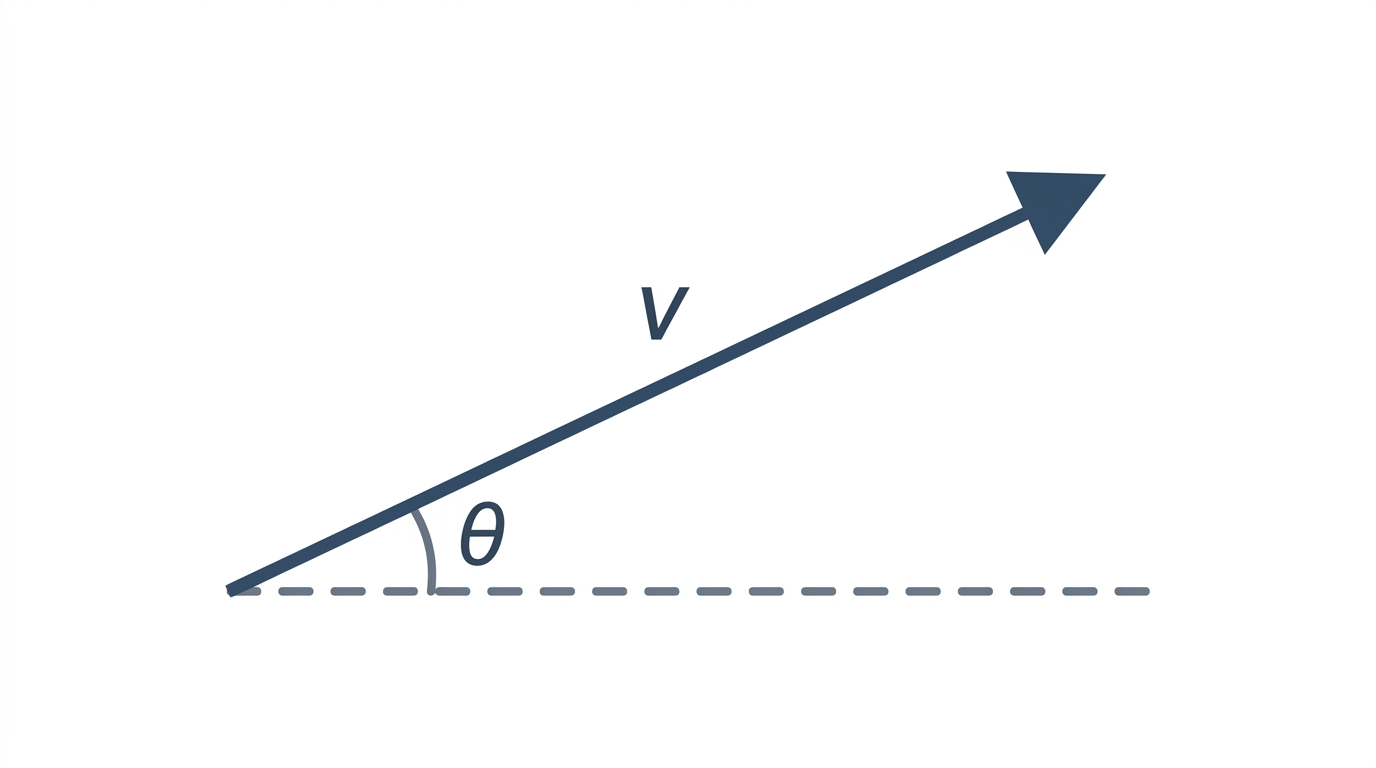
When written in text, a vector is shown with either an arrow over the letter — \(\vec{v}\) — or in bold (v). The magnitude alone, with no direction, is written without the arrow: \(v\) or \(|\vec{v}|\). So \(\vec{v}\) is "the velocity," but \(|\vec{v}|\) is "the speed" (how fast, without the where).
Components
A vector pointing in some arbitrary direction is hard to do arithmetic with directly. The trick is to break it into two perpendicular pieces — usually a horizontal piece and a vertical piece — called components.
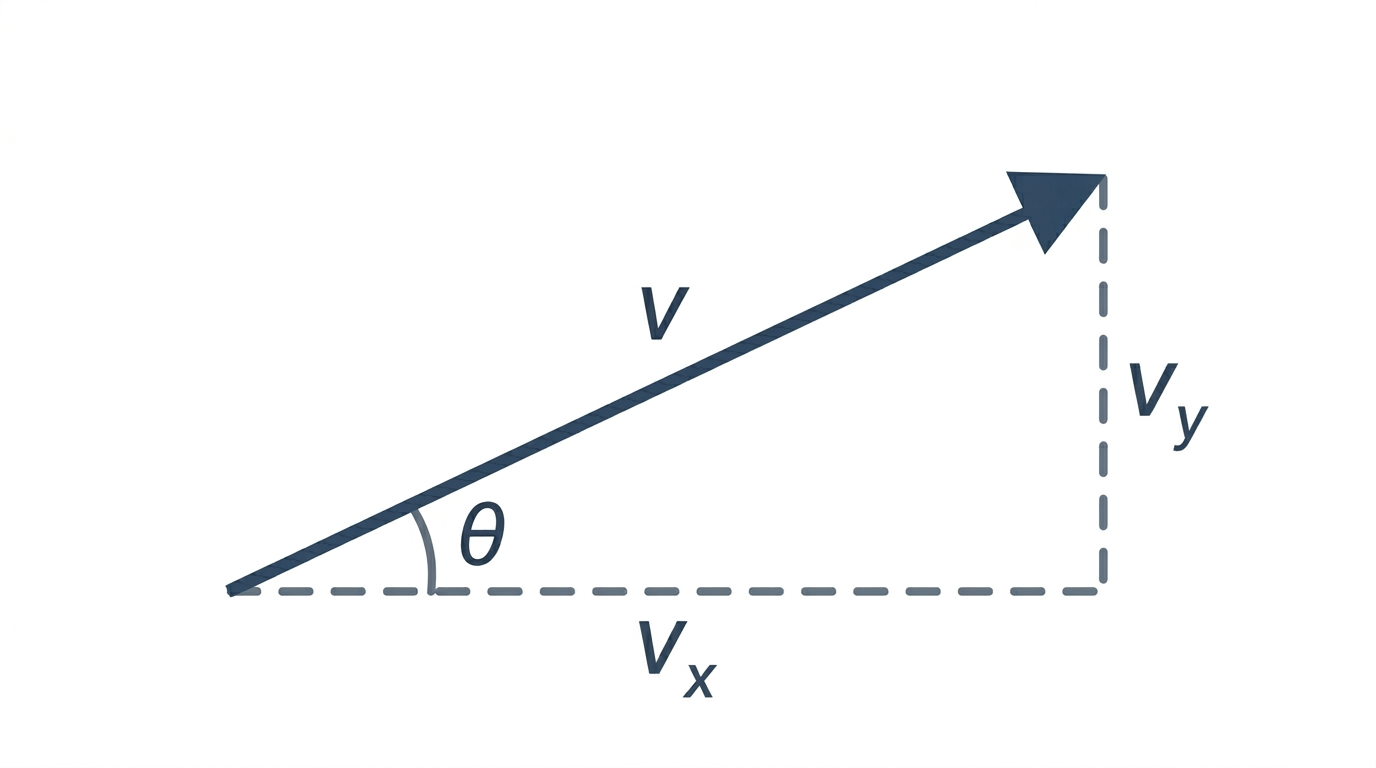
Look at the figure: the vector \(\vec{v}\), its horizontal component \(v_x\), and its vertical component \(v_y\) form a right triangle. From basic right-triangle trigonometry:
\[v_x = |\vec{v}| \cos\theta\] \[v_y = |\vec{v}| \sin\theta\]
Cosine for the horizontal piece (the side adjacent to the angle). Sine for the vertical piece (the side opposite the angle). The angle \(\theta\) is measured from the positive x-axis unless the problem says otherwise.
Example: resolving a velocity
A ball is thrown with a velocity of \(20\) m/s at an angle of \(30°\) above the horizontal. Find its horizontal and vertical velocity components.
\[v_x = 20 \cos 30° = 20 \cdot \frac{\sqrt{3}}{2} \approx 17.32 \text{ m/s}\] \[v_y = 20 \sin 30° = 20 \cdot \frac{1}{2} = 10 \text{ m/s}\]
The ball moves horizontally at about \(17.32\) m/s and upward at \(10\) m/s.
From Components Back to the Vector
If you already know the components and need the magnitude and direction, the same right triangle gives you both. The magnitude comes from the Pythagorean theorem:
\[|\vec{v}| = \sqrt{v_x^2 + v_y^2}\]
The direction (angle above the horizontal) comes from the inverse tangent:
\[\theta = \arctan\left(\frac{v_y}{v_x}\right)\]
If \(v_x = 3\) and \(v_y = 4\), then \(|\vec{v}| = \sqrt{9 + 16} = 5\) and \(\theta = \arctan(4/3) \approx 53.13°\). Same 3-4-5 right triangle you've seen in algebra and geometry.
Adding Vectors
To add two vectors you can't just add their lengths — the directions matter. There are two equivalent ways to do the addition.
Graphical method (head-to-tail)
Draw the first vector. Then draw the second vector starting from the tip of the first. The sum, called the resultant, is the arrow from the tail of the first vector to the tip of the second.
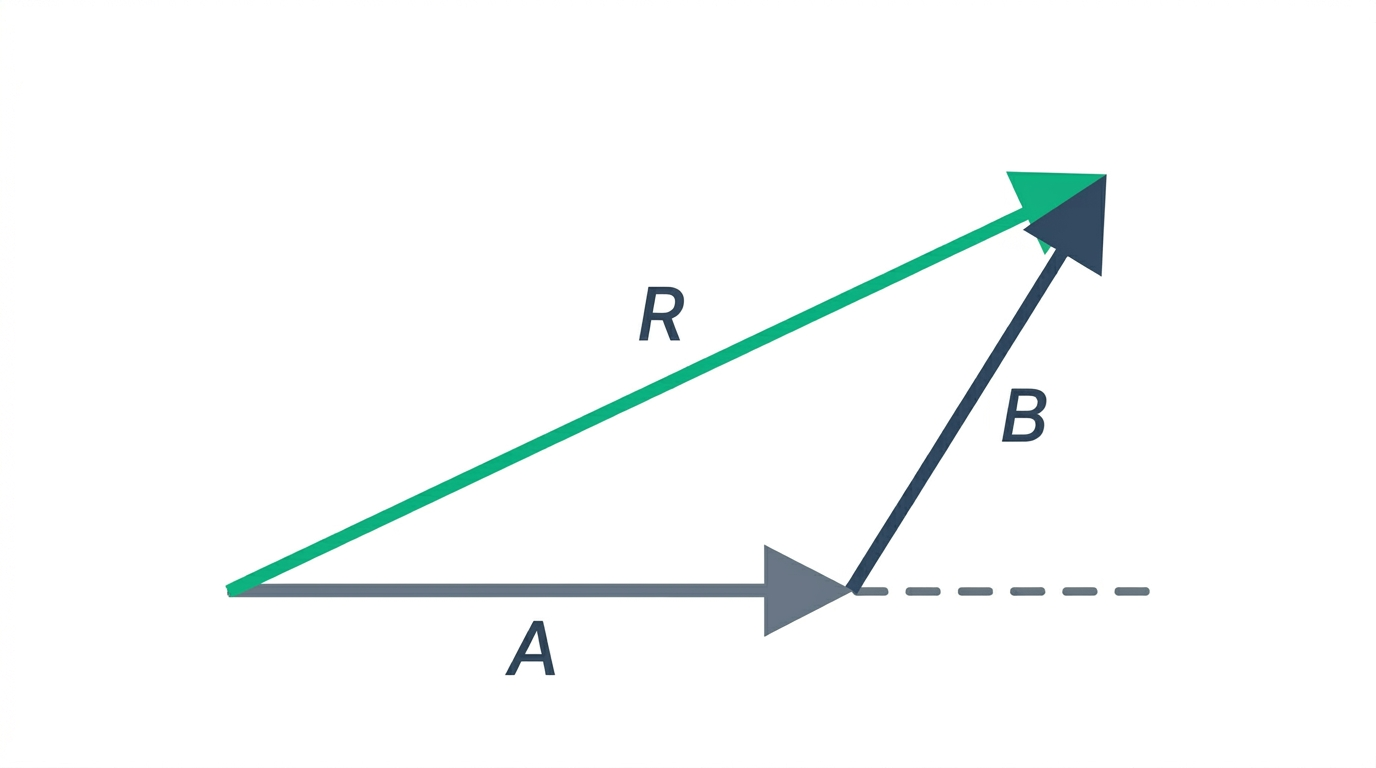
This is great for seeing what's happening but awkward for getting a precise numerical answer. For that, switch to the component method.
Component method (the calculation)
To add \(\vec{A}\) and \(\vec{B}\), add their components separately:
\[R_x = A_x + B_x\] \[R_y = A_y + B_y\]
Then convert back to magnitude and direction using the formulas from earlier:
\[|\vec{R}| = \sqrt{R_x^2 + R_y^2}, \qquad \theta = \arctan\left(\frac{R_y}{R_x}\right)\]
Worked example
Add \(\vec{A} = 5\) units at \(0°\) (along the x-axis) and \(\vec{B} = 3\) units at \(90°\) (straight up).
Step 1: components.
\(\vec{A}\) has \(A_x = 5\), \(A_y = 0\). \(\vec{B}\) has \(B_x = 0\), \(B_y = 3\).
Step 2: add the components.
\(R_x = 5 + 0 = 5\) \(R_y = 0 + 3 = 3\)
Step 3: convert back to magnitude and direction.
\[|\vec{R}| = \sqrt{5^2 + 3^2} = \sqrt{34} \approx 5.83\] \[\theta = \arctan(3/5) \approx 30.96°\]
The resultant has magnitude about \(5.83\) units and points roughly \(31°\) above the horizontal.
Practice Problems
1. A force of \(50\) N acts at \(60°\) above the horizontal. Find its horizontal and vertical components. Show answer\(F_x = 50 \cos 60° = 25\) N. \(F_y = 50 \sin 60° \approx 43.30\) N.
2. A vector has components \(v_x = 8\) and \(v_y = -6\). Find its magnitude and direction. Show answer\(|\vec{v}| = \sqrt{64 + 36} = 10\). \(\theta = \arctan(-6/8) \approx -36.87°\) (below the horizontal, since \(v_y\) is negative).
3. Add vectors \(\vec{A} = 4\) units at \(0°\) and \(\vec{B} = 4\) units at \(90°\). What is the resultant? Show answerComponents: \(R_x = 4\), \(R_y = 4\). Magnitude: \(\sqrt{32} = 4\sqrt{2} \approx 5.66\). Direction: \(\arctan(4/4) = 45°\).
4. Two forces act on a box: \(10\) N to the east and \(24\) N to the north. What is the net force, and in which direction? Show answer\(|\vec{F}| = \sqrt{10^2 + 24^2} = \sqrt{676} = 26\) N. Direction: \(\arctan(24/10) \approx 67.38°\) north of east.
5. A vector has magnitude \(15\) and points at \(135°\) from the positive x-axis. Find its components. Show answer\(v_x = 15 \cos 135° \approx -10.61\) (negative — the x-component points left). \(v_y = 15 \sin 135° \approx 10.61\) (positive — the y-component points up).
Related Math
Working comfortably with vectors leans on a few math topics worth a refresher if anything here felt rusty:
- Pythagorean theorem — magnitude from components
- Trigonometry — sine, cosine, tangent for resolving angles
- Special angles — exact values for \(30°\), \(45°\), \(60°\)