
Newton's Laws of Motion
Three short statements, originally published by Isaac Newton in 1687, that explain how forces and motion are related. Once you've internalized them, almost every introductory mechanics problem becomes a procedure: identify the forces on an object, add them as vectors, and apply \(F = ma\) to figure out what happens next.
This lesson covers all three laws, the math behind them (which is mostly the second law applied carefully), and how to set up a problem with a free-body diagram.
The First Law (Inertia)
An object at rest stays at rest, and an object in motion stays in motion at constant velocity, unless acted on by a net external force.
The everyday version is "things don't change their motion without a reason." A book on a table doesn't slide off by itself. A puck on frictionless ice glides forever in a straight line. The instinct that moving objects "naturally" slow down is wrong — they slow down because of forces like friction, not because motion needs constant input.
The first law is the qualitative version of the second law: it's what \(F = ma\) reduces to when the net force is zero. Zero force means zero acceleration, which means constant velocity — and "at rest" is just constant velocity with the constant equal to zero.
The Second Law (F = ma)
When a net force \(F\) acts on an object of mass \(m\), the object accelerates at:
\[a = \dfrac{F}{m}\]
or equivalently:
\[F = m a\]
Force, mass, and acceleration are all related by one short equation. Force is measured in newtons (N), mass in kilograms (kg), and acceleration in m/s². One newton is defined as the force that accelerates a 1 kg mass at 1 m/s².
The second law is a vector equation. If several forces act on an object, first add them as vectors to get the net force \(F_{\text{net}}\), then apply \(F_{\text{net}} = m a\). The direction of the acceleration matches the direction of the net force.
Worked Example: pushing a cart
You apply a steady horizontal force of \(30\) N to a \(12\) kg cart on a frictionless floor. What is the cart's acceleration?
\[a = \dfrac{F}{m} = \dfrac{30}{12} = 2.5 \text{ m/s}^2\]
The cart accelerates at \(2.5\) m/s² in the direction you push.
Worked Example: tug of war on ice
Two people pull on opposite ends of a \(5\) kg sled resting on frictionless ice. One pulls left with \(20\) N; the other pulls right with \(28\) N. What is the sled's acceleration?
Net force: \(F_{\text{net}} = 28 - 20 = 8\) N to the right.
\[a = \dfrac{F_{\text{net}}}{m} = \dfrac{8}{5} = 1.6 \text{ m/s}^2 \text{ to the right}\]
If both people pulled with the same force, the net force would be zero — and per the first law, the sled wouldn't accelerate at all.
The Third Law (Action-Reaction)
For every force one object exerts on another, the second object exerts an equal and opposite force on the first.
Push on a wall and the wall pushes back on you with the same magnitude. Stand on the floor and the floor pushes up on you (the normal force) just as hard as you press down on it. A rocket pushes hot exhaust gases downward; the gases push the rocket upward.
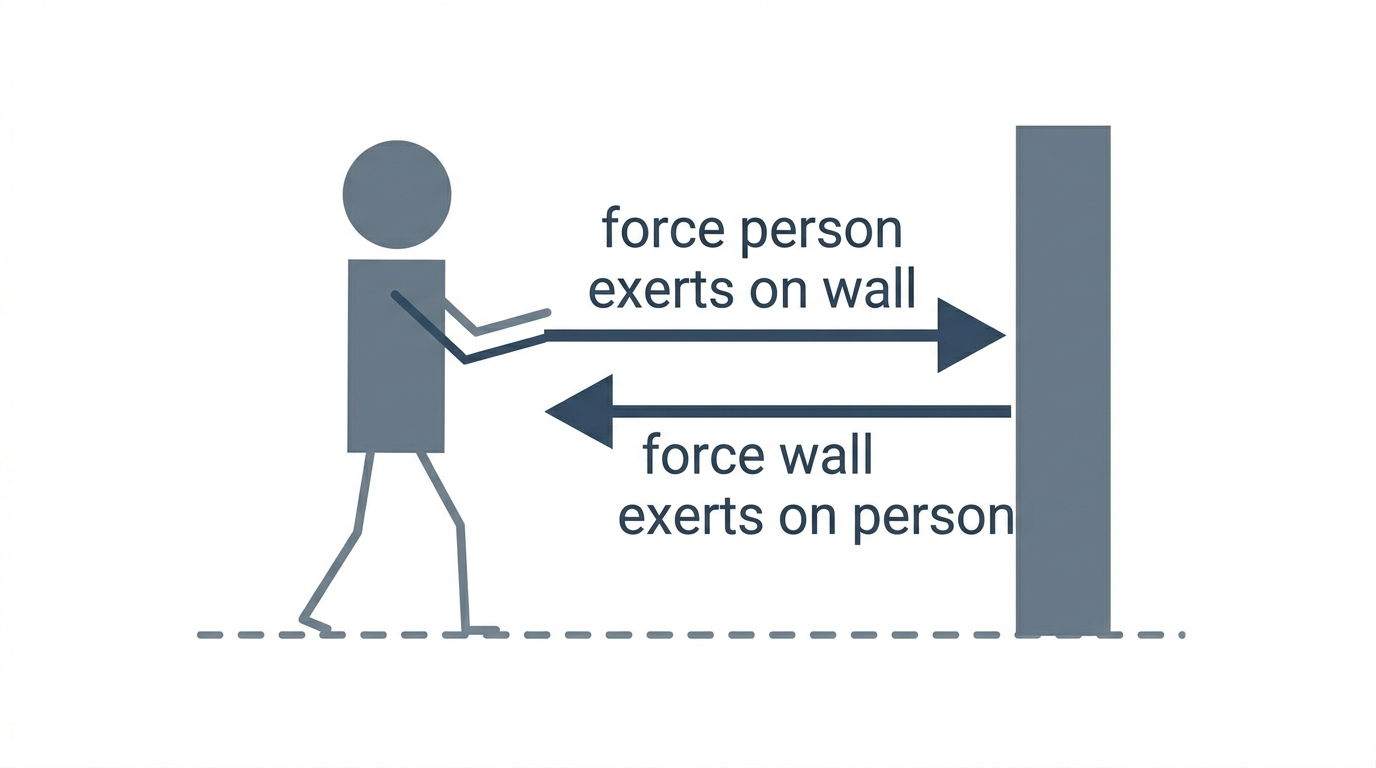
A common confusion: the two forces in an action-reaction pair act on different objects. They don't cancel within a single object. You can't argue "this sled has zero net force because Newton's third law" — the force you exert on the sled, and the force the sled exerts on you, are on different objects entirely. The forces on the sled are: your push, friction, gravity, and the normal force from the ice. Those are what add up to \(F_{\text{net}}\).
Free-Body Diagrams
To apply Newton's second law to a real problem, draw a free-body diagram — a quick sketch of the object with an arrow for every force acting on it. Common forces to look for:
- Gravity (weight \(W = mg\), pointing straight down)
- Normal force (the support force from a surface, perpendicular to the surface)
- Tension (the pull from a rope or string, along its length)
- Friction (parallel to the surface, opposing the relative motion)
- Applied forces (whatever someone or something is pushing or pulling with)
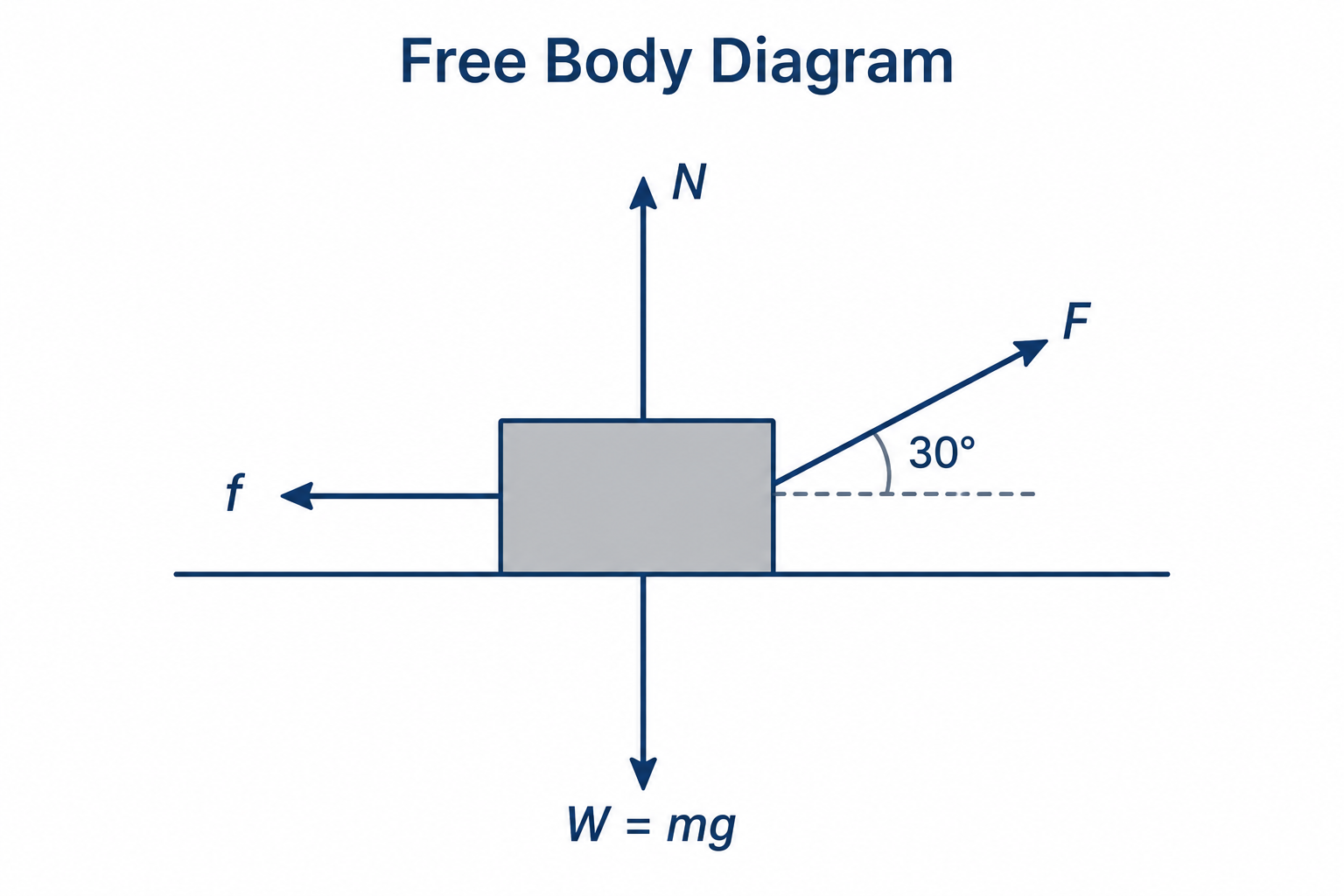
Once the forces are drawn, add them as vectors. The sum is \(F_{\text{net}}\). Apply \(F_{\text{net}} = m a\) to find the acceleration.
Worked Example: a falling object
A \(2\) kg book is dropped. Air resistance is negligible. What is its acceleration?
The only force is gravity: \(W = mg = (2)(9.8) = 19.6\) N downward.
\[a = \dfrac{F}{m} = \dfrac{19.6}{2} = 9.8 \text{ m/s}^2 \text{ downward}\]
That's just \(g\), of course — and it's the deeper reason all objects in vacuum fall at the same rate. The gravitational force is proportional to mass, and Newton's second law divides by mass, so the mass cancels.
Worked Example: a block on an incline
A \(10\) kg block sits on a frictionless ramp angled at \(30°\) above horizontal. What is its acceleration down the ramp?
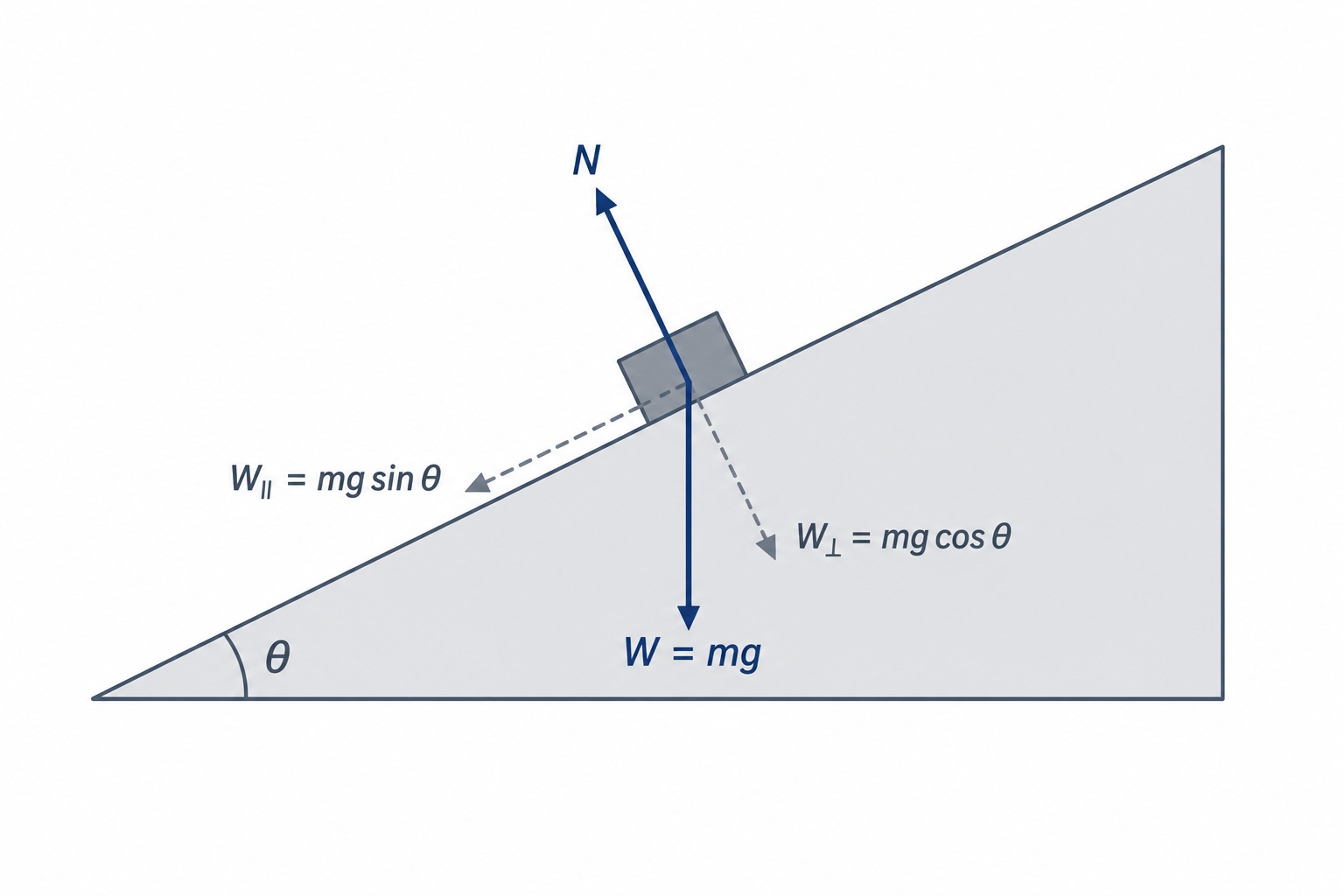
Forces on the block:
- Gravity: \(W = (10)(9.8) = 98\) N straight down.
- Normal force: perpendicular to the ramp's surface.
Split gravity into two pieces — one along the ramp, one into the ramp. The component along the ramp (pointing downhill) is \(W \sin\theta = 98 \sin 30° = 49\) N. The component into the ramp is canceled by the normal force, contributing nothing to motion.
\[a = \dfrac{49}{10} = 4.9 \text{ m/s}^2 \text{ down the ramp}\]
A useful general result: a frictionless ramp at angle \(\theta\) gives an acceleration of \(g \sin\theta\), regardless of the object's mass.
The Connection to Kinematics
Newton's second law gives the acceleration. The kinematic equations take it from there — once you know \(a\), the equations tell you velocity, position, and time. The two pieces work together as a single toolkit:
- Identify the forces and apply \(F = ma\) to find the acceleration.
- Plug that acceleration into the appropriate kinematic equation to find velocity, position, or time.
This combination — forces produce acceleration; acceleration produces motion — is the spine of introductory classical mechanics.
Practice Problems
1. What net force is required to accelerate a \(1500\) kg car at \(3\) m/s²? Show answer\(F = ma = (1500)(3) = 4500\) N.
2. A \(0.4\) N force is applied to a small object, causing it to accelerate at \(5\) m/s². What is the object's mass? Show answer\(m = F/a = 0.4 / 5 = 0.08\) kg (\(80\) g).
3. A \(50\) kg crate sits on a frictionless floor. You push with \(100\) N to the right; a friend pushes with \(30\) N to the left. What is the crate's acceleration? Show answerNet force: \(100 - 30 = 70\) N to the right. \(a = 70/50 = 1.4\) m/s² to the right.
4. A \(5\) kg block slides down a frictionless ramp inclined at \(20°\) above horizontal. What is its acceleration? Show answer\(a = g \sin\theta = (9.8)\sin 20° \approx 3.35\) m/s² down the ramp.
5. A \(1200\) kg car traveling at \(25\) m/s comes to a complete stop in \(5\) seconds. What average net force acted on it during braking? Show answerAcceleration: \(a = (0 - 25)/5 = -5\) m/s². Force: \(F = ma = (1200)(-5) = -6000\) N (opposite the direction of motion).
Related Math and Physics
Newton's second law sits at the intersection of vector math and equation rearranging:
- Vectors — forces are vectors; before applying \(F = ma\), add them as vectors
- Kinematic Equations — what to do with the acceleration once you have it
- Work, Energy, and Power — force times distance is work, an alternative bookkeeping that solves many of the same problems
- Trigonometry — splitting forces into components on inclined planes
- Solving Literal Equations — rearranging \(F = ma\) for whichever variable you want