
Work, Energy, and Power
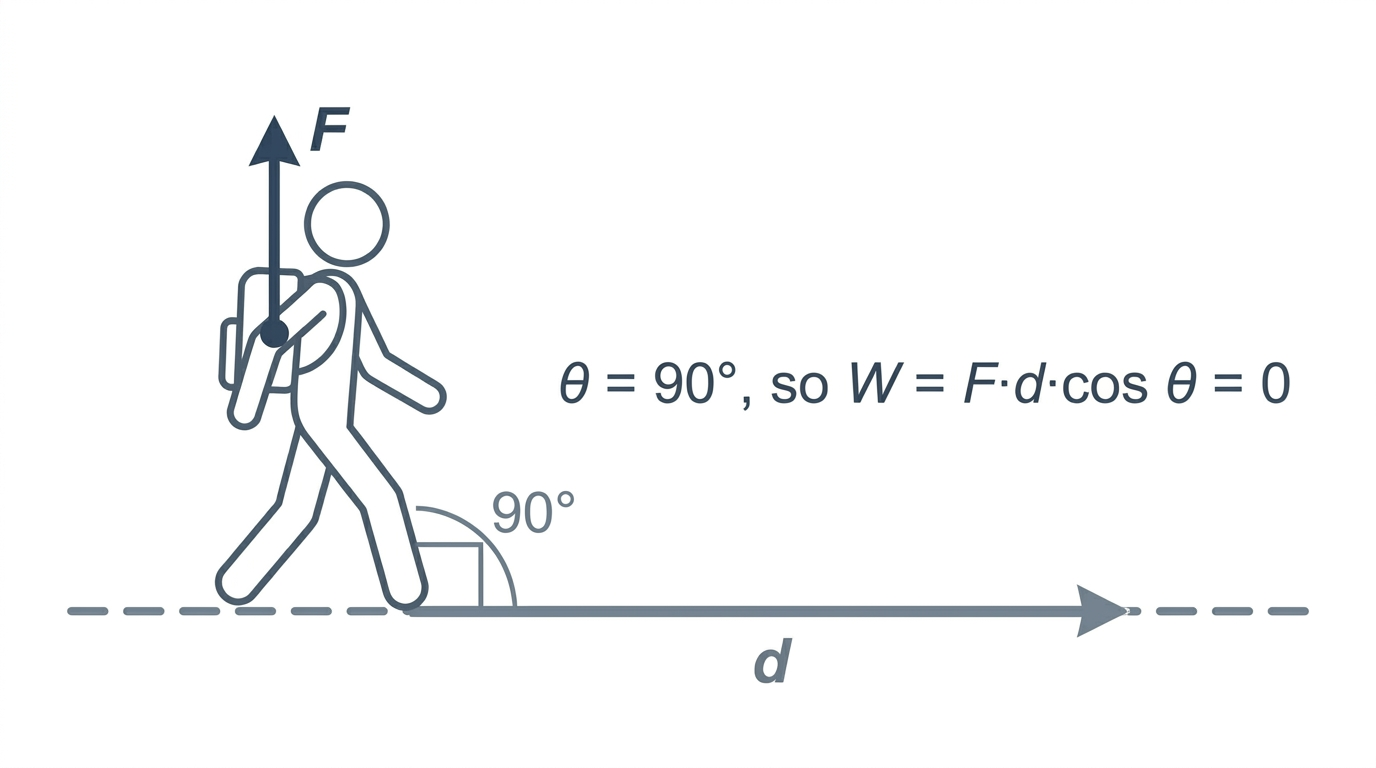
In everyday English, "work" means effort. In physics, work has a precise definition that sometimes disagrees with intuition. Pushing on a brick wall with all your strength accomplishes no physics-work if the wall doesn't move. Carrying a heavy backpack across a flat floor at constant speed? Also zero work on the backpack — the force you exert on it is vertical, while the motion is horizontal.
This lesson covers the precise definition of work, the two main kinds of mechanical energy (kinetic and potential), the work-energy theorem that links them, the law of conservation of energy, and the related concept of power.
Work
The work done by a constant force \(F\) acting on an object that moves a distance \(d\) is:
\[W = F d \cos\theta\]
where \(\theta\) is the angle between the force vector and the displacement vector.
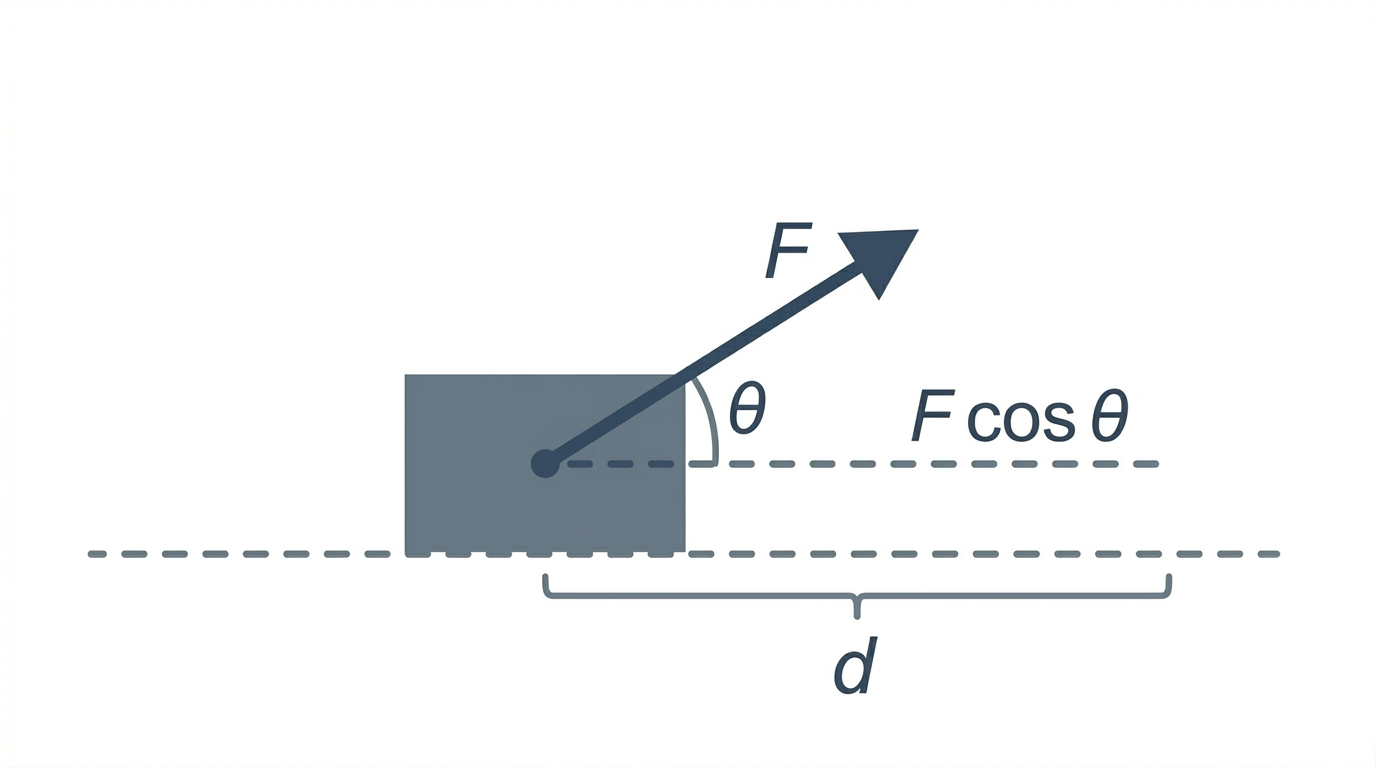
The cosine factor is what makes work different from "effort." When \(\theta = 0°\) (force in the direction of motion), \(\cos\theta = 1\) and the formula reduces to \(W = Fd\). When \(\theta = 90°\) (force perpendicular to motion), \(\cos\theta = 0\) and \(W = 0\) — no work at all, regardless of how big the force is. That's why carrying a backpack across a level floor doesn't count: the upward force you exert is perpendicular to the horizontal motion.
Work is measured in joules (J), where one joule is one newton-meter (N·m).
Worked Example: pushing a box
You push a box across a floor with a horizontal force of \(50\) N over a distance of \(4\) m. Force and displacement point in the same direction, so \(\theta = 0\) and \(\cos\theta = 1\):
\[W = (50)(4)(1) = 200 \text{ J}\]
You did \(200\) joules of work on the box.
If you instead push at an angle of \(30°\) below horizontal (like pushing a shopping-cart handle), only the horizontal component of the force lines up with the horizontal motion:
\[W = (50)(4)\cos 30° = (50)(4)(0.866) \approx 173 \text{ J}\]
Less work for the same total force — the vertical component of your push is absorbed by the floor without contributing to the motion.
Kinetic Energy
Kinetic energy is the energy of motion. An object of mass \(m\) moving at speed \(v\) has kinetic energy:
\[KE = \tfrac{1}{2} m v^2\]
The dependence on \(v^2\) matters a lot. Doubling the speed quadruples the kinetic energy. This is why a car at \(60\) mph carries four times the kinetic energy of one at \(30\) mph, and why highway-speed crashes are so much more destructive than city-speed ones.
KE is always non-negative, since \(v^2 \geq 0\). An object at rest has zero kinetic energy.
Worked Example: a thrown ball
A \(0.15\) kg baseball is thrown at \(40\) m/s. Its kinetic energy is:
\[KE = \tfrac{1}{2}(0.15)(40)^2 = (0.075)(1600) = 120 \text{ J}\]
Gravitational Potential Energy
Potential energy is the energy of position. For an object of mass \(m\) at a height \(h\) above some reference level, the gravitational potential energy is:
\[PE = m g h\]
with \(g = 9.8\) m/s² on Earth.
The reference height is your choice — usually the ground, the floor, or whatever the object would land on. PE is measured relative to that level: an object below the reference has negative PE.
Worked Example: a book on a shelf
A \(1.2\) kg book on a shelf \(1.8\) m above the floor has potential energy (relative to the floor):
\[PE = (1.2)(9.8)(1.8) \approx 21.2 \text{ J}\]
If you reset the reference to the shelf, the same book has \(PE = 0\) — and a book on the floor (now \(1.8\) m below the new reference) has \(PE = -21.2\) J. The numerical values change with the reference, but the differences in PE — which is what physics actually cares about — don't.
The Work-Energy Theorem
The most useful single fact in this lesson:
\[W_{\text{net}} = \Delta KE\]
The net work done on an object equals its change in kinetic energy. If only one force acts, the work that force does either speeds the object up (positive work) or slows it down (negative work). When several forces act, add up the work each one does to get the net.
Worked Example: a sled on ice
A \(20\) kg sled, initially at rest, is pushed with a \(30\) N horizontal force over \(5\) m on frictionless ice. How fast is it moving at the end?
Net work done by the push:
\[W_{\text{net}} = (30)(5) = 150 \text{ J}\]
By the work-energy theorem, \(\Delta KE = 150\) J. Since the sled started at rest, final \(KE = 150\) J.
Solve for the final speed:
\[\tfrac{1}{2}(20) v^2 = 150 \quad \Rightarrow \quad v^2 = 15 \quad \Rightarrow \quad v \approx 3.87 \text{ m/s}\]
The work-energy theorem is often the fastest route to a speed when you know the force and the distance — no need to invoke the kinematic equations.
Conservation of Energy
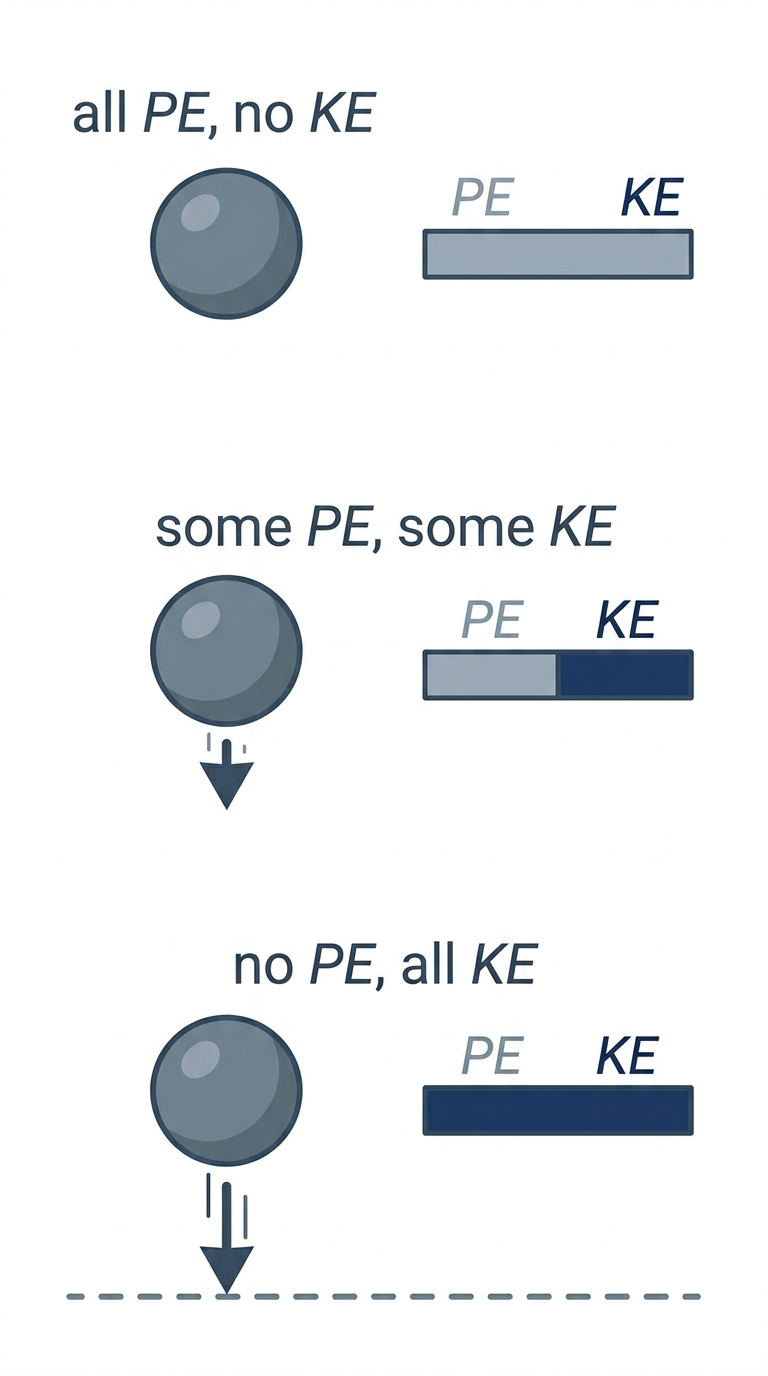
In a closed system with only conservative forces (gravity is the most common one), the total mechanical energy \(KE + PE\) stays constant. As one form decreases, the other increases by the same amount.
Worked Example: a dropped ball
A \(0.5\) kg ball is dropped from a height of \(10\) m. How fast is it moving when it hits the ground?
At the top (at rest): \(KE_0 = 0\), \(PE_0 = (0.5)(9.8)(10) = 49\) J. Total mechanical energy: \(49\) J.
Just before impact (height 0): \(PE_f = 0\), so all the energy is kinetic. \(KE_f = 49\) J.
Solve for the impact speed:
\[\tfrac{1}{2}(0.5) v^2 = 49 \quad \Rightarrow \quad v^2 = 196 \quad \Rightarrow \quad v = 14 \text{ m/s}\]
You could also reach this answer with the kinematic equation \(v = \sqrt{2gh} = \sqrt{2(9.8)(10)} = 14\) m/s. Energy conservation gives the same answer through a completely different reasoning path — that's the sign that both methods are valid.
Power
Power is the rate at which work is done — work per unit time:
\[P = \dfrac{W}{t}\]
measured in watts (W). One watt is one joule per second.
Two motors that do the same total work but at different rates have different power: the faster one is more powerful. A 100-watt light bulb converts electrical energy to heat and light at a rate of 100 joules per second.
Worked Example: lifting a box
A \(25\) kg box is lifted to a shelf \(1.5\) m above the floor in \(4\) seconds. What is the average power output?
Work done against gravity equals the change in PE:
\[W = mgh = (25)(9.8)(1.5) = 367.5 \text{ J}\]
Power:
\[P = \dfrac{W}{t} = \dfrac{367.5}{4} \approx 91.9 \text{ W}\]
About \(92\) watts of average power — roughly the wattage of an old incandescent bulb.
Practice Problems
1. How much work is done lifting a \(10\) kg crate vertically by \(2\) m? Show answer\(W = mgh = (10)(9.8)(2) = 196\) J. The force is upward, the displacement is upward, so \(\theta = 0\) and \(\cos\theta = 1\).
2. A \(1500\) kg car accelerates from rest to \(20\) m/s. What is its final kinetic energy? Show answer\(KE = \tfrac{1}{2}(1500)(20)^2 = (750)(400) = 300{,}000\) J, or \(300\) kJ.
3. A \(70\) kg hiker climbs \(800\) m up a mountain. By how much does her gravitational potential energy increase? Show answer\(\Delta PE = mgh = (70)(9.8)(800) \approx 549{,}000\) J, or \(549\) kJ.
4. A ball is dropped from rest at a height of \(5\) m. How fast is it moving when it hits the ground? Use energy conservation. Show answer\(mgh = \tfrac{1}{2}mv^2\), so \(v = \sqrt{2gh} = \sqrt{2(9.8)(5)} = \sqrt{98} \approx 9.9\) m/s.
5. A motor lifts a \(200\) kg load by \(12\) m in \(30\) seconds. What is the motor's average power output? Show answer\(W = mgh = (200)(9.8)(12) = 23{,}520\) J. \(P = W/t = 23{,}520 / 30 = 784\) W.
Related Math
Work and energy problems are mostly algebra with a healthy dose of:
- Vectors — work depends on the angle between force and displacement
- Trigonometry — that cosine in the work formula
- Solving Literal Equations — rearranging \(KE = \tfrac{1}{2}mv^2\) to solve for \(v\), and similar moves
The Work and Energy Calculator handles the arithmetic when you just need a numerical answer.