
Momentum, Impulse, and Conservation
When two cars collide head-on, the heavier one tends to keep going while the lighter one is knocked backward. When a skater catches a heavy thrown ball, both glide backward together. When a cannon fires, the cannonball flies forward and the cannon rolls backward across the deck. All three situations are governed by momentum and its conservation — a single physical principle that often solves collision problems with surprisingly little algebra.
Definition
Momentum is mass times velocity:
\[p = m v\]
It's a vector — same direction as the velocity. A 2 kg object moving east at 3 m/s has momentum 6 kg·m/s east. A 5 kg object moving west at 4 m/s has momentum 20 kg·m/s west.
The units are kilogram-meters per second (kg·m/s), which are equivalent to newton-seconds (N·s).
A useful intuition: momentum measures "how much motion" an object has. A dart has tiny mass but huge velocity; a freight train has huge mass but small velocity. Either can carry a large momentum.
Worked Example
A \(0.05\) kg dart, fired from an air-powered launcher, leaves the barrel at \(400\) m/s. What is its momentum?
\[p = m v = (0.05)(400) = 20 \text{ kg·m/s}\]
A \(1500\) kg car moving at \(20\) m/s has \(p = 30{,}000\) kg·m/s — about 1500 times more momentum than the dart, despite moving at only one-twentieth the speed.
Impulse
The change in an object's momentum is caused by a force acting over time. Specifically:
\[\text{impulse} \;=\; F \, \Delta t \;=\; \Delta p\]
Apply a force \(F\) for a time interval \(\Delta t\), and the object's momentum changes by \(F \cdot \Delta t\). That product is called the impulse.
This is really just Newton's second law rewritten. Starting from \(F = m a = m \tfrac{\Delta v}{\Delta t}\), multiply both sides by \(\Delta t\):
\[F \, \Delta t = m \, \Delta v = \Delta p\]
The impulse formula explains a lot of everyday physics. Why do airbags work? They lengthen the time over which the car decelerates its passengers. Same \(\Delta p\), but a longer \(\Delta t\) means a smaller \(F\) — and the smaller force is what keeps you alive. The same principle is why you bend your knees when landing from a jump.
Worked Example: catching a baseball
A \(0.15\) kg baseball is moving at \(30\) m/s toward the catcher. The catcher brings it to a stop over \(0.05\) s. What average force does the catcher's glove exert on the ball?
Change in momentum: \(\Delta p = m(v - v_0) = (0.15)(0 - 30) = -4.5\) kg·m/s.
Average force: \(F = \dfrac{\Delta p}{\Delta t} = \dfrac{-4.5}{0.05} = -90\) N.
The minus sign just means the force is opposite the original motion — the catcher is decelerating the ball.
Conservation of Momentum
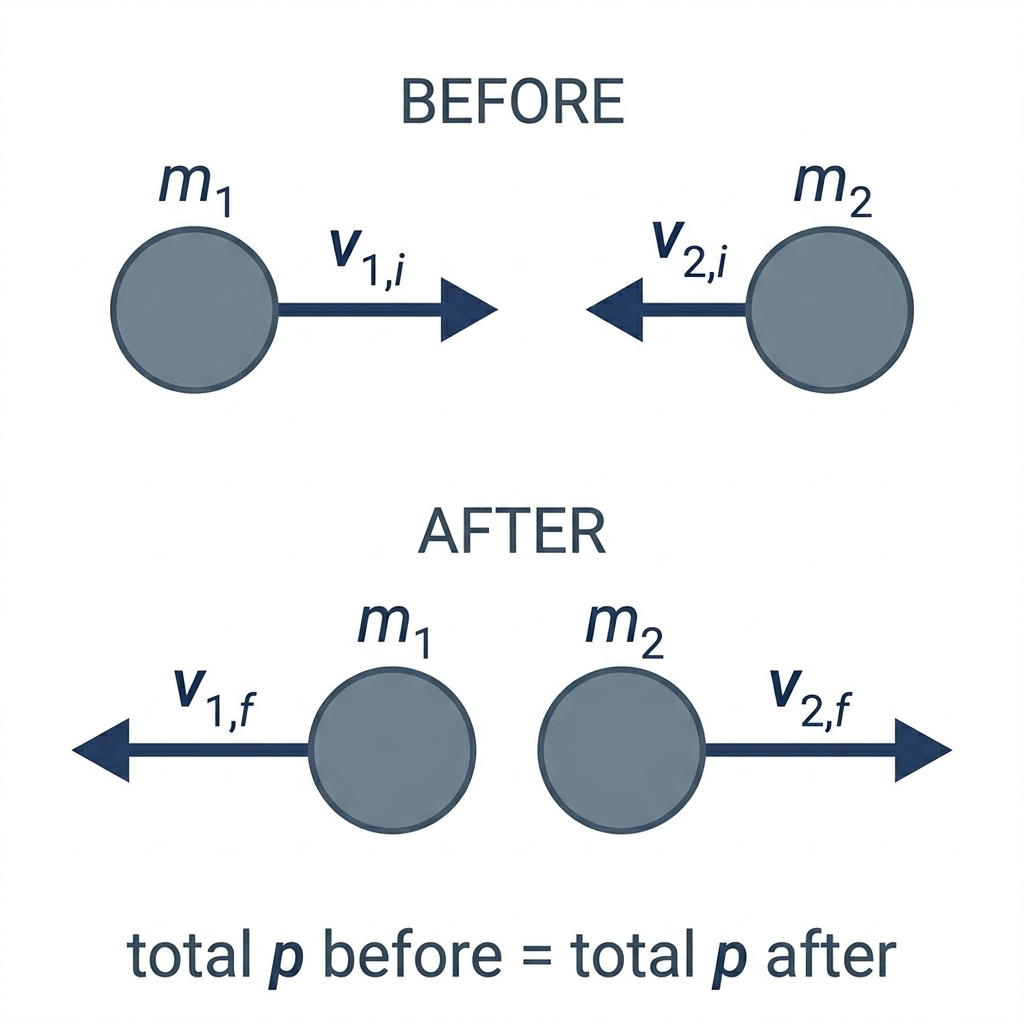
The single most important fact about momentum: in a closed system with no external forces, the total momentum is conserved.
If two (or more) objects interact — collide, push, separate, anything — the total momentum before the interaction equals the total momentum after:
\[p_{\text{before}} \;=\; p_{\text{after}}\]
For two objects:
\[m_1 v_{1,i} + m_2 v_{2,i} \;=\; m_1 v_{1,f} + m_2 v_{2,f}\]
The internal forces during the interaction (whatever they are) cancel in equal-and-opposite pairs because of Newton's third law. So no matter how messy the details, the total momentum vector before the interaction equals the total momentum vector after.
Worked Example: a perfectly inelastic collision
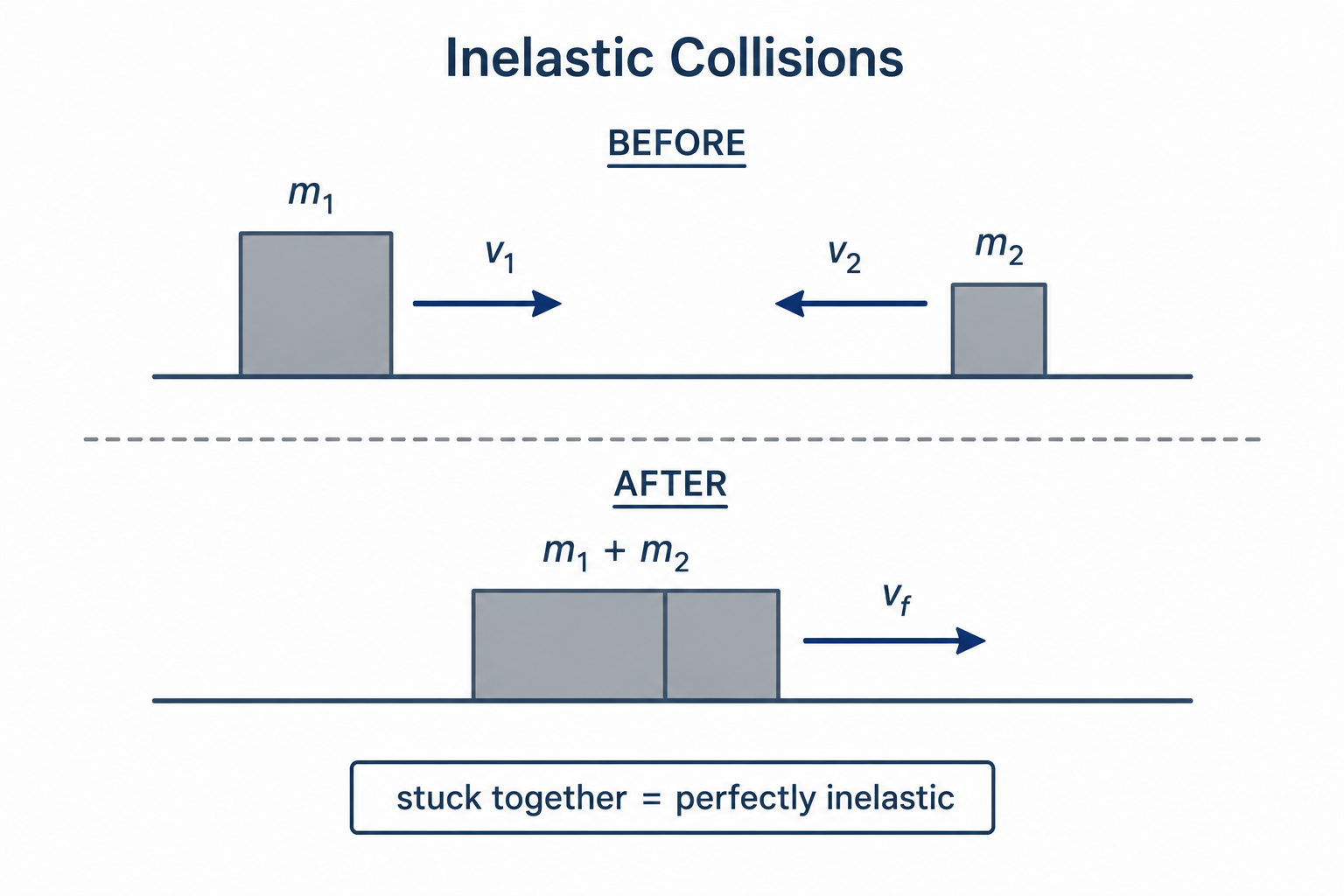
A \(1000\) kg car moving at \(20\) m/s east rear-ends a \(1500\) kg stationary truck. The two stick together after the collision. How fast does the wreckage move?
Total momentum before: \[p_{\text{before}} = (1000)(20) + (1500)(0) = 20{,}000 \text{ kg·m/s east}\]
After the collision, the combined mass is \(2500\) kg moving at some velocity \(v_f\). By conservation:
\[2500 \cdot v_f = 20{,}000 \quad \Rightarrow \quad v_f = 8 \text{ m/s east}\]
The wreckage moves east at \(8\) m/s — slower than the original car (because the combined mass is larger), but in the same direction (because the only momentum present originally was eastward).
Worked Example: a cannon's recoil
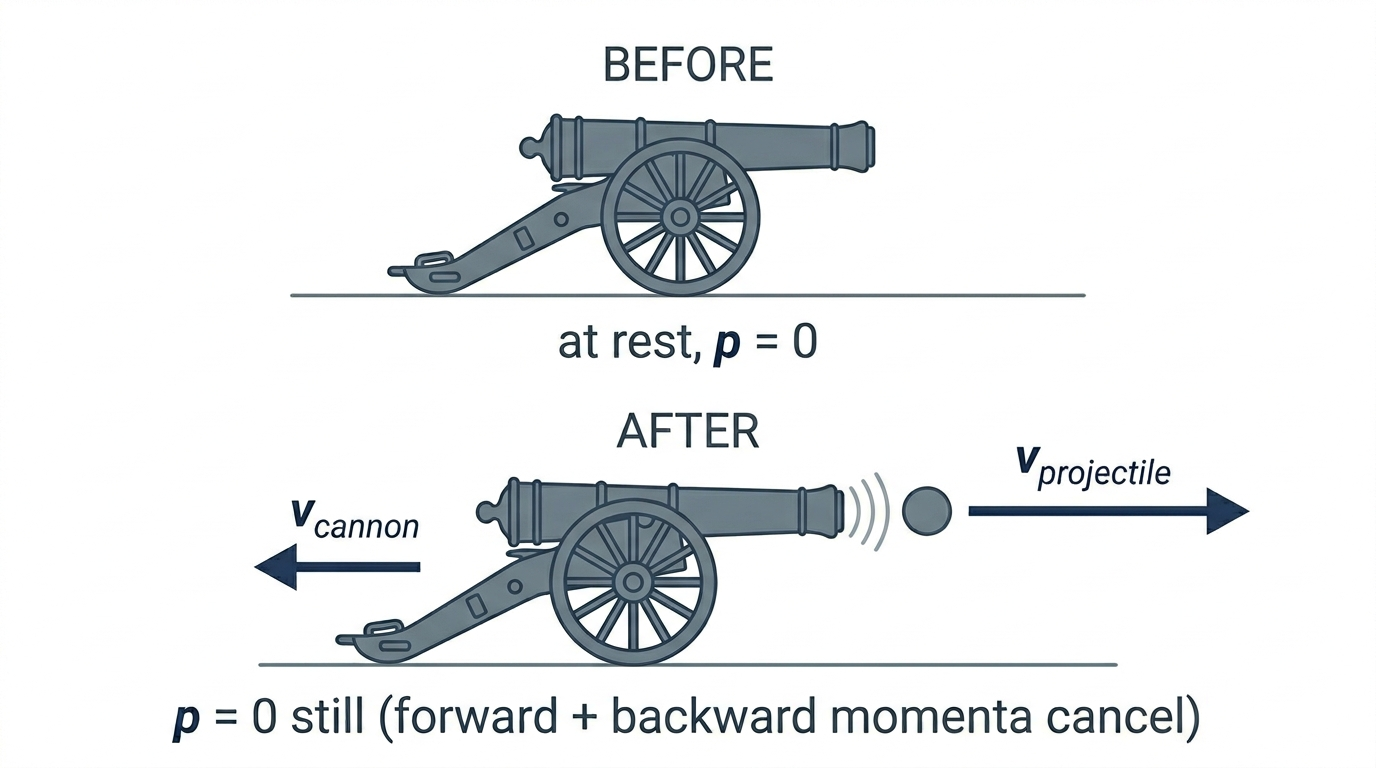
A \(600\) kg cannon fires a \(4\) kg cannonball that leaves the barrel at \(300\) m/s. The cannon was at rest before firing. What is its recoil velocity?
Initial momentum: zero (everything at rest).
After firing:
- Cannonball: \(p = (4)(300) = 1200\) kg·m/s forward.
- Cannon: \(p = (600)(v)\), where \(v\) is what we want to find.
By conservation, the total must still be zero:
\[(600)(v) + 1200 = 0 \quad \Rightarrow \quad v = -2 \text{ m/s}\]
The cannon rolls backward at \(2\) m/s. The cannonball is 150 times lighter than the cannon, so it moves 150 times faster — momentum balances even though kinetic energy is wildly lopsided.
Elastic vs. Inelastic Collisions
Collisions come in two flavors:
- Elastic — both momentum and kinetic energy are conserved. Examples: ideal billiard-ball collisions, atomic and subatomic collisions, anything bouncy and lossless.
- Inelastic — momentum is conserved, but kinetic energy isn't (some is lost to heat, sound, or deformation). Examples: most everyday collisions, especially when objects stick together (perfectly inelastic).
Conservation of momentum applies to both types. The distinction matters when you also want to use energy methods — only in an elastic collision can you write \(KE_{\text{before}} = KE_{\text{after}}\) as a separate equation.
The Connection to Newton's Laws
Momentum gives a bookkeeping alternative to Newton's laws. Where \(F = ma\) tracks force-and-acceleration moment by moment, conservation of momentum skips the messy intermediate detail and just relates "before" to "after."
For a complicated collision where the forces involved are huge but brief — and largely unknown — conservation of momentum is often the only practical tool. That's why momentum problems are usually easier than equivalent Newton's-law problems: you don't need to know what happened during the collision, only the initial and final states on either side of it.
Practice Problems
1. What is the momentum of a \(2\) kg ball moving at \(8\) m/s? Show answer\(p = mv = (2)(8) = 16\) kg·m/s.
2. A \(0.06\) kg tennis ball moving at \(30\) m/s is struck by a racket and rebounds in the opposite direction at \(40\) m/s. What is the impulse on the ball? Show answerTake the final direction as positive, so the initial velocity is \(-30\) m/s. \(\Delta p = m(v - v_0) = (0.06)(40 - (-30)) = (0.06)(70) = 4.2\) kg·m/s in the rebound direction.
3. Two skaters push off each other on frictionless ice. One has mass \(50\) kg and ends up moving at \(1.5\) m/s to the right. The other has mass \(75\) kg. How fast does the second skater move, and in what direction? Show answerTotal momentum before: zero. After: \((50)(1.5) + (75)v = 0\), so \(v = -1.0\) m/s — \(1\) m/s to the left.
4. A \(3\) kg ball moving at \(4\) m/s collides head-on with a stationary \(1\) kg ball. After the collision, the \(3\) kg ball continues in the same direction at \(2\) m/s. What is the speed of the \(1\) kg ball after the collision? Show answerBefore: \(p = (3)(4) + (1)(0) = 12\) kg·m/s. After: \((3)(2) + (1)(v) = 12\), so \(v = 6\) m/s in the original direction of motion.
5. A \(2000\) kg truck moving at \(15\) m/s collides with a stationary \(1000\) kg car. They stick together. What is their combined velocity afterward? Show answer\(p_{\text{before}} = (2000)(15) = 30{,}000\) kg·m/s. After: \(3000 v = 30{,}000\), so \(v = 10\) m/s in the truck's original direction.
Related Math and Physics
Momentum problems are mostly substitution into a conservation equation, with a vector flavor when more than one direction is involved:
- Newton's Laws of Motion — momentum is what the second law leads to when you integrate over time
- Vectors — momentum is a vector; for 2D collisions, conserve the x- and y-components separately
- Work, Energy, and Power — the kinetic-energy version of "before equals after" that supplements momentum conservation in elastic collisions
- Solving Literal Equations — rearranging the conservation equation for whichever variable you need